Tag Archives: Nigeria-Biafra war

Music in a time of war – 2

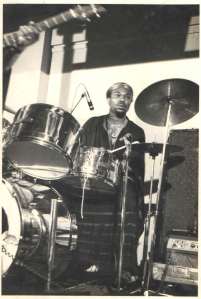
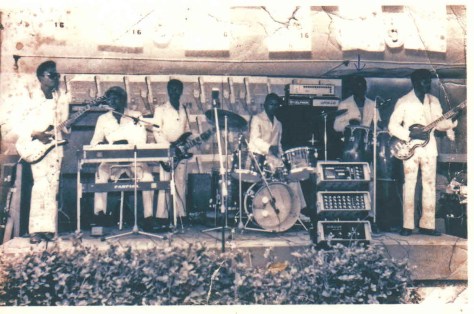
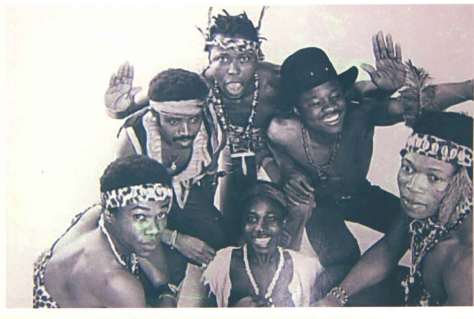
Members of my family were saying, “Come back. Come back.’ And I asked them, “What am I going to be doing in Biafra? Fighting?” After a lot of pressure, I decided I would go back but I knew I had to earn money. So I left for Biafra with a group of musicians. There was Travis Oli – the Singer, Mike Obanye – the Drummer, Frank Onyezili – the Rhythm Guitarist, Terry Eze – the Assistant Manager, Sonny Okosuns and myself. Sonny Okosuns was the only non-Igbo but he was not afraid because he was born in Enugu and could speak Igbo. We were arrested at Onitsha Bridge because they said we were spies. Sonny Okosuns was sent back while the rest of us were taken to the police station at Ridge Way, Enugu. I had some contacts at Enugu so I started to press buttons. I sent a note from police detention to Chuddy Soky, the Commander of the Biafran Air Force telling him of our plight. He drove to the police station and asked them to release us, which they did.

When we left the station, we met a young man called Ikenna Odogbo, a Disc Jockey and show host in Radio Biafra. He took us to live with him from where the musicians started their rehearsals while I went into the field to look for business.

I knew we couldn’t do anything without equipment so I went with a letter to the Director-General of the Biafran Civil Defence. After reading it he looked at me and said, “We are fighting a war and you are talking about music. Will you get out of this place?” I was about nineteen years old but I was talking with a lot of confidence. I was not deterred at all and headed straight to Ojukwu’s office. I had met him when he was the Military Administrator of East Central State. That was when Chubby Chekker, the American musician who invented the Twist, was touring the East. I was part of the tour which was sponsored by Coca Cola and we had paid Ojukwu a courtesy visit. When I arrived he was in a meeting so I spent five hours waiting for him. I was convinced I had a good product. He remembered me and I gave him the letter I had written to the Civil Defence. After reading it he said in his very calm manner, “And what did he tell you?” I said, “He drove me out of his office. He said I was crazy to be talking about music when there’s a war.” Ojukwu dialled a number and asked him to come to the office. Then he told me, “Please sit down.” When the Director General entered the office he almost collapsed. Ojukwu gave him my letter and asked him to read. He was shaking as he was reading it. When he finished, Ojukwu said to him, “Now, take this young man. Anything he asks for, do it.” I asked for a bus and a Peugeot wagon to move our men and equipment, and I had two drivers assigned to me.

That was how The Fractions became the Biafran Armed Forces Entertainment Group. We were moving from camp to camp and even played three times for Ojukwu in his bunker at Umuahia. They knew that music is a vital tool in any military operation so whenever the soldiers were going to war, we would play our best music, they would smoke and become charged up. But in a few hours some would be dead. They were not paying us but they gave us a lot of support, food items, cigarettes and whatever we wanted.

We were also playing at International Club Enugu where we were charging a gate fee. We were copying the American soul sounds such as Wilson Picket, James Brown and Aretha Franklin. The turn-out was always huge because there was not much entertainment during the war – no Television, no football, no games, no cinemas.

We introduced pop music to the east and it was really big. We also started the Sunday Jump and people were coming even in the midst of hostilities.

I also had a column in the Biafran Outlook, a government paper. The editor, Gab Idigo, knew I was already writing in Lagos so gave me a column where I was writing about The Fractions and music generally.

We played throughout 1967, 1968 and 1969. Owerri was our base when it was not occupied by the Nigerian forces. We played our last formal gig at Nkwerre just after Christmas 1969. After the show a few of us remained in the hotel. It was called Central Hotel. Around 4 a.m. some soldiers in a truck came into the hotel, arrested us and took us to Bishop Shanahan School Orlu, where they shaved our hair. That same morning they took us to a garrison to start military training. We had been conscripted and we thought the end had come.

The next day I knew I had to do something. We were hearing shelling so I headed to the gate. I saw a bucket lying on the ground and I picked it as if I was going to fetch water. It was a well-fortified gate but nobody questioned me because they must have thought I had been sent by an officer. I ran into the bush and right there I saw Frank Zili. He had left the camp without telling me because it was a tense situation. We meandered our way out of the forest and got to a safe place.

I returned to Lagos just before the war ended and it was by God’s plan. I was returning to Owerri with a member of the group when we met a Nigerian soldier at Mbieri. He had dug himself into a trench and could have killed us. His gun was pointed at us so we raised our hands. When he came out of the trench I saw from his facial marks that he was Yoruba. Immediately, Yoruba started pouring from my mouth. He relaxed and lowered his gun. We became acquainted and he offered us cigarettes. Later, he made Garri and we ate it with canned Egusi soup. The Nigerian soldiers used to carry a lot of supplies in their kit but the Biafran soldiers didn’t have anything. After he entertained us he said, “Look, I cannot leave two of you on your own.” We trekked from Mbieri to Owerri prison where he handed us over to his superiors. We told them we were members of The Fractions Pop Group and they said, “Okay, you have to play for us not just for Ojukwu’s army.” They gave us a jeep to pick our equipment at Anara. From there we turned back to Owerri and continued to Port Harcourt.

We arrived Port Harcourt around 6.00 am and drove to the headquarters of the marine commandos headed by Obasanjo. He was already in the field doing drills with the soldiers. Then, I saw Roy Chicago, the musician, coming towards me. He recognised me. “Tony, what are you doing here?” Then he turned to Obasanjo. “Olu, ore mi niyen o. Mo mgbe wan lo si eko – this is my friend o. I’m taking him to Lagos.” Roy had come to entertain Nigerian troops and was heading to the airport to be flown to Lagos that morning. That was how I came into Lagos.

I slept in Roy’s house that night. It was No 9 Bishop Crowther Street, Surulere. In the morning I decided to go for a walk around the area. A Volkswagen pulled up beside me and I heard a voice shouting, “Driver, stop, stop, stop!” It was Eddy Adenirokun and we just grabbed each other in an embrace. He said, “How did you get here? I thought you were in Biafra.” I was looking so haggard but I followed him to Daily Times office on Lagos Island. Sam Amuka was there, producing the Sunday Times for the next day. He’s such a funny guy and he said, “So you just came from Biafra? Okay, go and write about your experiences.” Immediately, I went off to type my story. My picture was splashed on the front page and I was paid three shillings, my first income after Biafra.


MY PHOTO BOOK

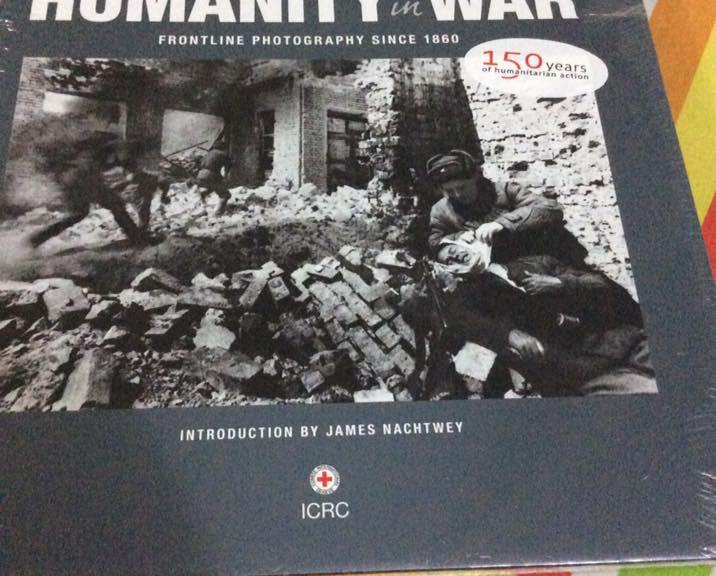
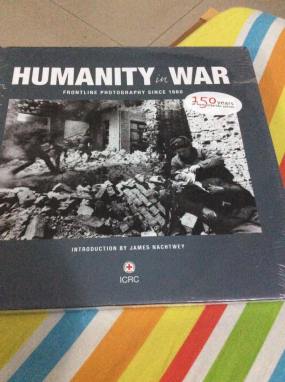
My book finally arrives, courtesy of the International Committee of the Red Cross.

On their October 4, during their ‘Ask An Archivist Day’ Facebook event, I had asked the ICRC about the Biafran children airlifted to Gabon, Ivory Coast, São Tomé, and even Europe, at different times during the war. I wanted to know about their journeys from Biafra, their lives in the host countries, and what became of them after they returned to Biafra. They referred me to the Chief Archivist who in turn suggested I visit the ICRC library in Geneva to get the information I wanted.

A few days later, I received a message saying I had won a book on account of my inquiries.

I didn’t go to Geneva, but since that day I have dug up a lot of information from the internet about the Biafran Airlift. I have found a couple of the airlifted ‘children’ and brave individuals who flew those dangerous missions that brought supplies into Biafra and, when necessary, evacuated vulnerable children to safety. Some of them have agreed to share their Biafran story with me.

The internet is truly an amazing place!

ICRC 1
MY BOOK, STILL BOXED UP
ICRC 2
VOILA!

Two Days in Athens

In the beginning.

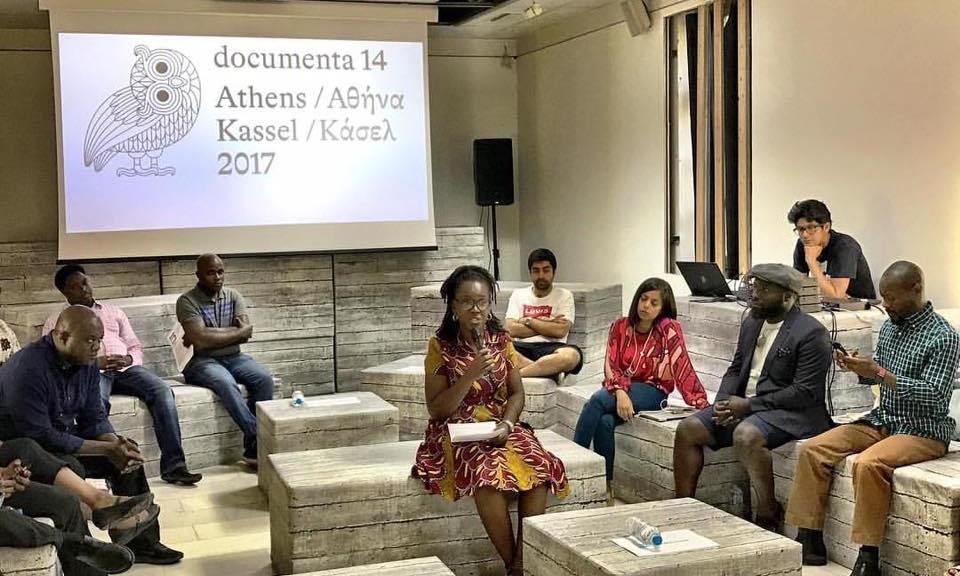
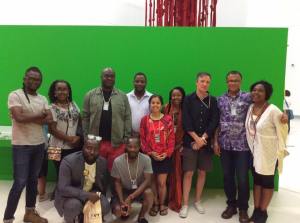
In March 2017 I had seen a post on Facebook announcing a conference called ‘Biafra’s Children, A Gathering of Survivors.’ I sent a message to the convener telling him about the project I started to document eye witness accounts of the Nigeria-Biafra war. All I wanted was visibility for the project through their website and any related publications. But a couple of emails and days later, I was invited to participate at the conference. It was a memorable two days in Athens.

 Wednesday; 28th June, 2017.

I am sitting alone at the departure lounge waiting to board my flight to Istanbul. My feelings are wavering between excitement and apprehension. The flight is scheduled for 11.40 pm but we eventually leave an hour later.

There are no dramas on board, except that the seat next to me has been taken over by a pregnant woman with a different seat number. The rightful owner of the seat is not very happy but the Air Hostess settles it quickly and we are assigned new seats.

It is morning, and a different world, when we arrive in Turkey. While looking for my boarding gate, I get acquainted with three Nigerians travelling to Belarus. Afterwards, I look for a place where I can rest and observe my surroundings.

I’m captivated by the way Turkish women dress. There are many groups of children around and I wonder where they are all headed to. There are many Muslims too, all clothed in white. I think they are going to perform the Hajj. It’s a long wait and I find myself seated opposite a group of French Muslims – some black, others Arab – travelling together. They speak little English and I speak little French, but we make conversation, clumsily, with a lot of hand gestures. The young man beside me says he wants to marry me. We both laugh. I think he’s just teasing. We all talk some more and I eventually take my leave to locate my gate. I am glad I left  because my flight is almost boarding. I have been looking at my phone which is still indicating Nigerian time.


Thursday; June 29, 2017.

Two hours later we are in Athens.

A stocky man with a prominent nose is holding up a piece of white paper with my name on it. I flash a smile and he smiles back.

Are you George, I ask.

I already know his name from the mail I was sent with a list of contact and support persons for the conference. He loads my suitcase in his car and as we drive away he apologises about the weather. There’s a heat wave in Athens and temperatures are above 35 degrees today. We talk about their economy and the refugee crisis. I feel as though I’ve been here before – the roads, the plants and hedges, the ‘Okada’ and its rider at the traffic junction are all familiar.

I ask him about the island of Corfu, a magical place I had read about in ‘My Family and Other Animals,’ by Gerald Durrell. He says his father is from Corfu and he can take me there if I want. I want to but I can’t. The conference schedule is tight.

I want to know about Skopios, Aristotle Onassis’s island. He lets out a laugh. You know Onassis? Yes, I say, I have read a lot about him – his stupendous wealth, his famous yatch named after his daughter, Cristina and especially, his marriage to Jackie Kennedy. George’s smile grows wider as I speak.

He points out landmarks and even parks on the highway for me to take photographs of the city – a sea of white buildings with brown roofs. He drops me off at President Hotel, still smiling and waving.

The Greeks are warm and friendly.

****

I try to nap but I can’t. So I go down to the lobby where I recognize some of the other participants. We get acquainted.

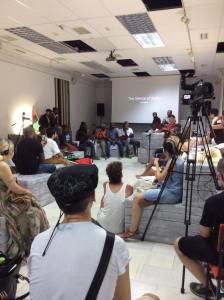
An event has been fixed for this evening. It’s a visit to the Museum of Contemporary Art to see Olu Oguibe’s Time Capsule of books and memorabilia from the Biafran war. He’s the convener of the Biafran Children’s Conference and one of the participating artists of documenta14.

I am tired and my ears are aching. But I’m glad I attended. There are jaw-dropping installations by other artists. It’s incredible what the human mind can conceive.

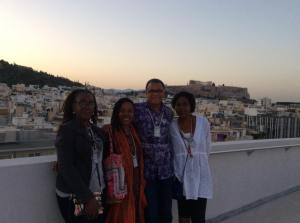
Afterwards we climb to the roof top. The sun is setting but we can see the city spread out before us. The Acropolis is in the distance and on the walls of a building somebody has written, ‘Welcome and Enjoy the ruins.’

Dinner turns out to be a spread of salads, bread, sardines, olive oil and other fare I barely recognize. There’s wine too. The Greeks love their salads and wines. Afterwards, the others want to go to a Nigerian restaurant. I even hear somebody mention Isi Ewu. It sounds interesting but all I want to do is nurse the ache in my left ear.

Faith and I take a taxi back to the hotel.

Sleep comes easily.

****

Friday; June 30, 2017.

Nigerians will say, ‘Traveling without sight-seeing, is that one traveling?’

I am determined to make the most of the two days, so after breakfast, I disappear. First, to documenta14 Press Office, to edit my presentation. And then to the tourist area around the Kidathineon and Adrianou. Tourists are milling about. The paved, narrow streets are lined on both sides by faded white buildings housing shops and cafes. There’s planting everywhere. Artefacts, clothes, books, jewellery, house hold items and much more are on sale. The ambience is traditional and modern all at once.

I hurry from shop to shop, taking in the sights, taking photos, asking questions. This particular shop keeper has a toothy smile. He’s tanned a dark brown and has an accent that sounds American. I am curious. He says the British think he’s American while the Americans thinks he’s British. We both laugh. English is my default language, perhaps that’s why you sound American to me, I say. He tells me he’s Greek, grew up in South Africa and lived in the US. He wraps my purchase while we chat some more.

The entire tour takes me about one hour. The conference starts in a couple of hours.

I head out to the taxi stand but first, something cold to drink. And a selfie.

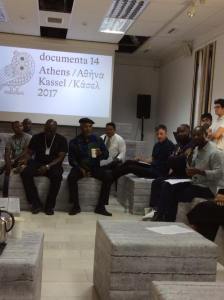
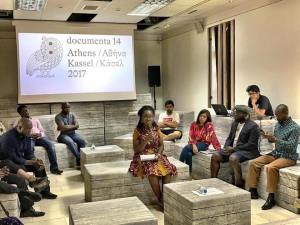
The speakers at tonight’s event are Olu Oguibe, Okey Ndibe, EC Osondu, Faith Adiele, Phillip Effiong, Obi Okigbo.

****

Saturday; July 1, 2017.

Butterflies are fluttering in my stomach. I will them to stop.

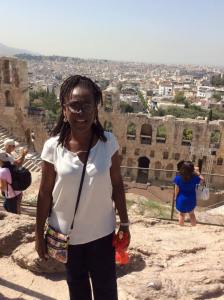
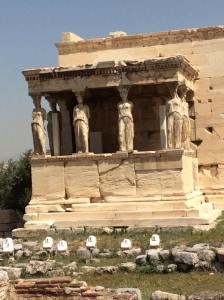
We have planned to see some of Greece’s cultural and historical sights, and after breakfast we set off for the Acropolis, an ancient citadel that sits above the city of Athens. It’s one of Athens’ most popular tourist attractions and houses the ruins of ancient temples some of which were built in 473 BC. The most popular is the Pathernon which is dedicated to Athena, the Greek goddess of wisdom, war and crafts.

The ruins are engineering and architectural wonders.

Tourists are warned to thread carefully because the path leading to the ruins are worn smooth by human traffic. The sun is scorching but the place is teeming with tourists.

I am in awe the whole time.

The day flies by. The butterflies in my stomach are quiet. I think the tour of the acropolis has helped to dispel my anxiety.

****

This evening, I and Emeka Kupenski Okereke, Berlin-based visual artist, photographer and film maker will talk about the work we are doing to preserve the memories of Biafra, mine through stories and his, through images and films. Our session is called ‘Generations and Legacies; Retrieving Biafra’s Memories.’

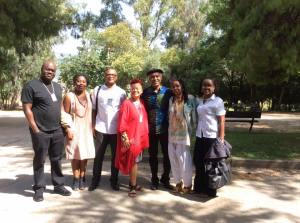
We arrive at Parko Eleftherias. Group photos are taken. Sound checks and everything else in order.

“Who is going first?” I ask.

“You,” Emeka says.

“No, you,” I say.

We both laugh.

I take my place, reluctant to make eye contact with the audience lest I see the disappointment on their faces. I start to speak, telling them how it all started in 2016 – the Facebook posts that ignited my interest and my resolve to look for survivors, to document their experiences, to help break the silence about Biafra.

I talk about some of the stories in the collection, about the brave men and women who embody them, who bear the emotional and physical scars of war, whose lives demonstrate the resilience of the human spirit.

When I finish, I hear applause. There are questions from the audience and Emeka takes his turn.

It wasn’t as scary as I thought.

Afterwards, as we interact with the audience, two ladies walk past me on their way out. I thank them for coming and give each of them a hug. A few minutes later, I see them back in the hall and walking towards me. One of them says they have something to tell me. We find a seat.

She tells me their family had lived in Lagos but when the war started they fled. They say their father is still alive and would be delighted to talk to me. I am leaving the next day but I ask if I can come over in the morning. They won’t be in, she says, so we exchange phone and Skype numbers. I thank them for reaching out and promise to call.

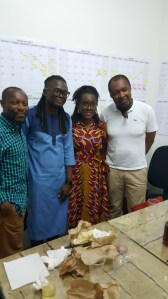
Dinner was a big deal – lots of food and laughter. Afterwards, those who had early flights to catch left. The rest of us strolled back to the hotel which was close by. The lobby was empty of guests so we sat there, gisting, till about 3.00 am. We were all tired and sleepy, but ‘goodbye’ is a difficult word.

****

Sunday; July 2, 2017.

My head is foggy but I drag myself to the bathroom.

My flight is by 3.35 pm.

Most of the others have left, so it’s just me and Faith. She’s a teacher and memoirist and the first day we arrived I told her about my journey into writing.

Breakfast is the usual spread – varieties of breads, cakes, cheese, butters, eggs, bacons, fruits, cold and warm beverages. I’m happy to see Faith at the restaurant and we agree to meet at the swimming pool in an hour’s time.

The pool is located on the 21st floor and a few people are lounging around on deck chairs. Others are in the water. Coming from the tropics, I am used to high temperatures, but this is extreme. In spite of it, I wonder why anybody would want to sit or swim under such intense heat. Then I remember they may be coming from places where sun is a luxury.

Faith and I chat a bit and I take photographs. The height is dizzying but the view is great – buildings look clustered, streets are barely-discernible, awnings provide dashes of color to a landscape of mostly-white houses and brown roofs.

We say our good byes.

****

Back in my room, my suitcase is packed. I have a few more hours on my hands and I contemplate dashing out to explore the neighborhood. But I realize I am still sleepy. I fall into bed fully clothed. Sometime later I jump up in a panic. It’s almost 1.00 pm and George will be here by 1.30pm.

A quick look around the room confirms that everything is packed. My travel documents are in a purse slung across my body.

I’m in the lobby sending a mail when the entrance door swings open and George bounds in. He’s beaming as he approaches me. Is this all, he asks, grabbing my suitcase. I say yes and he heads out to the car. A few minutes later, we’re racing to the airport.

Did you enjoy your trip, he asks. I said I did but it was too brief. We talk some more and 30 minutes later we drive up to the lot in front of Turkish Airlines. He brings out my luggage and we shake hands. Please come back another time, he says, and bring your children with you. I tell him I will.

He enters his car and pulls away, still smiling and waving.

****

For The Love Of Family – Part 2

[Ben Onwuka was a former Biafran soldier who was wounded in battle. He talks about other wounded soldiers who were evacuated to Holland by the International Committee of the Red Cross for medical attention. A couple of them became mentally unstable and one was eventually committed to a mental institution in Holland. He also talks about returning to Nigeria to look for *Ruth, the girl he loved, who he had also promised to marry.]

                                                                         ———-

We were disappointed to hear that Biafra was no more; doesn’t exist anymore. We couldn’t believe it. We never thought Biafra would lose the war. We so believed in it – the efforts we put in, the determination. Anybody who really fought the war with all his mind was disappointed. We were confused and emotional. After everything, we didn’t have anything to show for it.

The Dutch people knew we were hurt because we lost the war. They said they can’t force us to go back since we came as Biafrans, but if we decide to go, they’ll arrange for our going back. They said it’s either we stay and study or we learn a trade so that when we decide to go back we will have some skills. I’m very much indebted to them.

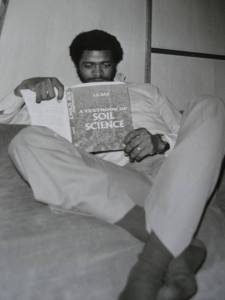
One boy, Christopher, wanted to do banking. Felix, from Ngwa, also wanted banking because he did Commercial School in Nigeria. I wanted to do Medicine because I saw a lot of people dying in Biafra and that was my motivation. But they don’t give foreigners scholarships for medical studies and it takes about eight years to finish. It also costs a lot of money. So I thought of agriculture because of my experience of hunger in Biafra. My aim was to return and help my country. I started with Agricultural Secondary School, a bit of Forestry and landscape architecture, then entered States Tropical Agricultural Higher School where I got my first degree in Tropical Agriculture.

17407929_10211548664210116_67754857_o
Ben, as a student of Biology and Entomology

After that I went to work in Wageningen and obtained my second degree in Biology and Entomology in Wageningen University and Research Centre. My major work was irradiation of insects to induce lethal genes in them or induce translocation in their genes for the purpose of insect control. These were done in the institute for Atomic Sciences in Agriculture in Wageningen where I live until now.

Some of the other soldiers didn’t fare so well. One of them was John who developed mental problems. He joined the army as a very young boy of seventeen or eighteen years. He underwent several operations because his mouth was shattered, so they tried to reconstruct his teeth and mouth and jaws. So much so that he became mentally confused. They used shiny metals for the construction, so he had appendages on his head like antennas which made him look like a mobile robot. When he comes out people will be staring. Sometimes they used his skin to do skin grafts. They cut it and pull it, and you see it growing from here to there. They used it to construct his lips because there was nothing left there.

I remember one day when we were in the Military Rehabilitation Center. They gave me a special room because I was an officer. John knocked on my door and when I opened it he just dived under my bed and said, “Oga, please, they’re looking for me. They are looking for me.” I said, “John, nobody is looking for you. Please come out.” He said, “They want to kill me this night. You don’t know what they are doing. This is a way to get me. I don’t know why you can’t see this.” All the other boys came and pleaded. But he kept on doing this. Every time it will start. Eventually, they put him in a psychiatric center and we went there to visit him. I could see death in his face. He said, “Please, I am going with you people. Do you see they have marked where they will bury me?” It was so sad to see. We were new and couldn’t speak Dutch but John will say something like, “The news this afternoon was saying that John has to be killed, must be killed.” But you can’t do anything to stop him. When it became impossible to treat him, they sent him back to Nigeria. He was accompanied by a military nurse who gave his family a lot of money to take care of him. They also promised to be monitoring his progress. The wounds had healed in a way so he was able to eat. They even put false teeth but who takes care of such things in the village? You have to bring it out, brush it and put it back. He even had special food from Holland. But we heard he went to the village shop and stole cigarettes, so they beat him up. And whenever he passes, people will be making fun of him, saying things like, “Ony’ara, o n’ezu kwa oshi – Mad man. He also steals.” John eventually became the village lunatic. The white nurse came a second time to see what became of John and was so disappointed with his condition. He stayed back for some time and tried to take care of him. He gave the family money again to continue the care and he remained in contact with them. But the third time he asked about John, they told him John was dead.

Another person who developed mental problems over there was Victor from Nsukka area. He became quite dangerous, setting his house on fire and threatening to kill somebody who was making calls in a public phone booth. He claimed the person was plotting against him. Anytime the tell us what is going on, it doesn’t matter what time of the night, we will go to see him. He even claimed he had impregnated my girlfriend’s friend. She had gone with us to the hospital to visit him and she liked him so much. So, every time he sees Crystal, my wife, he will ask, “Where is your friend? She’s having my child.” He became so dangerous they put him in a very, very highly guarded psychiatric hospital where it became impossible for us to see him or get information about him. Till today I think of Victor.

Cyril’s case was different. His two legs were amputated and he had artificial legs. But he was so clever he was speaking Dutch within six months we were in Holland. He was playing music for people, doing disk-jokey. He will hire sex [pornographic] films and invite people to his house to see the films. He was even smoking grass and riding his motor cycle without licence. He could commit a crime and they’ll look at him like, okay he’s a Biafran and he has no legs. He became problematic financially to the Dutch people so they offered him money to go back home. Actually, they made the same offer to all of us. If you want to go back home, they give you about 15,000 guilders to resettle. It was big money. When Cyril showed interest in going home, they increased the money and paid for his transport back. His plan was to start a business when he returns home. He promised to stay in touch but we never heard from him again. Any time I’m in Nigeria, I think of him and wonder what became of him.

I was settling down to my new life but I couldn’t forget *Ruth.

BEN ONWUKA 20
Ben, as a sportsman in Holland

There was a Red Cross man who was going to Nigeria and I gave him an assignment to look for her. He succeeded and went to my family, but they told him that *Ruth’s family left Achina when the war ended and she went with them without even crossing the street to say to my own parents, “I am going.” I get emotional when I remember this because I had even given them wine that I will marry her. My brother told the Red Cross man to tell me, “The person you’re calling your wife didn’t even say bye-bye to us. Till today we have not heard anything about her.” On my own part, I had never been to her village but I knew she was from Eke, around Nsukka. That was when I decided to take my mind off her. I got a white girlfriend, who later became my wife. I told her about Ruth, that I’m still in love with her and I don’t know where she is. She was so sad about the situation but she also liked me a lot.

The first time I wanted to travel to Nigeria, I told my wife I am going to look for *Ruth, that I must see her. You know, when you are interested in somebody, you are always interested in that person. By then I already had my first child, Amara. My wife bought a present and asked me to give to her. That was in 1975.

I got to Enugu and headed to 66 Zik Avenue, which was where I met her. The people I met there said they know the family but they left a long time ago. I didn’t know what to do. I walked to the bus stop and was standing there, thinking of what to do when a young man stopped me and asked if I was one of the musicians coming to perform in Enugu that day.   BEN ONWUKA 15I used to dress in a flashy way then – high heels, jeans, Afro and beards – so he mistook me for somebody in show business. When he was speaking his voice was very familiar and I said to him, “Your voice resembles a voice I used to know.” He looked at me again and said my own face is a bit familiar. I asked him if he has ever lived in Achina. He said, “Yes, we were refugees in Achina.” I asked him if he knew any Ben and he said yes. He looked at me again and exclaimed, “Are you Ben?” I said yes, I am Ben. He embraced me and I said, “I’m looking for your sister.” He said *Ruth was married but I said he should take me to her. We went to his house first and after taking some drinks, we set out. I was so excited as I sat in the sitting room waiting for *Ruth to come out. Then, I heard her voice. She was saying, “Kedu onye n’acho kwa nu m’ kita? I na ghi a gwa ya na m n’akpa ishi – who is the person looking for me now? Why didn’t you tell the person I’m plaiting my hair?” She entered the room with hair half-plaited and when she saw me she screamed, “Ben!”

After she recovered from the shock, she pleaded with her brother to take me back to his house. I was surprised because I was prepared to meet her husband. In less than one hour she arrived at her brother’s house, looking very flashy. I saw *Ruth again as a woman. She started crying and we held ourselves. I asked why I had to leave her house and she narrated how she was in an unhappy marriage because her husband was possessive and beat her often. We talked and talked and after, I gave her a present from my wife. She said she was waiting for me to come back for her because I was her first love and had already given wine to her parents. I was so sad. I told her it wasn’t possible because we were both married and had a child each. She said that anytime I come to Nigeria, she will be available for me. I said, “My God.” But I understand what must have happened. She may have been forcefully married off to the man. After the war, people had nothing to eat and if you see a lady and promise to marry her the parents will just ask you to bring whatever you have and take her away. I promised to visit her anytime I come to Nigeria. I promised to be giving her some money as long as her husband doesn’t know.

I didn’t have any more contact with *Ruth until seven or eight years ago when I went to Enugu. Through an acquaintance, I traced her brother through his wife who had a shop in town. When I got there, I introduced myself and told her I was looking for her husband’s sister, *Ruth. She asked me to describe her, so I mentioned the names of her siblings and relations. Immediately, she called her husband on the phone, “Hello dear, there’s somebody waiting for you here.” Soon, he arrived. He had aged a bit but I could see some of his facial features still there. He kept looking at me, then he said, “Ben, what brought you here after so many years?” I told him I met *Ruth when I came back many years ago, that I wanted to see how she and her children are doing. I saw his face changing. The wife said, “We are very sorry. *Ruth is dead.” I couldn’t believe it. I kept saying, “What? Late? Died?” They said she died the previous year from bleeding caused by injuries to the head. The brother’s wife said if I had come earlier, *Ruth wouldn’t have died; that she talked about me all the time.

That day, I felt like my wife just died. Even though *Ruth is dead I still long to see her children. The next assignment is to trace her brother again and see how I can get in contact with her children.

BEN ONWUKA 4

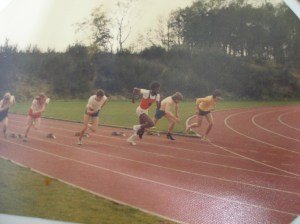
Ben Onwuka is a former Biafran soldier. Before that he was the Nigerian champion in the 400 meters race, 1964-65. He lives in Holland with his wife, children and grandchildren.


The many difficulties of war – Part 2

On the 17th of January, 2017, Professor Akachi Adimora Ezeigbo agreed to meet with me and tell me her Biafran story.  On the 23rd of the same month, I traveled to Abakiliki in Ebonyi State to interview her. I felt a bit apprehensive as I had never met her before, but my worry proved to be needless because she was very warm and welcoming. For almost three hours we had a very enlightening discussion. And when we were done, she opened a bottle of wine, and we drank to life and health.

The first part of our discussion was published on May 30th, 2017. The second part is presented here in a question-and-answer format.

Enjoy!!

                                                             ——————–

VO – How did life eventually return to normal for you and your family?

AAE – After the war, I went back to Queen’s school, Enugu. But Queen’s school was destroyed. There was no refectory. The dormitories had no beds, so we placed mats on the floor and slept. Those from more comfortable homes bought mattresses. There were no books and you needed to have money to register for your School Certificate or the Higher School Certificate examination. My father, who had been in government before the war, was retired compulsorily because of his war engagement. Many others were retired like that. My mum sold some of her jewelry and wrappers, sometimes to wives of Nigerian soldiers, in order to raise money for our upkeep. Many women did the same. Sometimes she sold fruits, for any money that came in was useful. Even to pay for my external examination was difficult. When my father eventually got some money – about twenty pounds – they picked his pocket at Onitsha Motor Park. Luckily, one of my teachers in secondary school, an Anglican missionary who had left Port Harcourt when the war started, sent ten pounds to me for the exams. She was very good to me because she saw the potential in me and had told my father I was university material. Else, I would have been married off after the war as many girls were. The thing is, when children have potential it’s good to nurture it. A lot of people came to marry me after the war and my father was criticized by his relations for sending his daughters back to school. But he persisted and in 1971, my sister and I got federal government scholarships purely on merit. This was in spite of the fact that we had just emerged from the devastation of a terrible war. I was even informed that my HSC result was one of the best in the country. It was amazing when the two scholarships came. That’s how we were able to go to university. My father couldn’t have coped.

My parents are late now. My sister eventually became the first professor of Mass Communication in Nigeria. Her name is Chinyere Okunna and she served in Peter Obi’s cabinet as his Chief of Staff, Commissioner for Budget and also for Information. She’s now the Dean of Social Sciences at Nnamdi Azikiwe University, Akwa. One of my brothers worked in Shell and took an early retirement to live with his family in Canada. My youngest sister lives in US with her family. The one who was shell shocked is a business man. One just retired last year from the Federal Ministry of Education.

Yes, we survived the war as a family in spite of our losses – human and material.


VO What did the deprivation, constant displacement and other traumas of war do to you?

AAE – What the war did to me was to make me a person whose heart was constantly palpitating, always worried and anxious about what will happen next.


VO – Have you been able to overcome those feelings?

AAE – Partially. It’s not as much as it was during the war and being a committed Christian has helped too. When I find myself in a painful situation, I pray and commit it to God. I have also become more mature with age and take things in my stride.


VO – What else did the war experience do to you?

AAE – It taught me that there is no situation that doesn’t have a way around it; that no problem is insoluble. You only have to think and decide what to do. Most importantly, death has been demystified. Dying doesn’t worry me anymore because I have experienced the death of many loved ones.

VO – Most survivors I’ve spoken to seem to have adjusted so well psychologically and emotionally, in spite of all the traumas they experienced. I do not sense any bitterness in most of them.  And it isn’t as though they went through therapy afterwards. What do you think accounts for this? Is it the much talked about Igbo spirit or a hardiness peculiar to Nigerians as a people?

ANSWER – Maybe it’s a Nigerian thing but most of all it’s the Igbo spirit. Igbos are very optimistic and nothing can keep them down. No matter how bad a situation is, they hope it will get better. Even the twenty pounds they gave to people after the war didn’t get to my family. My father went a number of times but the crowds were so much he decided not to depend on it. My mother never bothered. She had been a successful business woman and had a lot of money in the bank. This was the experience of many families. Yet people survived. They started struggling afresh and bounced back.

VO – What was your own personal journey to healing?

AAE – As a secondary school girl, I had written my first novel, “Tainted Custom”. Even at that time I didn’t know much about creative writing but I had a literary ambition. I still have the manuscript and even though it hasn’t been published, people conducting research about my work or phases in African writing usually ask to examine it. Also, after the war, I told myself I was going to write about that terrible experience. And my PHD thesis was the first thing I wrote about the war. It was based on the literature of the Nigerian civil war and published as a book in 1991. Its title is Fact and Fiction in the literature of the Nigerian Civil war and it explores the fictional accounts; the non-fictional accounts written by the generals; the speeches by Odumegwu Ojukwu and Yakubu Gowon; the books by Green, Forsythe, Uwechue, Mezu, etc, and, of course, other imaginative literatures on that war. While writing that thesis, I was weeping. I was remembering my own experience and all those children who died of Kwashiokor. Roses and Bullets is the latest book I have written on the war. I don’t have any pain any longer. It has become totally purged and I only look at it as a historical experience which I have learned some lessons from. I have another novel, Children of the Eagle, and a short story, The war’s untold story. So, writing was a purgation and very therapeutic.


VO – Do you think enough literature has come out of that crisis? And what do you think about the quality of what has been written?

AAE – If there’s any aspect of Nigerian history that has been properly documented in writing, especially literature, the Nigerian civil war is the one. There’s been so much in terms of books, novels, short stories, plays, poetry collections, memoirs and essays. Chinua Achebe, Wole Soyinka, Cyprian Ekwensi, Gabriel Okara, John Munonye, Elechi Amadi, Femi Osofisan, Chimamanda Adichie, Ben Okri, Mabel Segun and her daughter, Omowunmi Segun, Kole Omotosho and many others have all written works based on the war. More books are still coming out. People have been organising conferences and seminars about the war. Some are collecting eye witness accounts such as the one you’re working on now.

VO – Do you think this body of work truly represents the narratives of that war?

AAE – Yes, especially because people are writing from different perspectives – gender, historical, political, pro-Biafra, anti- Biafra, and so on.


VO – Are people reading these works? Do people even know they exist and if they do, are they easily accessible?

AAE – Nigerians are not reading enough. I am in the habit of asking people if they have read certain books I feel they ought to have read. So I mention a title and ask, “Have you read this book?” and the response will be, “No, I haven’t.” “How could you not have read this book?” I ask further. It’s disheartening. The reading culture in Nigeria is nothing to write home about.


VO – Let’s go back to the post-war years. In your opinion, how did the war affect the Igbo society, culturally and otherwise?

AAE – In the pre-war Igbo society, there was a lot of honesty, integrity and hard work. But the war swept away our culture, our values and morals. Many young men went into armed robbery. People had become extremely poor and Biafran money was useless. Even the twenty pounds they promised, how many got it? It was also at this time they declared the indigenisation policy where other ethnic groups bought shares in companies as foreigners withdrew. Most Igbos didn’t have money to make such investments and that is the root of the lack of industrialization we see in our society, for example. We also had more Igbo women becoming promiscuous. Some went away with soldiers just to survive. Only few families who were working and receiving salaries were able to send their children back to school.

VO – The Afia Attack was very important during the war because it ensured that supplies of scarce commodities found their way into Biafra which was blockaded by the Nigerian government. Many of the traders were women because many adult men were either fighting in the war or in hiding.  Some people have said that this helped to set the Igbo woman on the path of becoming more emancipated, assertive and business minded. Do you think this claim is correct? Again, in what ways do you think the Afia Attack affected the women who took part in it?

AAE – I don’t agree with that assertion because Igbo women have always been very vibrant traders. N’obodo anyi, onwere ihe a n’a kpo ‘o jebere afo lo nkwo.’ It describes women who go to trade in other towns and return home after several days. These would be mature women who didn’t have babies or young children at home. This was also one of the reasons men were polygamous so that when one woman is not there, another will be. My mother was an astute business woman in the 50’s and 60’s. Even in the early traditional agrarian societies, when a man was planting yam his wife would be planting cassava or melon seeds or vegetables. So Igbo women have never folded their hands in idleness.

However, what the Afia Attack might have done was to open women’s eyes to wider circles and types of businesses. But it was not the catalyst. And again, some people have said it affected morality because some of these women were said to have been sleeping with the soldiers they met on the way. Others were no longer willing to subject themselves to being wives, preferring to live independently and make their own money. This is the impression you get based on the literature that has come out of that war such as Buchi Emecheta’s Destination Biafra or Flora Nwapa’s Never Again. You’ll also see that in Cyprian Ekwensi’s Survive the Peace, where a woman called Juliet abandoned her husband and went into business.

                                                                           ———-

AKACHI EZEIGBO PHOTO 1

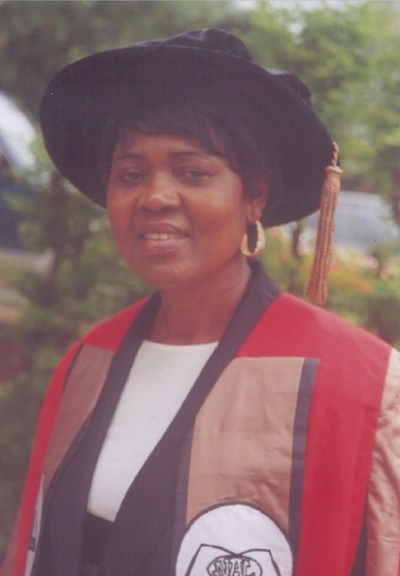
Akachi Ezeigbo, PhD, FNAL, FLSN, FESAN is a Professor of English, Department of Languages, Linguistics, Literary Studies & Theatre Arts, Federal University Ndufu-Alike, Ikwo, Abakaliki, Ebonyi State, Nigeria.


My Biafran Eyes, by Okey Ndibe

*My Biafran Eyes was published by Guernica on August 12, 2007.*

“My father’s decision to stay in Yola nearly cost him his life. He was at work when one day a mob arrived. Armed with cudgels, machetes and guns, they sang songs that curdled the blood. My father and his colleagues—many of them Igbo Christians—shut themselves inside the office. Huddled in a corner, they shook uncontrollably, reduced to frenzied prayers. One determined push and their assailants would have breached the barricades, poached and minced them, and made a bonfire of their bodies. The Lamido of Adamawa, the area’s Muslim leader, arrived at the spot just in the nick…He scolded the mob and shooed them away. Then he guided my father and his cowering colleagues into waiting vehicles and spirited them to the safety of his palace. In a couple of weeks, the wave of killings cooled off and the Lamido secured my father and the other quarry on the last ship to leave for the southeast.” – Okey Ndibe

                                                                  ————-

My first glimpse into the horror and beauty that lurk uneasily in the human heart came in the late 1960s courtesy of the Biafran War. Biafra was the name assumed by the seceding southern section of Nigeria. The war was preceded—in some ways precipitated—by the massacre of southeastern (mostly Christian) Igbo living in the predominantly northern parts of Nigeria.

Thinking back, I am amazed that war’s terrifying images have since taken on a somewhat muted quality. It requires sustained effort to recall the dread, the pangs of hunger, the crackle of gunfire that once made my heart pound. It all now seems an unthreatening fog.

~~~

As Nigeria hurtled towards war, my parents faced a difficult decision: to flee, or stay put. We lived in Yola, a sleepy, dusty town whose streets teemed with Muslims in flowing white babariga gowns. My father was then a postal clerk; my mother a teacher. In the end, my father insisted that Mother take us, their four children, and escape to safety in Amawbia, my father’s natal town. Mother pleaded with him to come away as well, but he would not budge. He was a federal civil servant, and the federal government had ordered all its employees to remain at their posts.

My mother didn’t cope well in Amawbia. In the absence of my father, she was a wispy and wilted figure. She despaired of ever seeing her husband alive again. Our relatives made gallant efforts to shield her, but news about the indiscriminate killings in the north still filtered to her. She lost her appetite. Day and night, she lay in bed in a kind of listless, paralyzing grief. She was given to bouts of impulsive, silent weeping.

Then one blazing afternoon, unheralded, my father materialized in Amawbia, stole back into our lives as if from the land of death itself.

“Eliza o! Eliza o!” a relative sang. “Get up! Your husband is back!”

At first, my mother feared that the returnee was some ghost come to mock her anguish. But, raising her head, she glimpsed a man who—for all the unaccustomed gauntness of his physique—was unquestionably the man she’d married. With a swiftness and energy that belied her enervation, she bolted up and dashed for him.

We would learn that my father’s decision to stay in Yola nearly cost him his life. He was at work when one day a mob arrived. Armed with cudgels, machetes and guns, they sang songs that curdled the blood. My father and his colleagues—many of them Igbo Christians—shut themselves inside the office. Huddled in a corner, they shook uncontrollably, reduced to frenzied prayers. One determined push and their assailants would have breached the barricades, poached and minced them, and made a bonfire of their bodies.

The Lamido of Adamawa, the area’s Muslim leader, arrived at the spot just in the nick. A man uninfected by the malignant thirst for blood, he vowed that no innocent person would be dealt death on his watch. He scolded the mob and shooed them away. Then he guided my father and his cowering colleagues into waiting vehicles and spirited them to the safety of his palace. In a couple of weeks, the wave of killings cooled off and the Lamido secured my father and the other quarry on the last ship to leave for the southeast.

~~~

Air raids became a terrifying staple of our lives. Nigerian military jets stole into our air space, then strafed with abandon. They flew low and at a furious speed. The ramp of their engines shook buildings and made the very earth quake.

“Cover! Everybody take cover!” the adults shouted and we’d scurry towards a huddle of banana trees or the nearest brush and lay face down.

Sometimes the jets dumped their deadly explosives on markets as surprised buyers and sellers dashed higgledy-piggledy. Sometimes the bombs detonated in houses. Sometimes it was cars trapped in traffic that were sprayed. In the aftermath, the cars became mangled metal, singed beyond recognition, the people in them charred to a horrid blackness. From our hiding spots, frozen with fright, we watched as the bombs tumbled from the sky, hideous metallic eggs shat by mammoth mindless birds.

One day, my siblings and I were out fetching firewood when an air strike began. We threw down our bundles of wood and cowered on the ground, gaping up. The jets tipped in the direction of our home and released a load. The awful boom of explosives deafened us. My stomach heaved; I was certain that our home had been hit. I pictured my parents in the rumble of smashed concrete and steel. We lay still until the staccato gunfire of Biafran soldiers startled the air, a futile gesture to repel the jets. Then we walked home in a daze, my legs rubbery, and found that the bombs had missed our home, but only narrowly. They had detonated at a nearby school.

~~~

At each temporary place of refuge, my parents tried to secure a small farmland. They sowed yam and cocoyam and also grew a variety of vegetables. We, the children, scrounged around for anything that was edible, relishing foods that in less stressful times would have made us retch.

One of my older cousins was good at making catapults, which we used to hunt lizards. We roasted them over fires of wood and dried brush and savored their soft meat. My cousin also set traps for rats. When his traps caught a squirrel or a rabbit, we felt providentially favored. Occasionally he would kill a tiny bird or two, and we would all stake out a claim on a piece of its meat.

While my family was constantly beset by hunger, we knew many others who had it worse. Biafra teemed with malnourished kids afflicted with kwashiorkor that gave them the forlorn air of the walking dead. Their hair was thin and discolored, heads big, eyes sunken, necks thin and scrawny, their skin wrinkly and sallow, stomachs distended, legs spindly.

Like other Biafrans, we depended on food and medicines donated by such international agencies as Catholic Relief and the Red Cross. Sometimes I accompanied my parents on trips to relief centers. The food queues, which snaked for what seemed like miles—a crush of men, women, children—offered less food than frustration as there was never enough to go round. One day, I saw a man crumble to the ground. Other men surrounded his limp body. As they removed him, my parents blocked my sight, an effete attempt to shield me from a tragedy I had already fully witnessed.

Some unscrupulous officers of the beleaguered Biafra diverted food to their homes. Bags of rice, beans and other foods, marked with a donor agency’s insignia, were not uncommon in markets. The betrayal pained my father. He railed by signing and distributing a petition against the Biafran officials who hoarded relief food or sold it for profit.

The petition drew the ire of the censured officials; the signatories were categorized as saboteurs. To be tagged a saboteur in Biafra was to be branded with a capital crime. A roundup was ordered. One afternoon, some grave-looking men arrived at our home. They snooped all over the house. They turned things over. They pulled out papers and pored over them, brows crinkled half in consternation, half in concentration. As they ransacked the house, they kept my father closely in view. Then they took him away.

Father was detained for several weeks. I don’t remember that our mother ever explained his absence. It was as if my father had died. And yet, since his disappearance was unspoken, it was as if he hadn’t.

Then one day, as quietly as he had exited, my father returned. For the first—and I believe last—time, I saw my father with a hirsute face. A man of steady habits, he shaved every day of his adult life. His beard both fascinated and frightened me. It was as if my real father had been taken away and a different man had returned to us.

This image of my father so haunted me that, for many years afterwards, I flirted with the idea that I had dreamed it. It was only ten years ago, shortly after my father’s death, that I broached the subject with my mother. Yes, she confirmed, my father had been arrested during the war. And, yes, he’d come back wearing an unaccustomed beard.

~~~

Father owned a small transistor radio. It became the link between our war-torn space and the rest of the world. Every morning, as he shaved, my father tuned the radio to the British Broadcasting Corporation, which gave a more or less objective account of Biafra’s dwindling fortunes. It reported Biafra’s reverses, lost strongholds and captured soldiers as well as interviews with gloating Nigerian officials. Sometimes a Biafran official came on to refute accounts of lost ground and vow the Biafrans’ resolve to fight to the finish.

Feigning obliviousness, I always planted myself within earshot, then monitored my father’s face, hungry to gauge his response, the key to decoding the news. But his countenance remained inscrutable. Because he monitored the BBC while shaving, it was impossible to tell whether winces or tightening were from the scrape of a blade or the turn of the war.

At the end of the BBC broadcasts, my father twisted the knob to Radio Biafra, and then his emotions came on full display. Between interludes of martial music and heady war songs, the official mouthpiece gave exaggerated reports of the exploits of Biafran forces. They spoke about enemy soldiers “flushed out” or “wiped out” by gallant Biafran troops, of Nigerian soldiers surrendering. When an African country granted diplomatic recognition to Biafra, the development was described in superlative terms, sold as the beginning of a welter of such recognitions from powerful nations around the globe. “Yes! Yes!” my father would exclaim, buoyed by the diet of propaganda. How he must have detested it when the BBC disabused him, painted a patina of grey over Radio Biafra’s glossy canvas.

~~~

In January 1970, after enduring the 30-month siege, which claimed close to two million lives on both sides, Biafra buckled. We had emerged as part of the lucky, the undead. But though the war was over, I could intuit from my parents’ mien that the future was forbidden. It looked every bit as uncertain and ghastly as the past.

Our last refugee camp abutted a makeshift barrack for the victorious Nigerian army. Once each day, Nigerian soldiers distributed relief material—used clothes and blankets, tinned food, powdery milk, flour, oats, beans, rice, such like. There was never enough food or clothing to go around, which meant that brawn and grit decided who got food and who starved. Knuckles and elbows were thrown. Children, the elderly, the feeble did not fare well in the food scuffles. My father was the sole member of our family who stood a chance. On good days, he squeaked out a few supplies; on bad days, he returned empty handed. On foodless nights, we found it impossible to work up enthusiasm about the cessation of war. Then, the cry of “Happy survival!” with which refugees greeted one another sounded hollow, a cruel joke.

Despite the hazards, we, the children, daily thronged the food lines. We operated around the edges hoping that our doleful expressions would invite pity. Too young to grasp the bleakness, we did not know that pity, like sympathy, was a scarce commodity when people were famished.

One day I ventured to the food queue and stood a safe distance away watching the mayhem, silently praying that somebody might stir with pity and invite me to sneak into the front. As I daydreamed, a woman beckoned to me. I shyly went to her. She was beautiful and her face held a wide, warm smile.

“What’s your name?” she asked.

“Okey,” I volunteered, averting my eyes.

“Look at me,” she said gently. I looked up, shivering. “I like your eyes.” She paused, and I looked away again. “Will you be my husband?”

Almost ten at the time, I was aware of the woman’s beauty, and also of a vague stirring inside me. Seized by a mixture of flattery, shame and shyness, I used bare toes to scratch patterns on the ground.

“Do you want some food?” she asked.

I answered with the sheerest of nods.

“Wait here.”

She went off. My heart pounded as I awaited her return, at once expectant and afraid. Back in a few minutes, she handed me a plastic bag filled with beans and a few canned tomatoes. I wanted to say my thanks, but my voice was choked. “Here,” she said. “Open your hand.” She dropped ten shillings onto my palm.

I ran to our tent, flush with exhilaration. As I handed the food and coin to my astonished parents, I breathlessly told them about my strange benefactor, though I never said a word about her comments on my eyes or her playful marriage proposal. The woman had given us enough food to last for two or three days. The ten shillings was the first post-war Nigerian coin my family owned. In a way, we’d taken a step towards becoming once again “Nigerian.” She’d also made me aware that my eyes were beautiful, despite their having seen so much ugliness.

~~~

Each day, streams of men set out and trekked many miles to their hometowns. They were reconnoiterers, eager to assess the state of life to which they and their families would eventually return. They returned with blistered feet and harrowing stories.

Amawbia was less than 40 miles away. By bus, the trip was easy, but there were few buses and my parents couldn’t afford the fare anyway. One day a man who’d traveled there came to our tent to share what he’d seen. His was a narrative of woes, except in one detail: My parents’ home, the man reported, was intact. He believed that an officer of the Nigerian army had used my parents’ home as his private lodgings. My parents’ joy was checked only by their informer’s account of his own misfortunes. He’d found his own home destroyed. Eavesdropping on his report, I imagined our home as a mythical island of order and wholesomeness ringed by overgrown copse and shattered houses.

The next day my father trekked home. He wanted to confirm what he’d heard and to arrange for our return. But when he got back, my mother let out a shriek then shook her head in quiet sobs. My father arrived in Amawbia to a shocking sight. Our house had been razed; the fire still smoldered, a testament to its recentness. As my father stood and gazed in stupefaction, the truth dawned on him: Some envious returnee, no doubt intent on equalizing misery, had torched it. War had brought out the worst in someone.

My parents had absorbed the shock of other losses. There was the death of a beloved grandaunt to sickness and of a distant cousin to gunshot in the battlefield. There was the impairment of another cousin who lost a hand. There was the loss of irreplaceable photographs, among them the images of my grandparents and of my father as a soldier in Burma during WWII. There was the loss of documents, including copies of my father’s letters (a man of compulsive fastidiousness, my father had a life-long habit of keeping copies of every letter he wrote). But this loss of our home cut to the quick because it was inflicted not by the detested Nigerian soldier but by one of our own. By somebody who would remain anonymous but who might come around later to exchange pleasantries with us, even to bemoan with us the scars left by war.

~~~

At war’s end, the Nigerian government offered 20 pounds to each Biafran adult. We used part of the sum to pay the fare for our trip home. I was shaken at the sight of our house: The concrete walls stood sturdily, covered with soot, but the collapsed roof left a gaping hole. Blackened zinc lay all about the floor. We squatted for a few days at the makeshift abode of my father’s cousins. Helped by several relatives, my father nailed back some of the zinc over half of the roof. Then we moved in.

The roof leaked whenever it rained. At night, rain fell on our mats, compelling us to move from one spot to another. In the day, shafts of sunlight pierced through the holes. But it was in that disheveled home that we began to piece our lives together again. We began to put behind us the terrors we had just emerged from. We started learning what it means to repair an inhuman wound, what it takes to go from here to there.

In time, my father was absorbed back into the postal service. My mother returned to teaching. We went back to school. The school building had taken a direct hit, so classes were kept in the open air. Even so, our desire to learn remained strong. At the teacher’s prompting, we rent the air, shouted the alphabet and yelled multiplication tables.
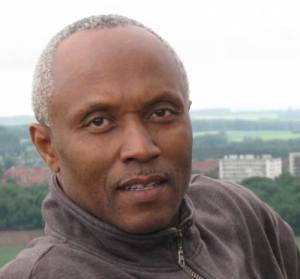
OKEY NDIBE PHOTO 4

                                                                            ———-

Okey Ndibe is the Shearing Fellow at the Black Mountain Institute, University of Nevada, Las vegas. He is the author of Arrows of Rain, Foreign Gods Inc., and Never Look An American In The Eye.


A FRIENDSHIP BROKEN BY WAR – PART 1

“… I went to fetch water from the stream and noticed there was a Nigerian soldier on the other side. He was staring at me and I became afraid…I looked at him, his gun, the way he was dressed. I said if I start running he’ll shoot, so I stood and stared back at him. He started walking towards me and shouted, “Smartisco!” M’ ku jaa. This was my hang-out [nick] name in Kaduna. I said who can be calling me this name here? I went closer. It was Yaya… Should I go forward or not? My eyes filled with tears. He waved at me. I waved back. Then he turned and walked away. The following day, the boy who went to fetch water came back with things like Oxford biscuits, Exeter Corn Beef, High Society cigarettes. He said he picked them from our own side of the stream…Every day after that, whenever our boys went to the stream, something was there. Everyday. I believe Yaya kept them for me. Maybe he thought I will come again to fetch water. But I never went back.” – Smart Eze

                                                                      ———-

I was one of the brightest kids in the village but my father was a peasant farmer, so I didn’t have the privilege of going to secondary school. I shuttled from one relation to the other – Aba to Lagos before ending up in Kaduna where I trained as an electrician. After my training, I got a job with Electrical Contractors of Nigeria limited.

The night of January 15, 1966, we were hearing explosions but we were not bothered because we were used to soldiers doing exercises. Saturday morning we set off to work at the Nigeria Air Force Base where we were carrying out various electrical installations, including air conditioners. As we drove past the Premier’s house I noticed that the police guard wasn’t there. But on both sides of the road we saw soldiers in camouflage uniforms lying down with their guns pointing towards us and signalling to us to go back. We knew something must have happened. Later we heard that a coup had taken place but we didn’t know who carried out the coup, for what purpose, was it in Kaduna, Zaria, Lagos or Ibadan? Towards the middle of the day news started coming out that the coup plotters killed a number of politicians, that Ahmadu Bello and Tafawa Balewa were affected, that the head of the coup was one Igbo officer. It went on till Sunday so there was a stand still. We didn’t know what to do.

When the rioting began, Southerners in general began feeling insecure. In July another coup took place and I said to myself, “This is time to leave.” But leaving was not easy. Northern soldiers had broken out of the barracks and joined the civilian mobs to attack the easterners. I was twenty one years old at the time and had many northern friends like Yaya and Mo, and some Igbo boys like Sunday and Victor. We were all young men, without any care in the world, going to parties and cinemas every Friday and Saturday, smoking, drinking. Mo and Yaya and some of the Hausa boys came and gave us advance warning that our street, Zaria Street, was going to be hot the next day. They gave us Agbadas to wear so that we’ll blend in with the mob when they come to attack. Then, they took our boxes ahead of us to the railway station. The following day, the mob came and we joined them as they went from house to house, killing, rampaging, up to the train station. We saw many atrocities that day. One child was crying, running around, looking for his parents. They raised him up and dashed him on the ground. His body started twitching and convulsing, until he became still. When we got to the railway, Yaya and the others handed our suitcases to us.

While we waited with others for the train to arrive, the soldiers came and started identifying the Igbo soldiers who had escaped from the barracks. They lined them up at the platform and shot them, and left the bodies there for the train to crush. Horror! We were terrified, asking, “When will the train arrive?” When it finally arrived, it was very full because it had been picking up people along the way. They were announcing that more trains were coming but we knew we couldn’t stay there. We managed to squeeze ourselves inside. People were almost trampled, some were already dead, no space, some hanging on the door of the train and when the train moved, I saw people falling off.

At Markurdi Bridge, some soldiers stopped the train and took some Igbo men out. What happened to them, you can guess. After several hours we arrived at Enugu. There was one huge man in the train. They had cut off his head so it didn’t come with the body. His photograph was used as propaganda to show the atrocities the northerners were committing against easterners. It caused an uproar in Igbo land.

When Victor and I returned to our village, it was late. That day was our market Sunday. When our market day falls on a Sunday we celebrate it with a big party. Our arrival caused a lot of merriment because other people also arrived from Kano, Jos, etc. Those whose relations hadn’t arrived were scared.

The military government at the time had established the Resettlement Commission to receive displaced easterners. The idea was to have our records so that when tensions died down we can all go back. We never thought we’d not go back. I registered with them and they organised a Grade Three Trade Test for Industrial and Domestic Installations for me. I passed the test and interview and, while waiting for the letter of appointment, the war broke out. All my dreams were now dashed.

But one happy thing happened around this time. My mother and father had separated when I was about three years old, but when she heard I survived the pogroms, she sneaked to a neighbour’s house and asked them to call me. She told me she was my mother and we were both crying. If she hadn’t come that day I would not have remembered her face again. We went to visit my younger sister who was married. We were all crying and I was imagining how Nigerian soldiers will come and kill my family. I said, “No. I will carry a gun. I must defend.”

I joined at the end of 1967 and my first posting was Ikot Ekpene sector, at one remote village. The Nigerians had entered there in September/October through their rubber plantations and were camped on one side of a hill. I think they were cut off there and didn’t get supplies for a long time. Our own group was camped on the other side of the same hill. There was a stream close by where we all used to fetch water but it was miraculous that we didn’t attack each other. I’m sure if our bosses had heard about it they would have court-marshalled us.

A few days into this extraordinary cease fire, I went to fetch water and noticed a Nigerian soldier on the other side of the stream. He was staring at me and I became afraid. Was he going to start shooting? I looked at him, his gun, the way he was dressed. I felt that if I start running he’ll shoot, so I stood and stared back at him. He started walking towards me and shouted, “Smartisco!” M’ ku jaa. This was my hang-out [nick] name in Kaduna. I said who could be calling me this name here? I went closer. It was Yaya. My body went cold. I didn’t know what to do. The stream was about three metres wide. Should I go forward or not? I didn’t want to attract attention so my group doesn’t start shooting thinking I have been captured, or his side will open fire. We didn’t talk but my eyes filled with tears. He waved at me. I waved back. Then he walked away.

The following day, the boy who went to fetch water came back with things like Oxford biscuits, Exeter Corn Beef and High Society cigarettes. He said he picked them at the point where we fetch water. Our leader said we shouldn’t touch them, that they may be poisoned. After I told them what happened, he said we could eat them but they insisted I eat first. Every day after that, whenever our boys went to the stream, something was there. Everyday. I believe Yaya kept them for me. Maybe he thought I will come again to fetch water. But I never went back.

One night we started hearing noise. We wondered if they were leaving or preparing to attack us. Before morning, they took us on, shooting. Kept shooting. We later found out that they changed the first group and brought in new people. They may have noticed that the former group was not taking us on. We returned fire but theirs was more, so we retreated and regrouped. They redeployed some of us to Port Harcourt where the Nigerians had taken over the airport. My ears were damaged in the attack and one of the boys I pulled out had his legs blown off. They took us to Aba General Hospital and when my ears cleared, I went home to recover.

I went back to the front and they attached me to the Ogbunigwe section of the engineering battalion. I was posted to the Afikpo zone where they trained me as an Ogbunigwe electrician and operator. Ogbunigwe was developed by Biafran scientists and was one of the highly effective defensive bombs in the weapons arsenal of the Biafran Army. It was made up of the main explosive in an encasement, the removable detonator, the battery and switch, and connecting cables. The main explosive segment came in different sizes – between 5 kilos and 500 kilos. The massive ones were transported to their locations by lorry, while the soldiers carried the lighter ones in their hands. The batteries and the detonators were put in separate bags. We used both car and torch batteries to generate the electrical power but whenever torch batteries were used, they were connected serially to each other to produce an electromotive force between 12 and 16 volts. The detonator could only be inserted into the main segment of the explosive and connected by wires to the batteries and the switch at the moment the Ogbunigwe was ready to be launched. The batteries had to be fully charged for the operation to be successful. It was a highly risky job for the operators and that is how I got blind.

SMART EZE PHOTOS 1
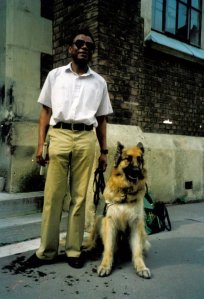
Smart Eze with his guide dog.

It happened on the 12th of November, 1968. There was shooting the whole of Saturday and Sunday. By Tuesday nobody was shooting again and we were trying to go further and deploy our Ogbunigwe so our troops can move forward. I don’t know how one of our boys touched the detonator and it exploded all over my face, chest, eyes, head. Some of the boys had their stomachs ruptured. Some had their arms cut off. Some died on the spot. The boy who detonated it, nothing happened to him. Those who were not wounded found a way to put us in an ambulance which took us to the Biafran Forces Hospital in Ohafia. I went in for surgery and when I woke up the next day, I heard people crying, boys in pains. I tried to see but I couldn’t. No light. Nothing.

One day, the boy who was helping me in the hospital, Chidike, told me there was a white man who was going from ward to ward looking at patients. When the man got to my bed, he inspected my eyes and asked if I would like to go to Austria for medical treatment. I said yes. Later on, Chidike overheard one of the Nigerian doctors telling the others that my eyes were beyond repair. But Dr. Bakker insisted I could learn a trade even if the doctors don’t restore my sight. He later told us he was under tremendous pressure from politicians and other prominent members of society to select their relations for treatment abroad. He said he followed his instincts and did as he was led.

While I was waiting to be evacuated from the hospital, the Nigerians entered from Afikpo and started shelling the hospital. I don’t think the staff were able to carry those who were immobile, but we escaped to St. Augustine’s, Nkwerre, and from there to Ekwerazu, where other wounded soldiers were waiting to travel out.

I told Chidike to take me to my village. My father was devastated to see me, his first son, being led by the hand. He opened my eyes and looked. Then, he placed his hands on my head and blessed me. I didn’t see him again because he died in April, 1970. My mother was crying but I couldn’t see her; I was only hearing her voice. I wish my father had lived to see how my life turned out.

The next morning, we left with my mother to Holy Rosary, Umuahia, where I signed enough relief for her. We returned to Ekwerazu. That same day, my village was sacked. The soldiers who drove us away from Ohafia had entered Umuahia and proceeded to Afo Ugiri, my village. If I hadn’t left that morning, I would have missed my group and not gone abroad.

Our plane was the last to leave Biafra. We had to wait for some time because Nigeria blockaded us until 1st of May, four months later. Maybe, if we had left earlier, they would have been able to restore my vision, even if partially. And if we had stayed longer, we would not have left because the war ended six months later.

                                                                       ———-

SMART EZE PHOTOS 3

Dr. Smart Eze obtained a Doctorate Degree in Philosophy from the University of Vienna, in 1979. He worked with the United Nations in Vienna, Austria from 1980 to 2005. In 1981 he was the Ambassador for the United Nations International Year of Disabled Persons. He currently serves as honorary board member and goodwill ambassador for LIGHT FOR THE WORLD, an Austrian civic organization that provides medical treatment and support to people living with eyes diseases, blindness and other disabilities in underprivileged regions of the world.

SMART EZE PHOTOS 6

SMART EZE PHOTOS 7

His autobiography, My Four Worlds, was published in July 2010, by AuthorHouse UK.  The German version “Meine Vier Welten” was published in 2015 by Epubli, GMBH, Berlin.

Dr. Smart Eze also speaks Igbo, French and German. He lives in Vienna, Austria with his wife and children.

The many difficulties of war – Part 1

“Another thing that added to the difficulties of life for us was our menstruation. When your period was coming you’d be dreading it because there were no sanitary pads. What I did was cut up old wrappers and sew the pieces together. I made up to ten of them. We either put them in our pants or made a loop in them and tied them with a rope around our waist. They would soak so much with blood before I washed them. I had a particular place where I used to dry them so people wouldn’t see them. After the four or five-day cycle I’d keep them neatly until the next one.” – Akachi Adimora-Ezeigbo.

                                                                     ———-

When the war started, I was a school girl at Archdeacon Crowther Memorial Girls’ School, near Port Harcourt, so I was already knowledgeable about life. There was so much deprivation, and life became cheap and meaningless. I must describe myself as one of the people who were traumatized by that war because I lost a number of relations and classmates, young boys of eighteen – nineteen years who went to fight in that war and died.

AKACHI EZEIGBO PHOTO 3
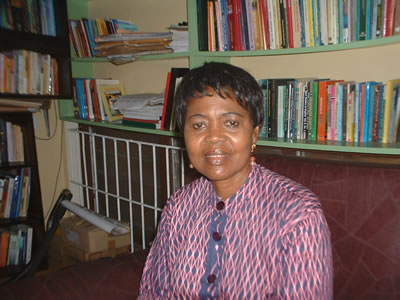
Professor Akachi Adimora-Ezeigbo in her library

Roses and Bullets, my war novel, is dedicated to them: my brother, Joseph Adimora; my cousin, Samuel Ogbuefi; my husband’s elder brother, Nathan Ezeigbo; and other close relatives.

We moved from Port Harcourt to Aba, to Mbano, and finally to our home town, Uga. There was constant displacement and in each place we lost something. When we got to Uga, the Biafran had built an airport there. The one at Ulli was for relief materials while the one in my place was purely for military purposes, where they kept all those Biafran Babies. Because of it, the Nigerian government raided Uga airport and the surrounding villages virtually every day and at nights.

Those air raids were particularly traumatic for me. They were terrible! The sounds would make you urinate in your pants, if you had pants to wear at all. The sound would strike you and paralyze you and leave you almost dead because when it came it would screech and then you had to run to the bunker. I’m sure people who had weak hearts died but we were young so we could withstand the shock. We had a permanent bunker and in the morning when you got up, you ate, if there was food, and then headed for the bunker. My father, who was a District Officer at some point, had a storey building, one of the few in my home town. But we were advised not to stay in the building because Nigeria Air Force was bombing anything they saw. We covered the roof with palm fronds but could not cover it completely. Biafra didn’t have effective air defense so sometimes when the Nigerian planes came for raids they would descend extremely low. In fact, one day, I looked up and saw the figure of the pilot. In the night you didn’t use any light so they wouldn’t see you. There was one woman who lived in the next village who was moving about in the night with a naked light. Immediately they saw the light, they rocketed the place and the woman died.

Uga was never evacuated because it was in the heartland of Biafra adjoining Akokwa and Akpulu. But as Biafra shrank, refugees from Awka, Abagana and other places came crowding into Uga, so the air raids now concentrated in the area and the surrounding towns such as Ekwulobia, Ezinifite, Amesi and Nkpologwu. Markets were now in the forests and were held at night because people were advised not to gather in groups in the day time.

During one particular raid, we ran out of the house and lay flat on the ground because there was no time to run into the bunker. The planes, which used to come in pairs, were releasing canon fire, shooting, rocketing. At the end of it, when I got up, the first thing I saw was eke [python] close to where I was taking cover. I wasn’t so scared because in Uga pythons do not bite. The locals treat them gently and with respect. Then, I saw a severed leg and an arm lying close by. People were groaning. It was horrible the way those planes killed people. It could just chop off the head or the whole trunk of a person. If you witnessed that war you would understand the reality of the fictional accounts in Half of a Yellow Sun, where the body of one of the characters kept running even after his head was cut off.

Then, there was the hunger. Sometimes there was nothing to eat. Most times we didn’t bother to go to the relief centers because one could stay there for a whole day without receiving anything. Some centers didn’t have enough supplies. Reverend Fathers were even accused of using the relief materials to lure girls. Some were accused of selling them to traders, for in the markets traders were selling stock fish, salt and other items. Some were using them politically – giving to certain people and not to others. One or two times I went begging but got nothing. After that I didn’t go again. Perhaps they didn’t want to give the locals, preferring to send the supplies to the refugee camps. Inevitably, people became more resourceful, trying to look for anything edible to assuage the hunger pangs. They would come out en masse to look for Aku – termites – in the early hours of the morning or at night. My family started eating the things we had never eaten before, like Uchakiri. I didn’t know those things were edible but when you see others eating them, you’d do the same. We cooked cassava leaves in soups and ate them with yam or cocoyam. We ate mpoto ede, cocoyam leaves. We dried the pink layer under the outer peel of cassava tubers and use it as food. My mother was making ogbono and okro soup with the tender leaves of the hibiscus flower. People who lived near small streams ate crabs. We would turn the manure in the goat pen and roast the lava we found crawling underneath. People ate rats and lizards. Now I can’t imagine myself eating these things but we relished them then. But many people still died. There was a massive continuous dying of young Children, especially from kwashiorkor. In my mother’s kindred some of the old men died because there was nothing to eat. Younger people survived because they managed to scrounge whatever they could for food.

They were also conscripting children as young as fifteen and sixteen years. My brother was fifteen when they conscripted him. He came back alive because there was a battle in the forest and they dispersed. My frightened brother ran away and came home as an Atimgbo, one suffering from shell shock. The military police was on the lookout for those who went on AWOL, so when he saw a Mami Wagon he would hail the occupant and say, “Driver give me smoke. Carry me. I’m going to Akokwa.” When he returned home, people were trooping in to sympathize with us. Women were exclaiming, “Ewuu, nwa m’o! Agha Biafra.” [Oh, poor child! This Biafra war.] After my mother gave him water to take a bath, she cooked his clothes in an iron pot for twenty four hours even though firewood was scarce. He had kwarikwata [body lice] and that was my first time of seeing them. They’re so flat it was difficult to pick them out from the fabric, so we dumped his clothes inside the pot. I don’t think he even had shoes because when they conscripted him my mum gave me, as young as I was, shoes to take to him. By the time I got there they had moved him to the war front, less than two weeks after they conscripted him. He couldn’t have had more than one week’s training. I wept so much and dropped the shoes with somebody who promised to send them to him. About five months after he came back the war ended.

Another thing that added to the difficulties of life for us was our menstruation. When your period was coming you’d be dreading it because there were no sanitary pads. What I did was cut up old wrappers and sewed the pieces together. I made up to ten of them. We either put them in our pants or made a loop in them and tied them with a rope around our waist. They would soak so much with blood before I washed them. I had a particular place where I used to dry them so people wouldn’t see them. After the four or five-day cycle I’d keep them neatly until the next one.

We had access to water because our house had a gutted roof which filled up our big underground tank during the rainy season. In the dry season we’d be hoarding the water. We also had a well called Umi. That was where we drew water for house hold chores. It was not always clear so we put alum in it. But the well water didn’t last till the next season so we went to streams like Ochi, Agwazi and Obizi. They had their source from the ground so they were there all the year round. It’s from Obizi spring in Uga that the Government provided running water to Aguata Local Government area in the present Anambra State, so you can imagine the size of this beautiful body of water.

It was even risky to be a young girl or woman during that time. After the war, the soldiers invaded everywhere. They came to my village too. They took many girls by force. Some went willingly. Others were enticed with food. They even took away people’s wives and the poor men were helpless. When you’re dealing with a man with a gun, what do you do?

AKACHI EZEIGBO PHOTO 1
Professor Akachi Adimora-Ezeigbo

                                                                     ——————-

Akachi Ezeigbo, PhD, FNAL, FLSN, FESAN is a Professor of English, Department of Languages, Linguistics, Literary Studies & Theatre Arts, Federal University Ndufu-Alike, Ikwo, Abakaliki, Ebonyi State, Nigeria.


My Father’s Fence – by Cheta Nwanze

*My Father’s Fence was published in Medium on December 24, 2016.*

“…the soldiers began firing. Many of those trying to flee were cut down as they fled. The rest of us fell to the ground in utter hopelessness. I lost count of time. The soldiers turned their guns on those of us lying on the ground and the staccato bursts of bullets continued into the late evening. To this day, I live with the smell of the blood of my brethren that died that day, with the cries of those of them who had lost hope and stood up and begged the soldiers to end it all. Maybe they were the ones who saved the lives of those of us who survived the slaughter, because as they begged to be killed and the soldiers obliged them they disrupted the flow of the massacre as the killers now concentrated on them.”

                                                                           ———-

It has often been said that when an Igbo man’s wife makes a request of him, he will move mountains to achieve it. Thus it was that when my mother, who lost her father, and some of her brothers, on the same rainy day in October 1967, asked my dad to do a memorial to them, he obliged and did the memorial on his fence. The pictures you’ll see next are the result, and I’ll do a sort of story guide.

On October 5, 1967, Nigerian troops took Asaba, on the banks of the River Niger, from Biafran troops. The retreating Biafrans had blown up the Niger River Bridge which links Asaba to Onitsha, so the feds could not cross the river. The feds returned to Asaba and turned on the civilians, accusing many of being Biafran sympathisers, a crime which, according to them, meant death.

On October 7, the leadership of the Asaba people gathered together and decided to do a rally, to show the support of the town for “One Nigeria”. This was captured here:

CHETA NWANZE PHOTO 1
A mural depicting Asaba indigenes gathering for a rally to support Nigeria. October 7, 1967, 0900 hours.

The people, on the advice of their leaders, wore akwa ocha – white cloth, which symbolizes, among other things, peace. Then they went to meet the Nigerian troops and their commanders. Depicted next:

CHETA NWANZE PHOTO 2
Mural depicting Asaba people meeting with Nigerian troops to show support for ‘One Nigeria.” Note the signs the people are carrying. October 7, 1967, 1100 hours.

As the meeting went on, the leader of the federal troops on the ground, told the people that he wanted to have a discussion with the men, so ordered his soldiers to separate the men and boys of military age, from the women. That’s next:

CHETA NWANZE PHOTO 3
First half of the mural


CHETA NWANZE PHOTO 6
Second half of the mural depicting the separation of the men from women by Nigerian soldiers in Asaba. October 7, 1967. At about high noon.

The next part of the story has been told to me by my uncle, who was an eyewitness to what happened next. After the women had been led away, and the men taken a bit of a distance away from the meeting point, the commanding officer said the following — “Ku diba su goma goma, ku je chikin chan de chan, kwu yi aiki de su.”

At that point, those, like my uncle, who spoke Hausa, understood what was coming next. Depicted next:

CHETA NWANZE PHOTO 5
Mural depicting the Asaba massacre. October 7, 1967, high noon to late afternoon.

The story, as told by my uncle, is saved in the Nigerian Village Square for posterity. I’m reproducing a part of it here:

I was standing with my elder brother Emma at the edge of the crowd. He was holding my hand. I had always been Emma’s little brother, shared his bed with him every night until he died. Even onto death, he felt his duty was to protect me. Emma was the very first person to be dragged by the soldiers. As they took him, he let go of my hand and pushed me further into the crowd. I saw Emma struggling with one of the soldiers and another one shot him from behind at point blank range. He fell to the ground with the blood from his back forming a pool around him. His shattered vertebrae exposed in the afternoon gloom, the first victim of the massacre that followed.

As soon as Emma fell, all hell broke loose. A good number of the men and boys, on seeing the first death, began to flee into the surrounding bushes and the soldiers began firing. Many of those trying to flee were cut down as they fled. The rest of us fell to the ground in utter hopelessness. I lost count of time. The soldiers turned their guns on those of us lying on the ground and the staccato bursts of bullets continued into the late evening. To this day, I live with the smell of the blood of my brethren that died that day, with the cries of those of them who had lost hope and stood up and begged the soldiers to end it all. Maybe they were the ones who saved the lives of those of us who survived the slaughter, because as they begged to be killed and the soldiers obliged them they disrupted the flow of the massacre as the killers now concentrated on them.

Finally, the bullets stopped. The heavens opened up and a light shower came forth. Even the heavens wept for the victims of that holocaust. I thought everybody was dead.

Then, I began to hear voices – the cries of the injured struggling to live and the regrets of some who had their limbs battered and were in need of help. It seemed to me that I was the only one who came out unscathed. Lying close by was a cousin of mine who had a bullet hole on his head and the middle finger of his right hand was shattered. He was alive and lives to this day. My father was lying not too far away. I did not know where the bullet hit him. His eyes were open as if he was staring at me, his favourite son. He was dead.

 I could not get up and escape into the bush as soon as we knew the soldiers had gone because there was no way I could go without my cousin who was injured. So we waited until it was dark then I helped him along and we found our way to my grandmother’s house.

The next morning, my mother came looking for us. There were five of us from my family – my father, my brothers – Paul, Emma and Gabriel, and I – who had been taken by the soldiers to the killing field. She found only me. Quickly she arranged for my sisters, my little brothers and I to escape with other people to Achalla, a few kilometres from Asaba. Later she went to look for the bodies of my father and brothers. She found only my father and Emma. She put them in a wheel barrow and went to bury them. The body of Paul was never found. He was only twenty-four. For several years, we lived with the illusion that he must have escaped somehow and found his way to Biafra. But we had to accept that somewhere in Asaba, like several others, lies the body of Paul in an unmarked grave. We found Gabriel in Achalla. He was shot in the waist, but somehow, the bullet missed his spinal cord. He had eight bullets in him. The last of them was extracted at Igbobi Hospital in 1978.”

This, is the story of one half of my family. The story of people, related to me by blood, who were more than decimated that day.

It is my story. I understand that everyone has his own story. I have told mine and I will keep telling it. If you must, tell yours. But for God’s sake, don’t attempt to muzzle me.

                                                                  ———-

Cheta Nwanze is the Head of Research at SBM Intelligence. He is also a writer and social commentator.


Music in a time of war – 1

“I remember an incident that happened at Akabo when the Nigerian soldiers were trapped in Owerri town. The brigade was very close to where we were performing and the soldiers were dancing and some of them were saying, “This war wey we dey fight so, abi make we come die when our ogas dey drink tea for house?”  After a performance, they’ll say, “Last night, that band good o!” Sometimes they even exchanged beer and cigarettes. But when there was a fight, they will fight to finish, because in the army they say the last order must be obeyed. These are the untold stories – the friendships within the war. This was the outlook in Biafra and it was very lively. It boosted the morale of the Biafran soldiers…” – Chyke Maduforo

                                                                      ———-

I was working with the International Committee of the Red Cross when I met members of the Figures Band taking refuge in my village. They had escaped from Port Harcourt after it fell to the Nigerian soldiers and were trying to re-organize.

CHYKE MADUFORO PHOTO 3
Chyke on the drums.

I fitted in perfectly with my skills and took over the drums. Berkely Jones moved from the drums to the lead guitar. Lemmy Faith was the lead singer and also handled the second guitar. Iyke Njoku was our Road Manager. Pat Moore joined us at Abba, Nkwerre, when we went to entertain the soldiers hospitalized at the Armed Forces Hospital. The commandant was Lieutenant Omoshe. We also performed at Research and Production centres. One was at Obizi High School at Mbaise here. Our music was so good that the Biafran Navy adopted us and changed our name to Sailors, so we started to perform for them when they had functions.

There were other music groups functioning in Biafra. One of them was the Atomic Eight, a High Life band which was in existence even before the war started. They were based at the Traveller’s Lodge, Aba. Their members were musically literate so the band was used by Mik Nzewi and Sonny Oti – a lecturer at the University of Jos – as a propaganda machine to entertain visitors and show the world what was going on in Biafra. Their performances were like orchestras and dance dramas and they were very effective. There were other groups, such as The Hykkers, The Fractions, The Jets and The Admirals. The propaganda group would use any of these groups, including ours, to entertain the forces in different camps, brigades and divisions. Sometimes we even played close to the front.

I remember an incident that happened at Akabo when the Nigerian soldiers were trapped in Owerri town. The brigade was very close to where we were performing and the soldiers were dancing and saying, “This war wey we dey fight so, abi make we come die when our ogas dey drink tea for house?” The following morning they’ll say, “Last night, that band good o!” Sometimes they even exchanged beer and cigarettes. But when there was a fight, they will fight to finish, because in the army they say the last order must be obeyed. These were the untold stories – the friendships within the war. This was the outlook in Biafra and it was very lively. It boosted the morale of the Biafran soldiers because they were not being paid. Where were they going to spend the money? What would they spend it on? There were supposed to do what was called allotments, which was to send part of their salaries to their families but when everything broke down – addresses, movements – that ended naturally. So they got their comfort through music. In fact the best friends of the soldiers were the musicians.

It was at this point we were called to come to Nkwerre to form another group. So, I, Berkely Jones and Pat Moore left Oguta and went to Nkwerre. We formed The Funkees and the day the group was launched was a terrific day. We decided on the name because the reigning dance style was funk and instead of spelling it FUNKIES, we decided on FUNKEES. We played with this name during the last bit of the war and that was what made us so popular. We were playing copy right by The Beetles, James Brown, Percy Sledge, Otis Redding, Sam Cooke, many others. We couldn’t record our own music because there were no recording studios so we were playing live shows.

CHYKE MADUFORO PHOTO 1
The Funkees

The Nigerian soldiers were approaching Nkwerre so the gun shots were coming closer. All they were doing at this time was looting. There was confusion everywhere. As if on cue, the other groups started to fold up one after the other. The Jets lost three of their members in a ghastly accident. The Fractions got locked up in military confinement for offences they committed against someone. The Hykkers split up while The Blossoms remained with the Nigerian Army at Owerri. But The Funkees had taken a decision to stay together and go into Nigeria together. We were prepared to be captured and we said, “If we must die, let us die together.”

That is how we became the only group that survived with both personnel and instruments intact. Providence also smiled on us when we met this Nigerian Army Lieutenant who saw us and it was as if he picked gold. He planned to take us to Owerri but he needed time to arrange for a vehicle that will take us and our equipment. It was at this time that we met Jake Solo, the bassist for The Fractions. He was with his brother, IK, now a medical Doctor, and Mike Collins, the drummer for The Fractions. They had just come out of confinement with their hairs shaved. We took them on and eventually, the army lieutenant came with a brand new Land Rover and we set off.

On the way, all we were seeing were dead bodies – both Biafran and Nigerian soldiers. It took us five hours to meander through this stretch of corpses. We arrived at Owerri at about 8.00 pm and were taken to Imo Motels. Later that night, Obasanjo, who was the commander of the 3rd division, came to receive us with his adjutant – Col Tumoye, whose brother-in-law was our bassist. His name was Felix Udofia and he had been the second bassist of The Hykkers. Colonel Tumoye came looking for Felix, who we called Murphy Lee, because they had information he was playing with a musical group. To determine we were not soldiers sent to kill him, Obasanjo asked us to play for him. Luckily, we had Jake Solo with us, so we performed and their fears were allayed. They handed us over to one Captain Keru who took good care of us.

Obasanjo promised to invite us to Port Harcourt but he didn’t. What we understood later on was they had asked all the Biafran officers to come and register at Owerri, but the Igbos were reluctant to come out. They were afraid they’ll exterminate them like what happened in Asaba. We later discovered that the reason Obasanjo left us at Owerri was to use our shows and draw young men out.

The same thing happened with civil servants at Enugu. Ukpabi Asika was finding it difficult to rehabilitate the Igbos and Enugu was a ghost town when we arrived. We started performing at Dayspring Hotel and Atlantic Hotel. Then we got into a deal with the 87 Division to perform monthly at the Officer’s Mess. The aim was to draw people out so that life can get back to normal. It worked because people started coming out, especially the young men who already knew The Funkees.

CHYKE MADUFORO PHOTO 2
The Funkees, after the war.

The Funkees is still in existence. Our policy is that the name will remain forever even if memberships change. Out of the original group, Berkely Jones, Pat Moore, Danny Heibs, Sonny Akpan and I are alive but they joined other groups after the war. I’m the only one from the original group that is left in the Funkees. Two years ago Danny and Sonny organised a theater show in London. I coordinate the new Funkees which is made up of two ladies and a man. They’ve done a remix of our songs in Igbo, English and French.

CHYKE MADUFORO PROFILE
Chyke Maduforo

                                                                           ———-

Chyke Maduforo is a business man. He is also the author of a book – Simpler Music Rudiments. He’s currently setting up a music academy that will nurture budding musical artistes. He lives in Imo State with his family.