Tag Archives: Nigeria-Biafra war

THE WAR DANCERS

I was born in Gusau but my earliest recollection of life was in Funtua. My father worked for Societe Commerciale d’Outer-Mer Automobile Nigeria (SCOA) as a District Manager responsible for trading and produce-buying, so we lived in different parts of northern Nigeria. He was a respected leader within the Igbo community, and recognized by the Emirate Council as the Igbo man to go to on matters that had to do with communal relations. At that time, the Igbo State Union was very strong in the north and once they took a resolution it was binding on all Igbos across the region.

About a year before the January 1966 coup, my father decided to take an early retirement because a friend of his in the Emirate Council informed him that a political crisis was brewing between Northern and Southern Nigeria which might boil over into violence. His friend advised him to leave because his name was top on the list of Igbos to be eliminated. My mother didn’t want to follow him immediately because she had a bakery, a chemist, and some other businesses, and was reluctant to start all over in an unfamiliar business terrain. However, they reached a compromise that she would move to Zaria, where he had a house, and where a lot more people from my hometown resided. Their thinking was that the large numbers of our people in Zaria would be able to defend themselves in the event of violence better than they would in Funtua.

In January 1966, I gained admission into St. John’s College, Kaduna. In July of the same year, the revenge coup took place, and the massacre of Igbo civilians started. As students, we lived within the relative security of the boarding house but as day students came with horrific stories of what was happening outside, I became deeply concerned about my mother and siblings in Zaria. I went to Father Canty, our Irish Principal, to obtain permission to travel to Zaria but he denied my request. Being a tenacious person, I went again but with a classmate of mine. This time, Father Canty agreed because he felt it was better to allow two people travel rather than one lone boy. He gave us one pound sterling from our pocket money to make the trip.

When we arrived Zaria, all seemed calm, so we set off on foot into Sabon Gari where our parents lived. On our way, an elderly Hausa man stopped us and asked us in Hausa, “My children, where are you going to?” We said we were going to Sabon Gari. He said, “No, no, no. Don’t go into Sabon Gari. What is happening in Sabon Gari is so much evil than I have ever seen in my entire lifetime.” He asked where we were coming from, and when we said Kaduna he said we should go back. My estimate of his age was about 70 years. He had a full white beard and might even have been an angel; I don’t know and may never know.

I wasn’t happy that we had come all the way and couldn’t accomplish our mission. I then suggested to Charles that rather than trek into Sabon Gari we should take a taxi. We boarded the first taxi that came by. As we drove into Sabon Gari, we could see a rowdy group of young men further up the road, armed with clubs, knives, cutlasses, axes, tyres, and other weapons. On sighting them, the taxi driver said he couldn’t continue the journey. I was furious and questioned why he would ask us to come down in the face of danger. He was adamant and said the violent mob will damage his vehicle. I told him he was fearful for his vehicle but not for our lives. When the mob noticed he was making a U-turn, some of them started running to catch up with the car. When we were out of danger, the driver asked us again to alight because he was heading to Kaduna. With great relief, we said we would follow him back.

On our way back to Kaduna, somewhere on the Zaria-Kaduna Road, an army truck was coming in the opposite direction from us. A hand was waving us down but our driver did not notice because he was talking with the man in the front seat with him. The army truck left its side of the road and headed towards us, in an attempt to force us off the road. Charles and I screamed, and our driver swerved into the bush. The army truck stopped, and the soldiers rushed at us. Seeing that the two people in front were northerners they spoke to them in Hausa, “Namu ne, kwo nasu ne—Are you one of us, or are you one of them?” The driver said he was one of them. They said they would have knocked us into the bush believing we were Igbos trying to escape. Then they cautioned the driver to be vigilant because the times were perilous. But before they got to our car, I had asked Charles not to answer any questions since his Hausa was not as fluent as mine. The primary school I attended from classes five to seven was Capital School, Kaduna, which the children of the northern elite and white expatriates also attended. This exposed me to the mannerisms of the children of the northern elite, so I could speak impeccable Hausa and act like them. As they turned to leave, one of the soldiers came back to us. His first question was, “Young boys, who are you?” I replied with a question as children of the elite are likely to do. “What is your problem with us? Are we disturbing you?” He replied that they just needed to know. I retorted, “You can see we are students.” The questioner mellowed down but insisted on knowing our names. I gave them the name of the man who had advised my father to leave the north, claiming he was my father. I reckoned that even if they decided to take us back to Funtua, the man would agree we were his sons, seeing that we were in trouble. My bluff worked because they let us go. Back in Kaduna, we again decided to trek back to our school. On our way, we found dead bodies littering the streets. The killings had taken place after we left Kaduna that morning. That was when it fully dawned on me that we took a very stupid risk.

A few days after this incident, the killer gangs started coming to our school, but our principal, Father Canty, and one Father Wolfe would tell them the Igbo boys had left. Still, they kept coming back. There may have been fellow students telling them we were still in school. This got the principal apprehensive, so he made arrangements for us to be airlifted from Kaduna to Enugu. Early one morning—I think it was in September 1966—at about 4.00 am, he went round the dormitories waking us up because army trucks were waiting to take us to the airport. Before this time, he had been smuggling the older Igbo boys in his 403 Peugeot pick-up van down to the east. He would squeeze many of them at a time into the pick-up, cover them with tarpaulin, and drive to Obollo Afor, the border town between current Enugu state and Benue state. There, he would leave them to find their way home. He did about four or five such runs, using different routes, until he made sure all of them were out of danger. For us younger boys, he bundled us into the waiting big army truck and took us to the airport. Those airlift operations were a tripartite arrangement between the federal government under Col. Yakubu Gowon, the northern regional government under Col. Hassan Katsina, and the Eastern regional government under Col. Chukwuemeka Odimegwu Ojukwu. The planes used were Airforce cargo planes that had no seats.

Back in Zaria, my mother was in her bakery when the killings started. My siblings were in school so she sent one of her workers to pick them up. But a bigger problem was how to move from the bakery to the army barracks, which was one of the safest places at the time. Eventually, they moved to the house of a Hausa family but word soon went out that a particular Hausa man was hiding Igbos in his house. One day, some young men came to search the house but the man of the house insisted that no such thing would happen, that no one would go into his purdah—kule—to search for anybody. They left. But that night, he moved my mother and siblings to another family and that’s how they kept moving from one family to another until they were able to get to the military barracks from where they were evacuated to the east by rail.

By the time I arrived Enugu there was no news of my mother and siblings. Notwithstanding, I had this insane confidence that they would come back safely. My father had the same confidence as I had. My mother’s relatives were crying and I was saying to them, “Don’t worry, she will come back safely.” Every day, I followed my Auntie Monica to the railway station to find out if a new train had arrived. Each day we went home, disappointed. But about a month after I came back, lo and behold, there was one of my siblings at the railway station. I screamed and said to Auntie Monica, “That’s my sister.” She was just five years old and when she realized it was me, she walked slowly to me and asked that I carry her. I asked her, “Where is Mummy?” She pointed in a certain direction and Auntie Monica followed me in disbelief. There was my mother and all my siblings in tattered clothing. They hadn’t taken their bath in more than two weeks. The emotional scene between my mother and her sister is one I will never forget.

My relatives soon put me in Colliery Secondary Technical School, on the hilltop in Ngwo. The shooting war had started at this time, and Eastern Nigeria was preparing for a war we believed would avenge the genocide committed against Ndi Igbo. Our school was the first to be closed in Biafra because it was on a high altitude and they needed it as a training camp for Biafran soldiers. We became idle and every morning I went with a few of my friends to Independence Layout where the Biafran army had converted some buildings to a Tactical Headquarters. We heard that Major Chukwuma Nzeogwu, our hero, operated from there so we went every day to catch a glimpse of him. Sometimes he came by helicopter which landed in an open space not far from the buildings. He usually looked serious but whenever we waved, he would wave back and that made our day. We were going there to stay in touch with what we believed was happening in Biafra because there were so many rumours flying around. There were also adults who came to hear the latest news and view our soldiers come and go.

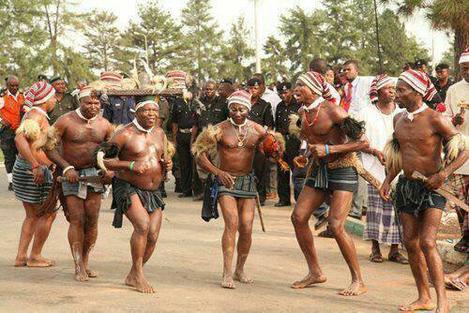
One day, a 911 lorry arrived with Abiriba War Dancers. Immediately they came down, they started dancing, wielding their machetes and other paraphernalia this way and that. They were reputed to have invisible powers and would even cut off the heads of their enemies in battle. This boosted our morale and people started bragging that the northerners would see hell since the Abiriba war dancers had joined the battle. After dancing, the warriors went to eat. I remember this clearly because we ran after their lorry as it drove them to Okpara square, in front of the Parliament Building. After they were fed, they continued dancing. In the evening, they left for the war front.

About two days later, when we came back to the Tactical Headquarters, a Mercedes-Benz 911 lorry drove in. The driver and motor boys were looking solemn. As one of them was coming down from the back of the lorry, the tail board opened. My God! I saw what I had never seen in my life. Dead bodies were piled up in the lorry. From the way they were dressed we realized they were the Abiriba war dancers we had seen a few days earlier. They had been taken to the Nsukka war front with cutlasses as their only weapons. That sight affected me so much that, for many days, I couldn’t eat. I don’t know what happened to the bodies but they may have been taken back to Abiriba for burial. With the benefit of hindsight after the war, I questioned how any army commander, who is experienced in modern warfare, would allow defenseless people go to war without modern weaponry. Many crazy things happened during the war and this is why we must avoid the temptation of going into another one.

Ozoemena!

–Emma Onyilofo
FRIENDS OF SAO-TOME AND PRINCIPE – PRESERVING BIAFRA’S L1049H SUPER CONSTELLATIONS

Mr. Xavier Munoz Torrent is a Geographer from Barcelona, who first came to Sao Tome and Principe in 1986. He is a member of Friends of Sao Tome and Principe, an association which was started 40 years after the Nigeria-Biafra war, and whose interest and work is in preserving the history of the island. http://www.saotomeprincipe.eu/caue_projetos/caue_activitats/caue_biafra2011.htm

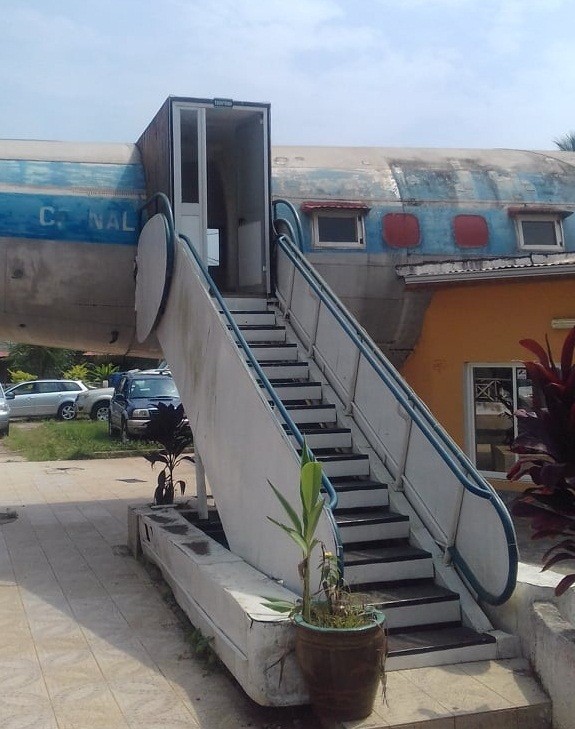
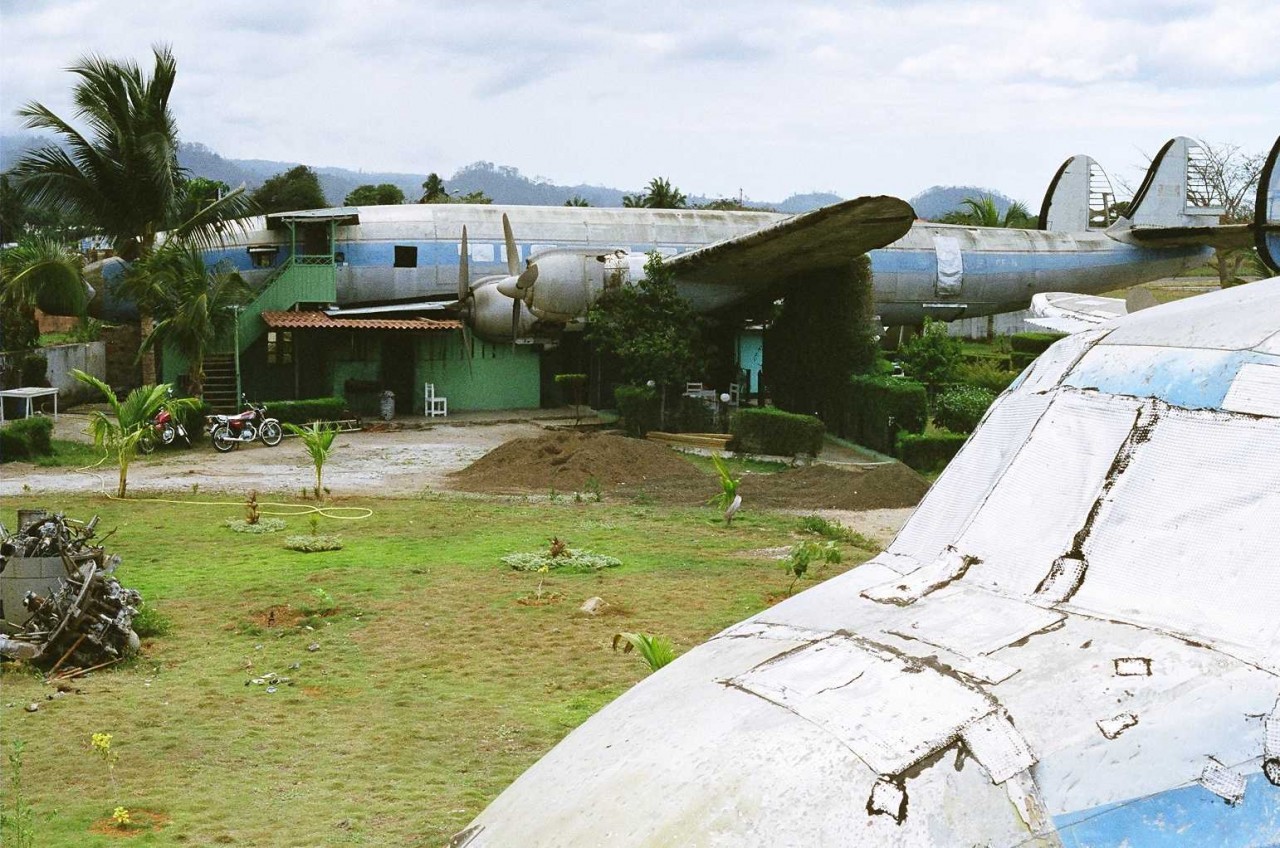
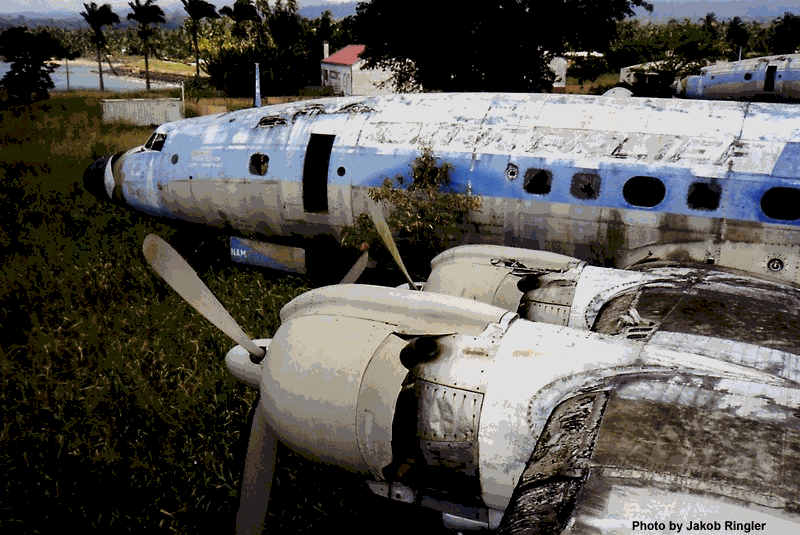
Some of the cultural landmarks which are of interest to the association are the two Lockheed L 1049H Super Constellation air planes which were used in the airlift into Biafra. Friends of Sao Tome and Principe has launched a campaign to “officially recognize as inheritance and preserve as monument” these two air craft and have made a proposal to their government to this effect. In the meantime, a Sao Tomean businessman, Mr. David de Mata, has converted one of the planes to a restaurant and the other to a discotheque, the idea being that it would prevent the plane from further detoriation. In an article published here – https://www.telanon.info/suplemento/2019/02/04/28600/patrimonio-nacional-ruinas-e-sucata/ Mr. Xavier says:

“What’s more, worrying comments now come to us about the deterioration of the structures of the two imposing Lockheed L1049H Super Constellation (“Connies”) planes near Sao Tome airport, which for a time have been preserved by the direction of the “As Asas do Plane” restaurant, which constitute the last remnant of the Biafra relief bridge, a titanic effort undertaken by a handful of international NGOs in the late 1960s…The risk of final destruction causes us special sadness to those who, from all parts of the globe, call for its preservation and suggest its conversion into a center for the study of historical memory…Its disappearance would constitute a new attack on history and culture, even against the memory of the dead in Biafra, a new act of total lack of sensitivity.”

Photos are taken from Friends of Sao Tome and Principe website. They show the Super Constellations in their present state.

SAO TOME 2

sao tome 3

RESETTLING WAR REFUGEES – STORIES FROM THE PEACE CORPS

THIS ACCOUNT WAS SENT IN VIA E-MAIL AND IS PUBLISHED HERE IN ITS ORIGINAL FORM)

I was a Peace Corps Volunteer from December, 1966, till October, 1969. I lived and worked as an Agricultural and Rural Development Officer. I started in the Keffi/Nasarawa areas and later moved to Jos and trained Benue/Plateau State community development staff. I also had many Tiv and Idoma friends and spent time visiting those areas as well as doing work in some of those communities. So, a good portion of my time was spent on the fringe of the war area between North and South (Federal/Biafra). At the end of my stay (and late in the war) I led some refugee resettlement activities on the Idoma/Biafra boarder area.

Let me start with a few recollections:


“You must be Chinese.” 

As a Northern Nigeria Community Development Officer in the Middle Belt area (about November 1966 until about October 1969) I had a Morris Mini-Moke vehicle. I began as overseeing Community Development in the Keffi/Nasarawa area. Later, this was expanded to include the Lafia area, all just north of the Benue River. Later, I was moved to Jos and put in charge of Community Development and training of Nigerians for the area that included Keffi, Nasarawa, Lafia and then the Jos area.  When the War began I often traveled throughout the area of my responsibility and into areas south of the Benue River which became part of the new State that I was working with.

One event that characterized the environment in the early part of the war (probably about late 1968) involved my traveling towards Gombe together with another Peace Corps Volunteer who lived in Lafia. We were doing some travelling towards Gombe in my Mini-Moke vehicle. There were many road blocks throughout the middle belt and north of the area of fighting. As we were driving north, we were stopped at a road block. There had been a lot of publicity regarding the Chinese assisting and supporting the Biafrans. My Peace Corps friend was about 5’ 7” tall and had black hair. Once we were stopped, the soldiers at the road block told us they were on the alert for Chinese spies and they felt that my fellow Peace Corps volunteer was likely to be a Chinese spy – he was short and had black hair and “looked like” he might be Chinese. They held us for several hours until an Officer came and decided that he seemed to be a European rather than Chinese, so that we could go. Scary, with soldiers, who had guns and thought that we, or at least he, could be a spy and a sympathizer to the Biafrans.


“Too late for a beer. Thank Goodness.” 

Early in the War I would be touring from Jos to check on Community Development project and personnel below the Benue River. There were lots of military and numerous road blocks, etc. I would usually go to Makurdi late in the afternoon and go to my Nigerian friend’s place. I’d usually wash (out of a bucket of water) and eat fufu with him and his younger brothers, and then we’d go to our favourite bar for a couple of beers and listen to live music. We had our favourite place where we’d so enjoy to spend time. This particular day I had started later and got to Makurdi later than usual. I washed, ate and then we talked and decided that it was too late, and I was too tired to go to our favourite place. That evening, a Nigerian soldier had been drinking and apparently was rejected by a women he fancied. He left the bar and then returned with a hand grenade and threw it into the bar. This is the bar we would have been at and the time we would have been there. We missed it. There were probably four to six killed and another dozen injured.


“Refugee Resettlement, go home.” “What’s in it for me?” 

I was tasked with leading a group of Nigerian community development workers from the Benue-Plateau State to do refugee resettlement work in mid to late 1969.  We were sent to an area South of the Idoma area of Nigeria, what would be in and near what would be described as North Western Biafra. There were about a dozen Community Development trainees from Benue-Plateau State that I took into this area.  We were working in a border area of Biafra and Federal territory that traditionally had three ethnic groups – the Ezis, Ezas and one other group that I can’t remember. Two were sympathetic to the Federal Government and one to the Biafrans. They traditionally had not gotten along. In the early stages of the war the Biafran sympathizers together with Biafrian soldiers swept north and drove the Ezis [I think] and the other group out of their traditional areas. Basically, everything was destroyed. Later, as the Federal forces returned to the area, the Ezis and the other tribal group swept back in and destroyed everything else standing in the Ezas areas. So, here we were coming into an area that had had tens of thousands of people previously and now had almost no one living in these areas and nothing standing except perhaps two to three cement buildings.  Our job was to get people to move back, especially prior to growing season. Those moving back would be the Federal sympathizers at this time. There were no roads, no bridges, and no buildings (except perhaps two that we were staying in – sleeping on woven mats on cement floors). Nothing remained in this area. We worked to open rough bridges and roads, and get things ready for rebuilding and resettlement and have time for planting. Most of the pro-Federal populations had been driven and evacuated (I don’t know where the Biafrian sympathizers went). Most seem to have gone to the Idoma area to Oturkpo. They were put up there and fed and housed and given as much care as was available. As we tried to get people to move back to their “home area” we held meetings and tried to do what would make returning quickly possible. And what we found was that almost all the people who had been living out of their area said they didn’t want to come back if there wasn’t going to be running water (in Oturkpo there were pumps at the end of each street), or if there wasn’t going to be zinc roofs (they had lived with mostly thatched roofs), or if there wasn’t going to be electricity (they had electricity each day for about twelve hours), why should they come back and leave these things behind?

I returned to the US on home leave…..before any of this got worked out so, I don’t know what happened. But, at the time I left, hardly any wanted to come back “home”. And the Biafrans who had been in the area before all of this? I have no idea what happened to them.

-John McComas


FROM VOLUNTEER TO RELIEF WORKER – STORIES FROM THE PEACE CORPS

(THIS ACCOUNT WAS SENT IN VIA E-MAIL AND IS PUBLISHED HERE IN ITS ORIGINAL FORM.)

Dear Vivian,

After so many years what I have written about my time in Nigeria during the Biafran war seems very slight but I hope it may be of some use to you. I’m always happy to answer any questions you might have, to elaborate or clarify anything if I can. Good luck with your project and please let me know the result.

In the spring of 1966 Peace Corps group XX, which trained at the University of California of Los Angeles for two months, arrived in Nigeria where volunteers were spread throughout the east and mid-west of the country. Initially I was assigned to teach English at a manual arts cum teacher training college in Asaba but when the school closed I was reposted to a newly opened Catholic manual arts training school in Onitsha across the River Niger where I taught sewing and cooking to young girls. The school was funded and built by Father Anthony Byrne of the Holy Ghost fathers, a dynamic kindly man with a keen sense of humour, who became well known for his courage and initiative in food and medical relief flights from Sao Tome to Biafra. The supervisor for the domestic science program at the school was the bubbling, highly competent Sister Felicitas (I’ve forgotten her order) who also worked at the Borromeo hospital in Onitsha that was staffed by lay doctors and nuns. I later heard she dragged a water tank several miles on her own to help those in need at the height of the war.

I had been in Nigeria not quite a year and a half when the war broke out. Tensions mounted, and one day the bridge across the Niger was closed, cutting us off from the rest of the country. There were food shortages and rumours flying that war was imminent, and a curfew was enforced. One morning a man from Peace Corps headquarters in Enugu appeared to say that I had an hour to collect a suitcase of belongings before the evacuation of PC volunteers in our sector of the eastern region of the country would begin. Those of us in Onitsha and close by crossed the Niger by boat and were met by a convoy from the US embassy headed by the consul, a Mr. Kennedy, who took two of us home to dinner. Eating shrimp jambalaya by candlelight off gold bordered plates with the US embassy seal seemed another world from what we had left behind, making the prospect of war seem unreal.

A year and a half later when I was living in the US I was contacted by a former PC volunteer recruiting people to return to Nigeria as relief workers. I went back to Lagos in January 1969 to work for Unicef, seconded to the International Committee of the Red Cross who were coordinating relief efforts. The Nigerian civil war had been in the headlines constantly during my absence from the country, with harrowing stories of the suffering in Biafra, where I had once been, so I jumped at the chance to help. My job was to report to the head of mission in Lagos on food relief to children in areas near the border of the war, and supplied through Calabar. At this juncture most of the major relief agencies worldwide were operating in my area, such as Oxfam, Save the Children, USAID, Protestant church groups and CARE. The Catholic priests and nuns already in the country before the war stayed at their posts, except for a few such as Father Byrne.

I was stationed about 2 miles from the front in a small village that was occupied by relief agencies that used the buildings for accommodation and ware housing for relief goods, most notably the German Red Cross who had sent doctors and nurses and staff already experienced in disaster relief, all of whom seemed far better suited to their jobs than many people I met. They had their own well stocked warehouses containing donations of clothing, bedding, and much else that came from many sources from what I saw, including surprising things like patchwork quilts from the USA (I still have one I used as my bed). The German Red Cross carefully controlled the distribution of these goods, partly perhaps because of the inevitable siphoning off of so much aid that was being sold in local markets instead of being given to those in need. However, I remember feeling frustrated that we couldn’t get the GRC to release more goods for distribution, even by trusted workers. There may have been corruption among the foreign aid workers, thou I never heard of it. All distribution of food, medicine, clothing, etc. was supervised ultimately by Nigerian nationals, as required by the Nigerian government, so they were ultimately responsible for ensuring aid reached the people. One of the most disillusioning discoveries was the rivalry between some of the aid organizations, many of whose workers regarded aid work as a job like any other. We were all extremely well paid with all sorts of allowances apart from our generous salary, and time off for R&R.

I reported regularly to my superior in Lagos on the problems of food distribution, mainly to children, particularly powdered milk. The problem was to instruct the mothers how to prepare it properly, in the right proportions, using boiled water so as not to cause gastric problems. I remember seeing hungry people scurrying to eat milk spilled from a lorry, scooping it up with their hands. Milk and flour which made up the bulk of food distributed where I was, quickly spoiled in the extreme heat and humidity, resulting in a lot of waste. Grain was distributed, which posed a problem of grinding, and was shipped by helicopter from Calabar. I was often on the grain run, clinging to sacks branded with the USAID logo of two hands clasping with the motto: ‘gift of the people of the United States’. One of the pilots had been in Vietnam, and another was reputed to be an ex-British mercenary. One evening for his amusement he allowed his pet mandril to jump on my shoulders and run his fingers through my hair, something I’ll never forget.

Much of the food aid that came to Nigeria during the war was not fit for consumption when it arrived, and often was inedible before it was shipped. This dumping, masquerading as ‘aid’, served as tax write-offs for companies or corporations apparently, but it kept coming. There was certainly malnutrition in the area where I worked, but no real starvation. We ourselves lived on American army K and C rations. Some workers drove their Land rovers on bush tracks into Biafran territory and possibly helped people if they could, though this was strictly forbidden by the Nigerian government, the explanation being that it would only prolong the war. I heard stories from workers who saw abandoned burnt out villages, with bodies rotting unburied. I once crossed the border into Biafra and remember the eerie silence of a village where the houses were peppered with bullet holes which was a shocking contrast to the peace and order I remembered when I used to travel in the bush near Onitsha, driving my Volkswagen van full of equipment, including an oven devised from a kerosene tin.

I left Nigeria after four months and returned to Europe with my husband whom I’d met during this time. He was posted back to Lagos after the war had ended, and we stayed there for seven more years, during which time I saw the beginnings of a new Nigeria.  I had the chance to return to Onitsha once, driving cross country. I could hardly recognize the school compound where I had worked which was now a bombed out shell.  My thoughts went to Father Byrne, whose life’s work had literally gone up in smoke.

– Laura Murison

THE EVACUATION FROM BIAFRA – STORIES FROM THE PEACE CORPS

Another Biafra Story

Allan Hall

Abakaliki 1966/67


Dear Editor,

It seems that the FON letters to the editor are becoming an archive repository for Biafra War stories so I will put my two cents worth in for future researchers.

I was part of Nigeria 24 (Ag/Rd) which trained at U.C. San Diego and flew to Nigeria in 1966. I was stationed in Abakaliki which was located near the Northern border. I partnered with Keith Hill and our job was to assist the Ministry of Works in constructing reservoirs using heavy earth moving equipment. The reservoirs contained water that was filtered so that villagers would have access to clean drinking and cooking water. We continued working on projects that were started by Dale Lamski whom we were replacing. He taught us a lot about the realities of Peace Corps life. We were housed in little tin shacks that we moved from project to project. One such location was in the same compound that former FON president Mike Goodkind lived.

Soon after we arrived Biafra seceded the war broke out. Periodically while sitting around a rest house drinking beer and munching on ground nuts an ex-pat would come over and recommend that we should go to Enugu because things were about to get hot militarily speaking. Except for getting there it was great fun for us to stay at the Presidential Hotel, eat well and socialize all on the Peace Corps tab. But getting to Enugu was a challenge. In most of Biafra there were three types of roadblocks; Police, Army and Civil Defense. The Police roadblocks were the easiest as they were manned be police who were reasonably well educated, trained and fairly well informed. The army checkpoints were challenging and time consuming as they were suspicious, lower rank and well-armed. The Civil Defense roadblocks were the scariest as they were usually manned by uneducated elders (all the younger men having gone to the army) who were armed with Dane guns and who were full of rumored “information” about white mercenaries (or was it missionaries).

Eventually the Biafran army came and commandeered the earth movers, tractors, dump trucks and anything else they could use in their war effort. The Peace Corp. took the stand that it was going to tough it out in this “police action” and not be seen as an organization that would cut and run at first sight of violence. After five or six trips back and forth between Enugu and Abakaliki we were finally advised that the total blockade around Biafra would be lifted temporarily so that we could evacuate. A Greek freighter was to sail into Port Harcourt in two or three weeks and all volunteers were to be transported out of the country and harm’s way.

The Peace Corp staff had mapped out every volunteer’s location and drafted pick-up assignments. I was in charge of one of the three or four van convoys. We were to drive from Enugu to Port Harcourt picking up volunteers on the way. The hardest part was coming into a village or small town, finding the PCV and informing them that they had about 20 minutes to pack 44 pounds of luggage say good bye to their friends, neighbors, chiefs, Headmasters and students they had lived with for months or years and leave.

Every convoy had a personal letter of passage signed by Col. Odumegwu  Ojukwu himself.  So we should have been able to breeze down the road through the roadblocks. Unfortunately, the ones manning them who could read did not believe that such a god like figure would write such a letter for mere mortals, so it was useless. My first passenger was not a volunteer but the director, Del Lewis, which was an asset except when, early on, we happened on a civil defense roadblock. Because Del, an African American, didn’t speak Igbo the locals were convinced that they had discovered a Hausa or Fulani. Seeing them put a Dane gun to his head was one scary sight. I didn’t realize that I could speak Igbo so fast to calm the situation but we got out of their by the skin of our teeth. What was both humorous and frustrating was coming upon three roadblocks in a row each within sight of the other (police, army and CD). Each one searching the suitcases or backpacks or purses. Mostly they were curious about what these Europeans hid in their boxes.

After picking up our assigned volunteers we arrived in Port Harcourt in time to board the Greek Freighter. They had made rectangular markings on the floor of the ship’s hold and each evacuee was assigned a space for the trip to Accra, Ghana. I don’t recall much about the trip except that we drank a lot of wine and were fed peanut butter sandwiches and got sea sick. Once in Accra we were transported to University of Ghana in Legon. I remember a Peace Corps official, C Payne Lucas, giving us various choices of going home or to another country. He was especially convincing in the Peace Corps way of selling my group on going to Somalia (“they hate Americans, they spit on you and throw sand in your face”). So most of my group went there and I understand that that is pretty much what happened to them.

Four of us, Bob Claflin, Jon Seale, Jim Hammons and myself made our way to Malawi (where they didn’t throw sand in our face) to finish our Peace Corps careers.

——————-

(This account was first published in the Fall 2013 issue (Vol.18, No 1, page 12) of the Friends of Nigeria newsletter. It was sent to me via e-mail)


A GORY FOOTBALL GAME – STORIES FROM THE PEACE CORPS

(THIS ACCOUNT WAS SENT IN VIA E-MAIL AND IS PUBLISHED HERE IN ITS ORIGINAL FORM)

Hello again, Vivian,

Just wanted to send a few notes about my own Biafran War encounters in 1967 while serving outside Abakaliki in what was then the Eastern Region/Biafra.

Unlike most Peace Corps volunteers I was a rural development volunteer whose primary assignment was to establish oil palm cooperatives in the county just west of Abakaliki. After independence was declared, the people in my service area saw the potential upcoming chaos as an opportunity to revive old tribal loyalties. The people I worked with spoke a rural dialect of Igbo. We were, as I recall, about 10 miles from the Northern Region Border, whose residents were non-Hausa plateau people. While at peace for many years, the groups on both sides of this remote, rural border, apparently had festering antagonisms. When independence was declared a consequence was that the national police were reluctant to provide routine enforcement and patrols on the regional borders. One day a month or so before my termination from the Peace Corps, I drove with my Nigerian counterpart to a village where we had made contact throughout my two years but had no active projects. I forget exactly why we made the trip, but it might simply have been to bring my time to closure with the people who lived there. When I arrived at the local elementary school I saw a soccer game in progress. When I approached closer, one of the local Igbo men approached our jeep and pointed out that the ball they were using was in fact the recently severed head of one of their “neighbours” who lived across the border in the north. This moment was simply opportune to carry on long simmering hostilities.

This incident which seemed to have little or nothing to do with the contemporary Igbo/Hausa conflict was a good illustration of unintended consequences of war.

A few years later I served as an artillery crew person in the U.S. Army in Vietnam, where the political communist vs.democracy tensions served a rationale for a fairly major world conflict. The troops I knew saw little difference between the communist enemy we were fighting and the often corrupt South Vietnamese whom the American government touted as the torch bearers of freedom and civilization. Both my Nigeria/Biafra and Vietnam experiences were clear lessons about the complexities of war. In fact they were lifelong lessons. I have not been back to either Vietnam or Nigeria, but I’m hoping that those of us who were affected by war more than a half century ago are able to use our experiences to make something better than the horrors of war out of understanding the nuances of the world around us.

Just some quick notes, Vivian. My best wishes for success with your project.

Mike Goodkind

A MASS MURDERER OF CHILDREN – STORIES FROM THE PEACE CORPS

                                                           A Mass Murderer of Children

                                                                                    by

                                                         Tom Hebert, Nigeria 04 (1962-1964)


                          An Afterword of Far Away In The Sky: A Memoir of the Biafran War                                                                                          by

                                                              David Koren, Amazon, 2012

In the Peace Corps, Nigeria 1962-1964, I first taught English in a poor but progressive Moslem high school in Ibadan, the capital of the Western Region. For my second year, I transferred to the University of Ibadan to help found the new School of Drama. While Nigeria was then a vibrant, ringing place, living as we were in an official “state of emergency,” soon we all knew the country was hell-bent for civil war.

Biafra, initially rising out of resistance to Northern Nigeria’s ancient Arab-Muslim expansionism, with a sometimes romantic but short-lived existence (about 20 months), the nation began with an egalitarian, progressive Igbo culture that traditionally had encouraged independent thinking, enterprise, and personal, collaborative, and communal creativity, and learning.

This new country had entered the war with hope, skilled talent, a competent leadership combined with a practical vision for the future. Indeed, it’s hard to disagree with Odumegwu Ojukwu, the erstwhile leader of Biafra speaking in 1994: “In three years, we became the most civilized, the most technologically advanced black people on earth.”

If Biafra had succeeded, dependent as it was on invented appropriate technologies —small scale, labor intensive, energy efficient, locally controlled, and people centered  all contrived in the storm of war, today Biafra would likely be an African Silicon Valley or minor Switzerland.

The entrepreneurial piece of the vision was summed up in the Principles of the Biafran Revolution, commonly known as the Ahiara Declaration, a document written by the National Guidance Committee of Biafra and delivered by President Ojukwu as a speech on June 1, 1969.

“Finally, the Biafran revolution will create possibilities for citizens with talent in business, administration, management and technology, to fulfill themselves and receive due appreciation and reward in the service of the state, as has indeed happened in our total mobilization to prosecute the present war.”

In a 1994 retrospective speech Ojukwu demonstrated the fruits of Igbo/Biafran ingenuity:

“During those three years, we built bombs, we built rockets, we designed and built our own delivery systems. We guided our rockets, we guided them far, and we guided them accurately. For three years, blockaded without hope of imports, we maintained engines, machines, and technical equipment. The state extracted and refined petrol, individuals refined petrol in their back gardens, we built and maintained airports, we maintained them under heavy bombardment. We spoke to the world through a telecommunications system engineered by local ingenuity. The world heard us and spoke back to us. We built armored cars and tanks. We modified aircraft from trainer to fighters, from passenger aircraft to bombers. In three years of freedom, we had broken the technological barrier.”

Unfortunately for the future of Africa, where such a model for dismantling colonial empires along positive cultural lines was, and is, a desperate requirement, Biafra’s dominant image to the world was not a political one, but an image set by the competing relief agencies: starving, pot-bellied Igbo children, dying it was reported, by the millions. Which wasn’t true: hundreds of thousands only.

But the talented Biafrans didn’t have control of the relief effort. On Sao Tome, at least, it was mostly run by church-related Europeans who incessantly squabbled amongst themselves as they often do on their own constantly shifting turf. So while we UNICEF volunteers tried to get on with everyone, it was tough to blink the obvious that the war’s infernal famine could be at least ameliorated with some proven American know-how.

So, hearing that somehow a retired American Air Force general had been sent to Sao Tome to advise the airlift, I went looking for him. In a dingy cubicle I found Joe Smith, who had been the officer commanding the history-making Berlin Airlift during the 1948-1949 Berlin Blockade. According to Wikipedia, General Smith organized an airlift that flew over 200,000 flights in one year, providing up to 4700 tons of fuel and food to the Berliners whose supply had been cut by the Soviets.

Given my recent work in Vietnam (founding and directing combat-base USO Clubs), both of us were schooled in American logistical superiority. Yes, a former Air Force general and a former Peace Corps Volunteer with some experience of war had much to talk about. We understood that if Americans were running the show — had control of the airlift — jingoism aside, with even few aircraft a few can-do, cut-to-the-chase Americans could damn sure have got the job done. But it wasn’t in the cards.

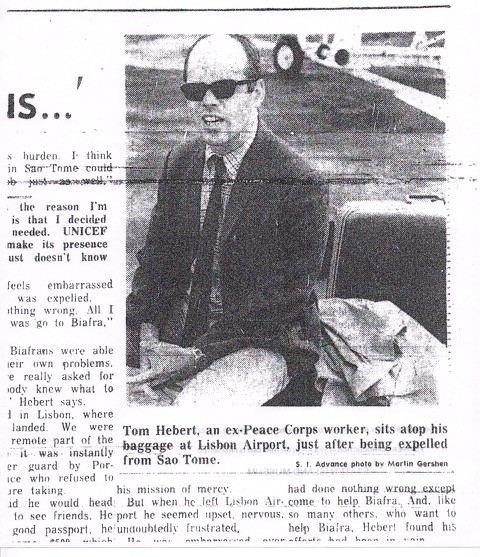
Gearing up to write this, I went to my cold and musty storage unit and pulled out fading files of my Biafra experience. Reading them for the first time in generations, on a torn, crinkly piece of primeval copy paper I first made out a barely legible newspaper article by the reporter Martin Gershen with his photograph of “Tom Hebert, an ex-Peace Corps worker sitting atop his baggage at Lisbon Airport, just after being expelled from Sao Tome.”

Part of Gershen’s interview on Thursday, October 28, 1968 during a return night flight to Lisbon on the Grey Ghost — a legendary gunrunning Biafran Lockheed Super Constellation — as published in the Staten Island Advance on November 17, 1968, “Nobody here asked for us…”:

“I could have stayed in Sao Tome forever if I went to work in the warehouses. But that job has the odor of a white man’s burden. I think the people in Sao Tome could do that job just as well,” Hebert says. “I guess the reason I’m in trouble is that I decided I wasn’t needed. UNICEF wants to make its presence felt but just doesn’t know how.” Hebert feels embarrassed because he was expelled. “I did nothing wrong. All I tried to was go to Biafra,” he says. “But the Biafrans were able to solve their own problems. Nobody here really asked for us and nobody knew what to do with us,” Hebert says. We parted in Lisbon, where the plane landed. We were taxied to a remote part of the field where it was instantly placed under guard by the Portuguese police.”

I also found my copy of the following letter, dated October 24th, 1968:

Biafran Special Representative

Biafra House, Sao Tomé.

Mr. Osuji

Dear Sir:

Today we are informed that Mr. Hebert’s clearance for Biafra has been obtained. Mr. Hebert would like to go in tonight to report to Dr. Middlecoop.

Yours respectfully,

Axel V. Duch, Captain,

Chief of Operations, NORDCHURCHAID

Well, that clearly didn’t happen. The letter grew out of my earlier chance midnight encounter with Mr. Osuji on a silent foggy street in colonial Portuguese Sao Tomé, softly lit by a bent old street light. In a strangely intimate scene, we talked of the war which was not going well for Biafra and the relief effort that chewed up so much money and energy and almost all of the world’s attention. As noted, the war had become not a fight for independence much like America’s own, but of relief planes and children with stomachs bloated from protein starvation — kwashiorkor. Mr. Osuji and I quietly shared a bitterness that night.

This TELEX, sent a day after my forced return to reality from a relief co-worker  to UNICEF in New York:

HEBERT DEPORTED LISBON YESTERDAY STOP REMAINING VOLUNTEERS REQUEST RETURN TICKETS IMMEDIATELY PLUS INFORMATION REGARDING POSSIBILITY TRANSFER LAGOS OPERATION STOP REPEAT STOP NEED OFFICIAL UNICEF INVOVLEMENT BIAFRA URGENTLY SIGNED DISGUSTED DAVIS.

Then, this November 4 TELEX to UNICEF from Mona Mollerup, of NORDCHURCHAID, a Danish non-profit much involved in the airlift:

DUCH INFORMS US THAT HEBERT WAS DEPORTED BY THE PORTUGUESE AUTHORITIES DUE TO DEMONSTATIVE, INSULTING BEHAVIOR AND AN UNCOOPERATIVE ATTITUDE. THE OTHER FIVE ARE DOING AN EXCELLENT JOB ON THE WAREHOUSES AND THE GOVERNOR HAS EXPRESSED HIS APPRECIATION FOR THEIR EFFORTS. GREETINGS.

The last is not all that Mrs. Mollerup said. From my notes: “Tom Hebert is a mass murderer of children!”

Well, that’s a load off.

Looking back, like Koren’s, my particular Biafra became the place my adult life really began — my training had ended. In a space of maybe three weeks, from the time of my arrival to my abrupt departure, my experience on Sao Tome underwent a sea change. Because I came to realize that the relief effort was a distraction, that what Biafra most needed was  1) political recognition and 2) rifles and cannons. Those were the co-themes of the First Nigeria/Biafra International Conference which a group of Returned Peace Corps Volunteers soon put on at Columbia University. I remember walking down a Senate hallway with several other RPCVs escorting an agreeable Sen. Ted Kennedy to a Senate meeting on recognizing Biafra. We also lobbied Nixon’s White House which, because of the media drumbeat of starving African children, was much concerned about Biafra to the point that recognition seemed possible. And I even rode up in an elevator with the famous Igbo novelist, Things Fall Apart and No Longer At Ease, Chinua Achebe!

But oddly, except as yet another African failure, Biafra has never since meant much to either Nigeria or the world at large. On a much later 1978 visit to Nigeria’s south-eastern region with a State Department team, I met with a state governor who had been a high Biafran official. Letting the others leave the room, I said, “Hail Biafra!” Stunned, looking to see if we were alone, he returned the salute,  “Hail Biafra!” As we talked that afternoon, for us Biafra had become a melancholy thing, with little impact—few noticeable effects and no heritage. Just a slight perturbation—a wobble—in Nigeria’s orbit — the one steadily degrading since 1962 to a Brechtian (nihilistic expressive) end. Shortly before the country, now a burnt-out case, likely crashes into the sun.

For me, could it be have been better? Yes. I could have been with David Koren in Biafra.

tom

LIVING IN SAINT-ANDRE REFUGEE CENTER, GABON – A FORMER CHILD REFUGEE’S ACCOUNT – PART ONE.

LEAVING BIAFRA

In 1968, just before Enugwu-Ukwu fell to the Nigerian troops, my family took refuge in my maternal grandparents’ home at Egbengwu, Nimo, a neighbouring town. When we got there, my grandparents’ house was teeming with refugees. The distribution center at Nimo was St Mary’s Primary School, and it was also completely occupied by refugees from surrounding towns like Enugwu-Ukwu, Nawfia, and Amawbia. One Irish priest, named Reverend Father Nolan, was in charge of relief distribution, assisted by other people such as Mr. Otie, the headmaster of the school. The Parish church was Assumpta Catholic Church but because of its location on the major road from Enugwu-Ukwu to Nimo it was close to the war front so it was not considered ideal as a relief distribution centre. It was on one of such visits to St Mary’s, in company of my younger sister, Rhoda, that Father Nolan announced that officials of CARITAS were coming to St Mary’s the next day to take sick children to Gabon. He told parents to bring their children who were ill the following day.

Although I was not suffering from kwashiorkor, I was frail and weak, so I made up my mind to present myself for consideration. I was just seven years old, but I saw it as a life-saving opportunity. My decision was not well received by my mother who reasoned that I was too young to be sprinted out to an unknown country beyond their care and reach. She broke down, saying, “Who is going to care and treat you like the mother who gave birth to you?” My dad, who was not known to give in easily to emotions, approved of my decision and offered to take me to St. Mary’s.

On arrival we saw babies, toddlers, and teenagers with bloated stomachs, swollen legs, and severely shrunken bodies, all looking like living ghosts. Many were too weak to stand, so they sat on the floor. Soon after, Father Nolan and Mr. Otie arrived with the CARITAS representatives. Mr. Igboka, the Catechist, was also there. When the selection started, all the kids in front of me were selected. I was rejected four times even though I buckled my feet on each occasion to create the impression that I was very ill. After my fourth rejection my father went into a tirade. This prompted the officials to call me forward, so I was the last kid to be selected that day.

The next stage was the documentation. The CARITAS officials wrote each child’s first name, surname, parents’ names, village and town, and the processing centre. Then they stuck an adhesive tape with identification number on our wrists. Mine was 492. This was the last documentation in Biafra.

As a green-coloured Austin lorry made its way towards us, my father came to me, shook my hands, and prayed that I would come back to meet them alive. My mother embraced me, sobbing. Other parents watched their children being loaded into the lorry, like cargo, and into an uncertain future. As our lorry slowly revved to drive off, I positioned myself to wave a final good bye to my parents. Years later, I learnt that my mother cried inconsolably for two days after my departure.

As soon as we departed Nimo, our chaperons informed us they were taking us to Ulli airport and from there to Gabon. On the way some children were crying. After some time our lorry stopped by the roadside so we could have lunch. It was either two small pieces of yam or one big piece placed on our palms.

When we got to Ulli airport, our lorry parked in an inconspicuous place waiting for the signal to approach the tarmac. I could see planes landing and taking off in the pitch darkness. After a long wait we drove up to the tarmac where a plane was waiting. For the first time, I saw an aircraft in a stationary position. The size was a far cry from the little bird-like thing we kids usually saw flying across the skies. We all came out of the lorry and a ladder was placed at the foot of the aircraft. Two big men positioned themselves, one at the foot of the ladder and the other at the top. One after the other, we were taken up the ladder into the aircraft. There were no chairs inside but there were blankets spread across the floor. We were given one or two cubes of sugar and asked to lie down. I could not remember when last I saw sugar in those terrible days, and I became excited again after the emotional separation from my parents. The door of the aircraft was shut, the engine started, the lights turned off, and I could sense a slow movement of the plane up to the time we became airborne.

We were woken up at Libreville International airport. My first impression was that this was real ‘obodo oyibo’ – a marvel. There were aircraft of different sizes and shapes, and that gave me the opportunity of seeing these planes at close quarters in broad daylight. Vans pulled up at the foot of our plane, and we all boarded. Those who were too weak to get into the vans were either helped in or carried inside. After a short drive our van pulled into a massive church complex. It was called St. Andre and the priest in charge was Monseigneur Camille.

———————–

The contributor, Johnny Abada, lives in the United States of America.

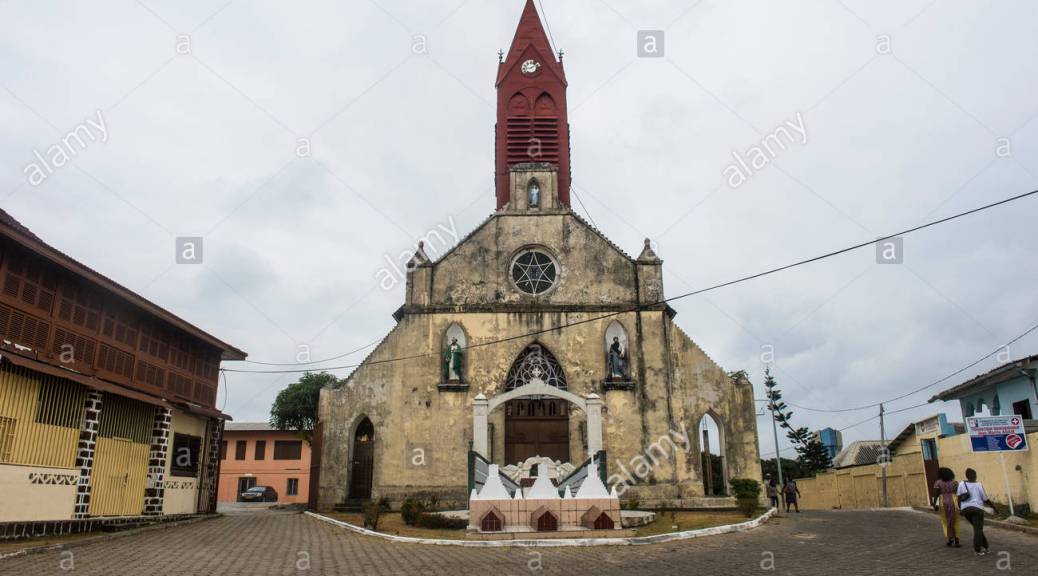
NB-The image on this post is taken from the internet. It shows St. Marie Cathedral, one of the centers used to house refugees during the Nigeria-Biafra war.


THE JAMAICAN WIFE

When our ship landed in Lagos most of the foreigners decided they weren’t getting off the ship. This was January 1966. The coup had already taken place. Dad decided we were going in. He had been given a job with the Water Resources in Lagos. So we got a flat at 51 Modupe Johnson Street, off Bode Thomas, Surulere. We were neighbours with the *Obas. They had three boys. And guess what? Their mother was also Jamaican. Six months later, the second coup took place.

One day we were told we had to move next door. And we were like, “Why?” But we packed up and moved next door. Before that my dad had gone out one day and come back with an Opel Record. It was a two door car. My dad was not around a lot. We thought he was going to work. Once in a while he would show up with the car. Sometimes he would leave the car and be gone. Then, one day he went out with mum and when they came back she had this baby in her arms.

Another day, dad was about to leave the house and I followed him. I was slow but when I got to the front window I saw him getting in the trunk of his car. I thought, “Why is dad getting into the trunk?” When I heard the rest of the story as an adult I realized that’s what he had to do to stay alive. I didn’t know where he was being taken. On reflection I think it had happened a few times but that was the only time I saw it.

One day dad shows up with the car and said, “You are going back to your grandparents.” That was the first time I would be going to Eastern Nigeria and I can proudly say I was stepping into Biafra because the Republic of Biafra had just been declared. On our way to the East we were stopped at the Onitsha Head Bridge by Biafran soldiers. They were saying they were not going to let us through. In the argument one of them slapped my dad. My mum grabbed a huge glass jug and jumped out of the car. She was waving it and threatening that the jug could break on his head if he laid a finger on dad. Jamaicans no dey play o. The arguments went on for some time and finally they let us go. From there we proceeded to our village which was not far from Onitsha.  That’s the last image I had coming into Biafra.

Tina – My mum didn’t speak Igbo and she had a foreign accent. The soldiers were cocking their guns as if to shoot us. The soldiers threatened they would throw my parents over the bridge into the water, which was far. I remember peering over the rails and the water seemed so far away. I don’t remember how the argument was resolved. We heard later from my dad that when he joined the army those men on that bridge that day were under his command.

Chinedu: Dad eventually joined the army and we were living with our mum in a flat off Edinburgh Road, Enugu. One time I got sick and mum was crying so much because I was in and out of consciousness. She came out looking for help but nobody was there to help, and tension was in the air.  She took me to Eastern Medical Centre and Dr. Okeke figured out what was wrong with me. Some weeks later, dad came back. He was a Civil Engineer and had gone for Officers Training. He told us we were going to the village, so we took off. That’s where we spent time with my grandparents, uncles and other relations.

Our house in the village was right on the Enugu-Onitsha road. That’s where I got the experience of a mass return. Everyone was heading towards Onitsha. It was a mass migration. Years later I was in America when Rwanda happened. I was watching a TV report about the crisis when I saw the mass of people trooping down the road with their luggage on their head. My body just started to shake because it brought back a lot of memories.

Tina: Another vivid memory I have is that everybody left the compound but my mum refused to leave. She felt that if she left our village my dad wouldn’t know where to find us. So we were sitting on our suitcases in front of my grandfather’s house waiting, and waiting. Dad was at Nsukka at the time but somehow he got a message that we hadn’t left with the others, so he sent his driver, Felix, to get us. We’d be dead now if it hadn’t been for Felix. [Laughter.]  Felix arrived in a station wagon and somebody helped him to bundle my mum into the car. We couldn’t take any of our belongings. We just jumped into the car and sped off. We didn’t realize how much danger we were in. That’s the strange thing about this – I can’t remember feeling frightened. In our escape Felix had to avoid all the major roads so he wouldn’t get caught by the soldiers.

Chinedu: Another memory I have was that dad buried his car during the war. Then he built something over the pit and covered it. After the war he dug it out and that’s what I used to learn to drive in 1973. I was 11 years old. [Laughter]

After our escape Felix took us to Ogbunike. The whole family was there and that was where we started seeing signs of the family not wanting to pay attention to us. It wasn’t blatant but it was happening. They were probably worried about what limited resources they had. When it came time to share food they weren’t including mum.

[Tina turns to Chinedu.] What was it about a bag of sugar?

Chinedu: Nicky was the size of a bag of sugar. That was the argument Dad gave Mum to convince her to leave. Nicky had not been fed well and therefore not grown to the normal size of a one year old, but she continued to stay in spite of all we were going through not getting enough food for five of us. He said it was better for her to take us back to England where we would be better cared for.

My grandfather also told me he didn’t like the way his children were treating us. They were doing it because they were looking out for themselves and we were foreigners. My mother, being Jamaican and her first time in the country, not able to speak the language, felt isolated, and my dad was not around.

Vivian: Maybe they felt you all were privileged, or they thought you should not have come back home.

Chinedu: Daddy was the reason they were getting all that salt and tinned food. Had it not been for him they wouldn’t have had anything. When you are not seen as part of a group you are treated as an outsider. Those things happen. To be accepted we had to work really hard. I remember the fight my mum had with my grandmother. She was dealing with that stress of not being given her own share of things. A knife was drawn but a lady who lived in the same compound separated the fight.

Dad’s division was under Cornel Achuzia. They used to refine oil so they always had fuel which they’d sell to buy food. My dad always sent someone to drop off the food, so we seemed to have food even when others didn’t. I remember eating a lot of crabs. Today, I do not like crab meat.

I remember we had five chickens which traveled with us as we moved from place to place. Each of us owned one and assumed ownership of it. The eggs were a steady source of protein. If my uncle Emeka felt like eating chicken he’d murder one of the chickens at night. [Laughter] He would come in the morning and say, “Nnaa, this chicken all of a sudden died.” And we’d have to cook it.

Tina – I remember thinking at the time that if the chicken had died of a disease and we cooked and ate it then whatever had killed the chicken would affect us too.  To be honest I don’t think I eat any of those chickens that had died in mysterious circumstances. It hadn’t occurred to me that it was my Uncle doing it.

After we left for Ogbunike there was a battle in our town, Ifite Dunu. It was known as Ifite-Ukpo then. Most people know about the battle that took place in Abagana, the town next to ours, but not the one in Ifite-Dunu. When the Nigerian soldiers came in to our town most houses were mud houses. They saw this big structure and moved in. It was my Uncle Cyril’s house. He had won the Jamaican Sweepstakes before the war so he was like a millionaire. He had houses in Onitsha and Enugu. After Enugu fell, the Biafran army made their way back and regrouped. Dad and his group decided they were going to attack my uncle’s house and dislodge the Nigerians. They succeeded, but the house was riddled with bullets. Even in 1973 when we came back from the UK we could still see casings all over the place. Uncle Cyril refused to fix the metal bars or repaint the walls. He just patched the holes.  He wanted a reminder of what happened because he lost his brother during that war.

Tina: There was a lot of traveling between places. We had to keep moving, sometimes we’d walk, sometimes my dad would send his driver to take us to the new place. Each time we were traveling the driver had to get out of the car to check the roads, because if there was a mound or something unusual on the road they were worried it was a mortar.

One of the places we stayed at was a school, I think. There was a field in front of it, and every foot of this field was covered in sharpened bamboo sticks. Each one was about four to five feet in height and so towered over me. We were told they were put there so that if Nigerian soldiers parachuted from their planes they wouldn’t survive the impact. I remember playing in this field, weaving in between the bamboo sticks oblivious to what they would do to a human being landing on it.

We spent some time at Abatete and Umunze. In one of these places we could stand on our veranda and see the fighting. It looked like a firework display.

There were two bunkers side by side. Our bunker was muddy and hadn’t been built properly so the walls were caving in. On this occasion we had to go to our neighbours bunker during the air raid. Our own collapsed and we were lucky we were not in it when that happened. On another occasion there was an air raid while we were playing away from the house. We hadn’t realized that we were so far away from the bunkers. We tried to run but everybody was shouting at us, “Lie down, lie down, lie down.” So we lay down in that field and we were watching the plane zoom past and come back, with a smoke trail, and then somewhere in the distance there was an explosion, boom, boom, boom, boom. The owner of the house where we were living, a reverend or something, drove down to where the sound came from. He had gone to pick the wounded and take them to where they could get help. When he came back he had to clean out his car. Everybody gathered around the car. I remembered this vividly. I struggled and pushed my head in between somebody’s legs and saw…whooo…I had never seen that amount of blood. That day was something else.

As I recall, I don’t remember fear. I don’t remember being scared. I just remember not liking certain things, not liking being in a different place, not liking how I had to be on the floor, because whenever we slept on the floor our faces would swell up. So if there was anywhere off the floor for me, Chinedu and Ifeanyi to sleep, we slept there, while Indy, Nicky and mum slept on the floor. They didn’t react as badly to sleeping on the floor as we did.

Chinedu: They were Nigerian born, that’s all I can say. [Laughter]

Tina: One of the things I don’t like, even now, is carrying bags when travelling. I make it a point not to. Where possible I check in all my luggage. I think it’s linked to the experience of moving from place to place. It didn’t matter how young you were, you had to carry something. It didn’t matter if your arms were tired you just had to carry things because you would need these things.

I’m sure we were traumatized because there’s no way you go through that experience without sustaining trauma, but you find a way to cope with it probably by blocking things out, because you have no choice.

Chinedu: You know what is Mkpor n’ani? When that thing goes off, my heart still skips. If I know it’s going to happen, then I’m fine, but if it happens unexpectedly I get agitated. And right now I haven’t watched any videos of refugees in the North East. I will watch clips of dead people but haven’t watched clips of people in IDP camps.

Vivian: Tell me how you were evacuated.

Chinedu: I remember the plane at night. I remember everybody hiding. Next thing you know, people were going out to the plane with lanterns. These people running with lanterns, where are they going? I didn’t know they were going to light up the runway. [Laughter] Those pilots, if I ever saw one, the kind hug wey I go give the guy erh? Imagine the planes in that kind of darkness. And African darkness is very dark. There’s no moon light. It is total darkness. And that lantern was just barely giving him light. Everybody rushed to board, but mum was still fighting, saying she wasn’t going. At the door of the plane she was still refusing. She’s a stubborn woman. That’s when we knew daddy wasn’t coming with us.

After the pilot taxied and turned around, na rush o, because there was no time. The Nigerian soldiers were shooting at the plane when we took off. It was a cargo plane. There were no chairs. And we were sitting on a bench. I remember the plane taking off and the benches falling. And once the plane took off it had to fly up at a sharp angle, to get fast above the line of fire. I know it was last week of November or early December, because we spent Christmas in Las Palmas, the Canary Islands. We remember the other people who were in the plane with us. One of our parents was either West Indian, or American or European. We flew to Sao Tome and from there to Equatorial Guinea, then Las Palmas in the Canary Islands, and finally London.

My dad never joined us. He had been promoted to a Lieutenant Colonel a few days before the war ended. He was hit in his neck by shrapnel. He spent the last days of the war in hospital, and another six months recovering. After he recovered he came to London to see us.

When everybody was being given twenty pounds my dad sold his wedding suit to a Nigerian soldier for fifty pounds. He hadn’t dug out his car yet. He said if he had dug it out they would have taken it. So, he sold his suit and had some money. And for a guy to say, “I am going to give you fifty pounds for that suit,” that was a lot of money back then. Some of those Nigerian soldiers were not bad people. They were doing a job.

Tina: Another impact I didn’t really know the war made on me until now is that when I go shopping I always buy a lot, usually much more than I need to. I always stock up so that if anything happens we will have something. That experience of not having what you need when you need it, and even when you did have it, it was never really enough. There’s a phrase I use to describe myself, “I am a war baby.” So the way I use that phrase is that no matter how little food or resources I have I’ll share it, not even manage it, I’ll share. I believe that when there are other people around you who are hungry and in need, and you have a little food and a few resources, you will have to share it. I practice this daily and I think that this is as a direct result of my war experience.

Chinedu: For me it’s my phobia for crabs. [Laughter]

Tina: We all went back to Nigeria in 1973, three years after the war ended.

Recently we had my mother’s DNA tested and we found out she’s sixty one percent Nigerian

BOYS’ COMPANY

The wounded soldiers were coming back to the village and telling us what was happening at the war front. They were showing us how to dodge bullets. They were carving guns with wood and giving us, teaching us how to do manoeuvres. They were preparing our minds to fight. But nobody told me how to dodge air raids. So, the first day it happened, I didn’t know it was air raid. I was fishing with my friend, Monday Iroegbu, from Amaogudu Otampa,  and I was wearing a red T-shirt. The bomber dropped nine bombs into the river. I was counting the bombs as they were being dropped, out of sheer curiosity. Monday is still alive and can corroborate this story. Some of the bombs exploded but many did not. We started running so they started spraying bullets at us. I got to one big tree and ran behind it. The helicopter lowered and parked in our ama, our village square. It was piloted by a white man. I believe they wanted to catch me alive. They just wanted a prize, a trophy. I ran into the bush and our people who were already taking cover there said, “Oh, remove your red shirt, remove your red shirt. That is why they are bombing this place.” So I removed it and threw it away. At the end of the day we came out and started counting dead bodies.

People were losing their homes because of the advancing enemy, but there was community assistance and collaboration. When they move to another community the people there will accept them. My grandmother took in over twenty people just because they were Ndigbo who were running for their lives. She was a local midwife so she was quite popular. We gave the refugees part of our farm land and they built temporary accommodations on it. We cooked communal food and shared to them. They were with us for almost four months before the war got to us and we became refugees ourselves.

We were hearing about the war on the radio, but majority of the things they were saying were propaganda. So, even when it was getting closer to us we didn’t know. When the soldiers eventually entered our community my mother said she was not going anywhere; that she won’t run from Lagos to the village, and then start running away again. Almost the entire community ran away but my mother was busy frying and selling garri. I said, ‘Mama, ndi mmadu a gba chaala oso – other people have run away.’ She said to me, ‘Nwa m’, ebe ariri nwuru wu ili ya – wherever the millipede dies is its grave.’ My sister came out of the bedroom and said, ‘Mama, if I die my blood is on your head.’ My mother was shocked. She said, ‘Who said that?’ I said, ‘It is Ifeyinwa.’ She said, ‘Ngwa, ngwa, ngwa – hurry, hurry, hurry, let us go.’ That is how we started preparing to leave.

The day our village collapsed, there was an old woman who couldn’t run because she was blind. Her name was Nneoma Ukazim. We used to call her Nne. Her children were in the army. One of them was working with the Nigerians against our people and later became the chairman of the Liberated Isuikwuato Area. So, there was nobody to help her. She was just trying to feel her way around, touching walls and fences. I told my mother that I wasn’t going to leave the old woman. So I took her. We got to a small river where two palm trees were placed across to make a bridge. The old woman couldn’t get on it so I, a ten year old, I carried her on my back to the other side. A Biafran soldier who was running from battle saw me and assisted both of us until we got to a safer place. Surprisingly, she survived the war and I became her confidant, to the extent that she told me her burial plans and gave me the clothes she wanted to be buried in. She died in the 70s.

We slept in somebody’s house the first night. The next day the shelling started in that community so we moved again. We kept moving. We moved about four times. The first place we ran to was a town called Ezere in Isikwuato. Some people ran to a place called Isi-Iyi. The war never got there. They said the deity in that place prevented the soldiers from getting there; that the people who ran there were safe. No bombs, no bullets.

A lot of people got lost due to the sudden movements. My sister, Florence, almost got lost. She went with other family members to Umuobiala, another community in Isikwuato, to visit my aunt, Mrs. Chidinma Ojiaboh. The day she was to come back, the shelling started. That day was what we called Church Ahia, when our market day falls on a Sunday. This happens once in eight weeks, and it is celebrated in a big way, like Christmas or Easter. So she couldn’t come back. And we couldn’t go to her. Even my aunt she had gone to visit, they left her and ran away. So my sister was running alone in a bush between Umuobiala and Afo Ugiri, when the vigilante found her. They were also called Civil Defence and were the liaison between the civilian population and military authorities. When they identify orphans they take them to the Red Cross. They assumed she was an orphan because she said she didn’t know the whereabouts of her parents. They took her to a camp where other children were waiting to be evacuated. But during the documentation one of the soldiers recognized her. He was from our village. That was how he sent us a message across enemy lines. We moved, me and my mother.

The Nigerian soldiers were still sleeping when we got to the check point, so we sneaked through their backyard. It was when we were coming back that they caught us. They asked us where we were coming from. They said I was Ojukwu soldier. I denied several times. They were convinced that Biafra was using child soldiers, which was true. They were using child soldiers to steal for the army. I was one of them. They called us Boys Company. They will send us to steal food and clothes. We will wear only our shorts. They will shave off our hair and rub oil on our bodies so that if they catch you, g’a gbu cha pu – you will slip away. We even stole guns and ammunition. Those who did very well in the training were given real guns which they called Ojukwu Catapult. They very small submachine guns and were easier for young boys to carry. The training was two weeks. They taught us manoeuvres, weapons handling, parade, how to recognize the enemy. Those of us who were born outside Igbo land spoke different languages. I was very good in Yoruba so it was an advantage. When the Nigerian soldiers catch you, you speak Yoruba to them and they say, ‘Omo ale, just let him go.’ My uncle was in the BOFF, the Biafran Organisation for Freedom Fighters. The day they caught him he started speaking Hausa. He was very fluent in it. Very fair in complexion. He said he was Dan Kano, that he was from kano. They asked him all manner of questions and he answered correctly, so they went drinking with him. He escaped and came back to tell us the story.

There was even an airstrip in my community where lighter air craft used to land. It was in that vast land between Okigwe and Uturu, right from where you have ABSU up to Ihube. During the war it was called Ugba junction because there was a big Ugba tree there. They camped Nigerian soldiers on that land. But before it was captured by Nigeria, Biafra was using it as an airstrip. Before our place fell we were the ones protecting the airstrip. We used to put pongee sticks all over the fields so that no aircraft will be able to land. At night when our own planes are coming in, because we already know they are coming, we will create a path for them to land. The flights were a collaboration between the Biafran Air Force and some foreign bodies. Some of those journalists who came, came as aid workers. Some were bringing arms and relief materials, and also helping to move children of well-to-do Biafrans out. These are stories that will not make the headlines.

We had uncles and brothers who were working for the Biafran government digging trenches. Those trenches were dug by civilians, not by soldiers. They were using older men who were too old to fight. They were also using them for propaganda. They will go and dig trenches and come back with information about the enemy.

Where you have Stella Maris College at Uturu, there used to be a rehabilitation center for wounded soldiers. They called it Hope Ville. They were making shoes and all manners of crafts during the war.

Biafra was very organised. And everybody contributed. My parents contributed. I contributed. They called it Win the War effort. Everybody made contributions to that war. If you were making baskets, you donate them to the Biafran Government. Anything you can provide – farmland, houses – you give to the government. When they need an office, you vacate yours. Biafra succeeded because of communal efforts and that was why the war lasted for so long. The Nigerian army thought they could over-run the entire South East within days. But Ojukwu miscalculated. You have no arms, no bullets, you say you are waging a war. So those who are talking about Biafra did not witness the war, they are doing it because of the marginalization in Nigeria.

Certain communities were even divided. Nigerian soldiers on one side and Biafran soldiers on the other. People used to sneak across to the Nigerian side to buy food and other things. They call it Ahia attack. I was following my mother to these markets. Some of them were designated as Ahia Ogbe – market for the deaf and dumb. Because of the air raids. These markets were held in the forests and only sign language was used. One day I escorted my mother to a market in Ishiagu to buy yams. We walked the whole day. I was carrying three long native baskets – abo. Inside the baskets I had yams and Adu, which is like cocoyam. My mother was also carrying a basket. Do you know that at every road block Biafran soldiers will take one yam? By the time we got to our village our baskets were almost empty. I cried that day and I said, “God, do not allow Biafra to win this war because if we do we are going to see worse things.” Ojukwu was no longer in control. The soldiers were hungry. They were committing atrocities in the areas they controlled.

The hunger was so much that one day we ate the wild variety of Una, the one called unabiwu. There was nothing else to eat. We said if bullets don’t kill us something else will kill us. After the meal, we slept for four days at a stretch. We didn’t wake up for four days. It probably contains very high levels of cyanide. We were lucky to have even woken up. On another occasion we ate a wild variety of beans. We bought it mistakenly, and it almost killed us. I was the first person it affected because immediately after eating I started having hallucinations. They gave us palm oil and coconut water, and that was what saved us. The only person who wasn’t affected was my sister, Florence, the one who was found in a forest. She had a stronger constitution.

Just like my sister, my father was presumed dead during the war. We mourned him. They put something in the ground and conducted a symbolic burial for him. It was after the war that one of my uncles ran into him in Liverpool, England. He asked him what he was doing in Liverpool and my father said, “They told me my wife and children are dead. What am I coming to do in Nigeria?” My uncle told him we were all alive, that only one of us died. My father said, “What of my wife?” My uncle said, “Your wife is alive.” What happened was that my father was in the navy and Nigeria wanted them to bombard Port Harcourt with the NNS Aradu. He and his colleagues refused. They diverted the ship and abandoned it at sea. They were rescued by a Congolese fishing boat which took them to Congo. President Sese Seko granted them asylum and facilitated their move to England. The Nigerian government recovered the ship but it’s no longer sea worthy. After the war my father came back to the village, but we had to undo the burial we had done. They performed some rites before he could enter the compound. The government arrested him, court marshaled him, and sacked him with no benefits. He eventually became a sailor and that is what he was doing until he retired.

Anyway, after interrogating me and my mother at the check point, the Nigerian soldiers let us go. We brought my sister back. By then we had been liberated.

-Richard Harrison

[Cover photo courtesy internet]