
I was born in Gusau but my earliest recollection of life was in Funtua. My father worked for Societe Commerciale d’Outer-Mer Automobile Nigeria (SCOA) as a District Manager responsible for trading and produce-buying, so we lived in different parts of northern Nigeria. He was a respected leader within the Igbo community, and recognized by the Emirate Council as the Igbo man to go to on matters that had to do with communal relations. At that time, the Igbo State Union was very strong in the north and once they took a resolution it was binding on all Igbos across the region.
About a year before the January 1966 coup, my father decided to take an early retirement because a friend of his in the Emirate Council informed him that a political crisis was brewing between Northern and Southern Nigeria which might boil over into violence. His friend advised him to leave because his name was top on the list of Igbos to be eliminated. My mother didn’t want to follow him immediately because she had a bakery, a chemist, and some other businesses, and was reluctant to start all over in an unfamiliar business terrain. However, they reached a compromise that she would move to Zaria, where he had a house, and where a lot more people from my hometown resided. Their thinking was that the large numbers of our people in Zaria would be able to defend themselves in the event of violence better than they would in Funtua.
In January 1966, I gained admission into St. John’s College, Kaduna. In July of the same year, the revenge coup took place, and the massacre of Igbo civilians started. As students, we lived within the relative security of the boarding house but as day students came with horrific stories of what was happening outside, I became deeply concerned about my mother and siblings in Zaria. I went to Father Canty, our Irish Principal, to obtain permission to travel to Zaria but he denied my request. Being a tenacious person, I went again but with a classmate of mine. This time, Father Canty agreed because he felt it was better to allow two people travel rather than one lone boy. He gave us one pound sterling from our pocket money to make the trip.
When we arrived Zaria, all seemed calm, so we set off on foot into Sabon Gari where our parents lived. On our way, an elderly Hausa man stopped us and asked us in Hausa, “My children, where are you going to?” We said we were going to Sabon Gari. He said, “No, no, no. Don’t go into Sabon Gari. What is happening in Sabon Gari is so much evil than I have ever seen in my entire lifetime.” He asked where we were coming from, and when we said Kaduna he said we should go back. My estimate of his age was about 70 years. He had a full white beard and might even have been an angel; I don’t know and may never know.
I wasn’t happy that we had come all the way and couldn’t accomplish our mission. I then suggested to Charles that rather than trek into Sabon Gari we should take a taxi. We boarded the first taxi that came by. As we drove into Sabon Gari, we could see a rowdy group of young men further up the road, armed with clubs, knives, cutlasses, axes, tyres, and other weapons. On sighting them, the taxi driver said he couldn’t continue the journey. I was furious and questioned why he would ask us to come down in the face of danger. He was adamant and said the violent mob will damage his vehicle. I told him he was fearful for his vehicle but not for our lives. When the mob noticed he was making a U-turn, some of them started running to catch up with the car. When we were out of danger, the driver asked us again to alight because he was heading to Kaduna. With great relief, we said we would follow him back.
On our way back to Kaduna, somewhere on the Zaria-Kaduna Road, an army truck was coming in the opposite direction from us. A hand was waving us down but our driver did not notice because he was talking with the man in the front seat with him. The army truck left its side of the road and headed towards us, in an attempt to force us off the road. Charles and I screamed, and our driver swerved into the bush. The army truck stopped, and the soldiers rushed at us. Seeing that the two people in front were northerners they spoke to them in Hausa, “Namu ne, kwo nasu ne—Are you one of us, or are you one of them?” The driver said he was one of them. They said they would have knocked us into the bush believing we were Igbos trying to escape. Then they cautioned the driver to be vigilant because the times were perilous. But before they got to our car, I had asked Charles not to answer any questions since his Hausa was not as fluent as mine. The primary school I attended from classes five to seven was Capital School, Kaduna, which the children of the northern elite and white expatriates also attended. This exposed me to the mannerisms of the children of the northern elite, so I could speak impeccable Hausa and act like them. As they turned to leave, one of the soldiers came back to us. His first question was, “Young boys, who are you?” I replied with a question as children of the elite are likely to do. “What is your problem with us? Are we disturbing you?” He replied that they just needed to know. I retorted, “You can see we are students.” The questioner mellowed down but insisted on knowing our names. I gave them the name of the man who had advised my father to leave the north, claiming he was my father. I reckoned that even if they decided to take us back to Funtua, the man would agree we were his sons, seeing that we were in trouble. My bluff worked because they let us go. Back in Kaduna, we again decided to trek back to our school. On our way, we found dead bodies littering the streets. The killings had taken place after we left Kaduna that morning. That was when it fully dawned on me that we took a very stupid risk.
A few days after this incident, the killer gangs started coming to our school, but our principal, Father Canty, and one Father Wolfe would tell them the Igbo boys had left. Still, they kept coming back. There may have been fellow students telling them we were still in school. This got the principal apprehensive, so he made arrangements for us to be airlifted from Kaduna to Enugu. Early one morning—I think it was in September 1966—at about 4.00 am, he went round the dormitories waking us up because army trucks were waiting to take us to the airport. Before this time, he had been smuggling the older Igbo boys in his 403 Peugeot pick-up van down to the east. He would squeeze many of them at a time into the pick-up, cover them with tarpaulin, and drive to Obollo Afor, the border town between current Enugu state and Benue state. There, he would leave them to find their way home. He did about four or five such runs, using different routes, until he made sure all of them were out of danger. For us younger boys, he bundled us into the waiting big army truck and took us to the airport. Those airlift operations were a tripartite arrangement between the federal government under Col. Yakubu Gowon, the northern regional government under Col. Hassan Katsina, and the Eastern regional government under Col. Chukwuemeka Odimegwu Ojukwu. The planes used were Airforce cargo planes that had no seats.
Back in Zaria, my mother was in her bakery when the killings started. My siblings were in school so she sent one of her workers to pick them up. But a bigger problem was how to move from the bakery to the army barracks, which was one of the safest places at the time. Eventually, they moved to the house of a Hausa family but word soon went out that a particular Hausa man was hiding Igbos in his house. One day, some young men came to search the house but the man of the house insisted that no such thing would happen, that no one would go into his purdah—kule—to search for anybody. They left. But that night, he moved my mother and siblings to another family and that’s how they kept moving from one family to another until they were able to get to the military barracks from where they were evacuated to the east by rail.
By the time I arrived Enugu there was no news of my mother and siblings. Notwithstanding, I had this insane confidence that they would come back safely. My father had the same confidence as I had. My mother’s relatives were crying and I was saying to them, “Don’t worry, she will come back safely.” Every day, I followed my Auntie Monica to the railway station to find out if a new train had arrived. Each day we went home, disappointed. But about a month after I came back, lo and behold, there was one of my siblings at the railway station. I screamed and said to Auntie Monica, “That’s my sister.” She was just five years old and when she realized it was me, she walked slowly to me and asked that I carry her. I asked her, “Where is Mummy?” She pointed in a certain direction and Auntie Monica followed me in disbelief. There was my mother and all my siblings in tattered clothing. They hadn’t taken their bath in more than two weeks. The emotional scene between my mother and her sister is one I will never forget.
My relatives soon put me in Colliery Secondary Technical School, on the hilltop in Ngwo. The shooting war had started at this time, and Eastern Nigeria was preparing for a war we believed would avenge the genocide committed against Ndi Igbo. Our school was the first to be closed in Biafra because it was on a high altitude and they needed it as a training camp for Biafran soldiers. We became idle and every morning I went with a few of my friends to Independence Layout where the Biafran army had converted some buildings to a Tactical Headquarters. We heard that Major Chukwuma Nzeogwu, our hero, operated from there so we went every day to catch a glimpse of him. Sometimes he came by helicopter which landed in an open space not far from the buildings. He usually looked serious but whenever we waved, he would wave back and that made our day. We were going there to stay in touch with what we believed was happening in Biafra because there were so many rumours flying around. There were also adults who came to hear the latest news and view our soldiers come and go.
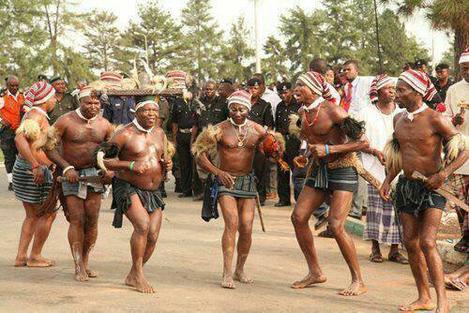
One day, a 911 lorry arrived with Abiriba War Dancers. Immediately they came down, they started dancing, wielding their machetes and other paraphernalia this way and that. They were reputed to have invisible powers and would even cut off the heads of their enemies in battle. This boosted our morale and people started bragging that the northerners would see hell since the Abiriba war dancers had joined the battle. After dancing, the warriors went to eat. I remember this clearly because we ran after their lorry as it drove them to Okpara square, in front of the Parliament Building. After they were fed, they continued dancing. In the evening, they left for the war front.
About two days later, when we came back to the Tactical Headquarters, a Mercedes-Benz 911 lorry drove in. The driver and motor boys were looking solemn. As one of them was coming down from the back of the lorry, the tail board opened. My God! I saw what I had never seen in my life. Dead bodies were piled up in the lorry. From the way they were dressed we realized they were the Abiriba war dancers we had seen a few days earlier. They had been taken to the Nsukka war front with cutlasses as their only weapons. That sight affected me so much that, for many days, I couldn’t eat. I don’t know what happened to the bodies but they may have been taken back to Abiriba for burial. With the benefit of hindsight after the war, I questioned how any army commander, who is experienced in modern warfare, would allow defenseless people go to war without modern weaponry. Many crazy things happened during the war and this is why we must avoid the temptation of going into another one.
Ozoemena!
–Emma Onyilofo
 My Biafran Story