Tag Archives: Childhood memories

LIVING IN SAINT-ANDRE REFUGEE CENTER, GABON – A FORMER CHILD REFUGEE’S ACCOUNT – PART ONE.

LEAVING BIAFRA

In 1968, just before Enugwu-Ukwu fell to the Nigerian troops, my family took refuge in my maternal grandparents’ home at Egbengwu, Nimo, a neighbouring town. When we got there, my grandparents’ house was teeming with refugees. The distribution center at Nimo was St Mary’s Primary School, and it was also completely occupied by refugees from surrounding towns like Enugwu-Ukwu, Nawfia, and Amawbia. One Irish priest, named Reverend Father Nolan, was in charge of relief distribution, assisted by other people such as Mr. Otie, the headmaster of the school. The Parish church was Assumpta Catholic Church but because of its location on the major road from Enugwu-Ukwu to Nimo it was close to the war front so it was not considered ideal as a relief distribution centre. It was on one of such visits to St Mary’s, in company of my younger sister, Rhoda, that Father Nolan announced that officials of CARITAS were coming to St Mary’s the next day to take sick children to Gabon. He told parents to bring their children who were ill the following day.

Although I was not suffering from kwashiorkor, I was frail and weak, so I made up my mind to present myself for consideration. I was just seven years old, but I saw it as a life-saving opportunity. My decision was not well received by my mother who reasoned that I was too young to be sprinted out to an unknown country beyond their care and reach. She broke down, saying, “Who is going to care and treat you like the mother who gave birth to you?” My dad, who was not known to give in easily to emotions, approved of my decision and offered to take me to St. Mary’s.

On arrival we saw babies, toddlers, and teenagers with bloated stomachs, swollen legs, and severely shrunken bodies, all looking like living ghosts. Many were too weak to stand, so they sat on the floor. Soon after, Father Nolan and Mr. Otie arrived with the CARITAS representatives. Mr. Igboka, the Catechist, was also there. When the selection started, all the kids in front of me were selected. I was rejected four times even though I buckled my feet on each occasion to create the impression that I was very ill. After my fourth rejection my father went into a tirade. This prompted the officials to call me forward, so I was the last kid to be selected that day.

The next stage was the documentation. The CARITAS officials wrote each child’s first name, surname, parents’ names, village and town, and the processing centre. Then they stuck an adhesive tape with identification number on our wrists. Mine was 492. This was the last documentation in Biafra.

As a green-coloured Austin lorry made its way towards us, my father came to me, shook my hands, and prayed that I would come back to meet them alive. My mother embraced me, sobbing. Other parents watched their children being loaded into the lorry, like cargo, and into an uncertain future. As our lorry slowly revved to drive off, I positioned myself to wave a final good bye to my parents. Years later, I learnt that my mother cried inconsolably for two days after my departure.

As soon as we departed Nimo, our chaperons informed us they were taking us to Ulli airport and from there to Gabon. On the way some children were crying. After some time our lorry stopped by the roadside so we could have lunch. It was either two small pieces of yam or one big piece placed on our palms.

When we got to Ulli airport, our lorry parked in an inconspicuous place waiting for the signal to approach the tarmac. I could see planes landing and taking off in the pitch darkness. After a long wait we drove up to the tarmac where a plane was waiting. For the first time, I saw an aircraft in a stationary position. The size was a far cry from the little bird-like thing we kids usually saw flying across the skies. We all came out of the lorry and a ladder was placed at the foot of the aircraft. Two big men positioned themselves, one at the foot of the ladder and the other at the top. One after the other, we were taken up the ladder into the aircraft. There were no chairs inside but there were blankets spread across the floor. We were given one or two cubes of sugar and asked to lie down. I could not remember when last I saw sugar in those terrible days, and I became excited again after the emotional separation from my parents. The door of the aircraft was shut, the engine started, the lights turned off, and I could sense a slow movement of the plane up to the time we became airborne.

We were woken up at Libreville International airport. My first impression was that this was real ‘obodo oyibo’ – a marvel. There were aircraft of different sizes and shapes, and that gave me the opportunity of seeing these planes at close quarters in broad daylight. Vans pulled up at the foot of our plane, and we all boarded. Those who were too weak to get into the vans were either helped in or carried inside. After a short drive our van pulled into a massive church complex. It was called St. Andre and the priest in charge was Monseigneur Camille.

———————–

The contributor, Johnny Abada, lives in the United States of America.

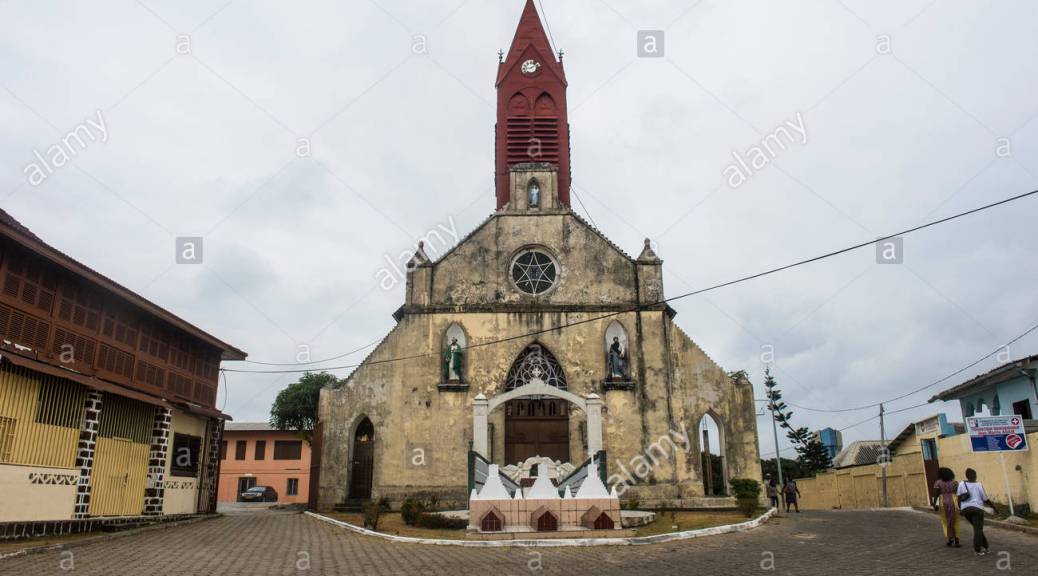
NB-The image on this post is taken from the internet. It shows St. Marie Cathedral, one of the centers used to house refugees during the Nigeria-Biafra war.


THE JAMAICAN WIFE

When our ship landed in Lagos most of the foreigners decided they weren’t getting off the ship. This was January 1966. The coup had already taken place. Dad decided we were going in. He had been given a job with the Water Resources in Lagos. So we got a flat at 51 Modupe Johnson Street, off Bode Thomas, Surulere. We were neighbours with the *Obas. They had three boys. And guess what? Their mother was also Jamaican. Six months later, the second coup took place.

One day we were told we had to move next door. And we were like, “Why?” But we packed up and moved next door. Before that my dad had gone out one day and come back with an Opel Record. It was a two door car. My dad was not around a lot. We thought he was going to work. Once in a while he would show up with the car. Sometimes he would leave the car and be gone. Then, one day he went out with mum and when they came back she had this baby in her arms.

Another day, dad was about to leave the house and I followed him. I was slow but when I got to the front window I saw him getting in the trunk of his car. I thought, “Why is dad getting into the trunk?” When I heard the rest of the story as an adult I realized that’s what he had to do to stay alive. I didn’t know where he was being taken. On reflection I think it had happened a few times but that was the only time I saw it.

One day dad shows up with the car and said, “You are going back to your grandparents.” That was the first time I would be going to Eastern Nigeria and I can proudly say I was stepping into Biafra because the Republic of Biafra had just been declared. On our way to the East we were stopped at the Onitsha Head Bridge by Biafran soldiers. They were saying they were not going to let us through. In the argument one of them slapped my dad. My mum grabbed a huge glass jug and jumped out of the car. She was waving it and threatening that the jug could break on his head if he laid a finger on dad. Jamaicans no dey play o. The arguments went on for some time and finally they let us go. From there we proceeded to our village which was not far from Onitsha.  That’s the last image I had coming into Biafra.

Tina – My mum didn’t speak Igbo and she had a foreign accent. The soldiers were cocking their guns as if to shoot us. The soldiers threatened they would throw my parents over the bridge into the water, which was far. I remember peering over the rails and the water seemed so far away. I don’t remember how the argument was resolved. We heard later from my dad that when he joined the army those men on that bridge that day were under his command.

Chinedu: Dad eventually joined the army and we were living with our mum in a flat off Edinburgh Road, Enugu. One time I got sick and mum was crying so much because I was in and out of consciousness. She came out looking for help but nobody was there to help, and tension was in the air.  She took me to Eastern Medical Centre and Dr. Okeke figured out what was wrong with me. Some weeks later, dad came back. He was a Civil Engineer and had gone for Officers Training. He told us we were going to the village, so we took off. That’s where we spent time with my grandparents, uncles and other relations.

Our house in the village was right on the Enugu-Onitsha road. That’s where I got the experience of a mass return. Everyone was heading towards Onitsha. It was a mass migration. Years later I was in America when Rwanda happened. I was watching a TV report about the crisis when I saw the mass of people trooping down the road with their luggage on their head. My body just started to shake because it brought back a lot of memories.

Tina: Another vivid memory I have is that everybody left the compound but my mum refused to leave. She felt that if she left our village my dad wouldn’t know where to find us. So we were sitting on our suitcases in front of my grandfather’s house waiting, and waiting. Dad was at Nsukka at the time but somehow he got a message that we hadn’t left with the others, so he sent his driver, Felix, to get us. We’d be dead now if it hadn’t been for Felix. [Laughter.]  Felix arrived in a station wagon and somebody helped him to bundle my mum into the car. We couldn’t take any of our belongings. We just jumped into the car and sped off. We didn’t realize how much danger we were in. That’s the strange thing about this – I can’t remember feeling frightened. In our escape Felix had to avoid all the major roads so he wouldn’t get caught by the soldiers.

Chinedu: Another memory I have was that dad buried his car during the war. Then he built something over the pit and covered it. After the war he dug it out and that’s what I used to learn to drive in 1973. I was 11 years old. [Laughter]

After our escape Felix took us to Ogbunike. The whole family was there and that was where we started seeing signs of the family not wanting to pay attention to us. It wasn’t blatant but it was happening. They were probably worried about what limited resources they had. When it came time to share food they weren’t including mum.

[Tina turns to Chinedu.] What was it about a bag of sugar?

Chinedu: Nicky was the size of a bag of sugar. That was the argument Dad gave Mum to convince her to leave. Nicky had not been fed well and therefore not grown to the normal size of a one year old, but she continued to stay in spite of all we were going through not getting enough food for five of us. He said it was better for her to take us back to England where we would be better cared for.

My grandfather also told me he didn’t like the way his children were treating us. They were doing it because they were looking out for themselves and we were foreigners. My mother, being Jamaican and her first time in the country, not able to speak the language, felt isolated, and my dad was not around.

Vivian: Maybe they felt you all were privileged, or they thought you should not have come back home.

Chinedu: Daddy was the reason they were getting all that salt and tinned food. Had it not been for him they wouldn’t have had anything. When you are not seen as part of a group you are treated as an outsider. Those things happen. To be accepted we had to work really hard. I remember the fight my mum had with my grandmother. She was dealing with that stress of not being given her own share of things. A knife was drawn but a lady who lived in the same compound separated the fight.

Dad’s division was under Cornel Achuzia. They used to refine oil so they always had fuel which they’d sell to buy food. My dad always sent someone to drop off the food, so we seemed to have food even when others didn’t. I remember eating a lot of crabs. Today, I do not like crab meat.

I remember we had five chickens which traveled with us as we moved from place to place. Each of us owned one and assumed ownership of it. The eggs were a steady source of protein. If my uncle Emeka felt like eating chicken he’d murder one of the chickens at night. [Laughter] He would come in the morning and say, “Nnaa, this chicken all of a sudden died.” And we’d have to cook it.

Tina – I remember thinking at the time that if the chicken had died of a disease and we cooked and ate it then whatever had killed the chicken would affect us too.  To be honest I don’t think I eat any of those chickens that had died in mysterious circumstances. It hadn’t occurred to me that it was my Uncle doing it.

After we left for Ogbunike there was a battle in our town, Ifite Dunu. It was known as Ifite-Ukpo then. Most people know about the battle that took place in Abagana, the town next to ours, but not the one in Ifite-Dunu. When the Nigerian soldiers came in to our town most houses were mud houses. They saw this big structure and moved in. It was my Uncle Cyril’s house. He had won the Jamaican Sweepstakes before the war so he was like a millionaire. He had houses in Onitsha and Enugu. After Enugu fell, the Biafran army made their way back and regrouped. Dad and his group decided they were going to attack my uncle’s house and dislodge the Nigerians. They succeeded, but the house was riddled with bullets. Even in 1973 when we came back from the UK we could still see casings all over the place. Uncle Cyril refused to fix the metal bars or repaint the walls. He just patched the holes.  He wanted a reminder of what happened because he lost his brother during that war.

Tina: There was a lot of traveling between places. We had to keep moving, sometimes we’d walk, sometimes my dad would send his driver to take us to the new place. Each time we were traveling the driver had to get out of the car to check the roads, because if there was a mound or something unusual on the road they were worried it was a mortar.

One of the places we stayed at was a school, I think. There was a field in front of it, and every foot of this field was covered in sharpened bamboo sticks. Each one was about four to five feet in height and so towered over me. We were told they were put there so that if Nigerian soldiers parachuted from their planes they wouldn’t survive the impact. I remember playing in this field, weaving in between the bamboo sticks oblivious to what they would do to a human being landing on it.

We spent some time at Abatete and Umunze. In one of these places we could stand on our veranda and see the fighting. It looked like a firework display.

There were two bunkers side by side. Our bunker was muddy and hadn’t been built properly so the walls were caving in. On this occasion we had to go to our neighbours bunker during the air raid. Our own collapsed and we were lucky we were not in it when that happened. On another occasion there was an air raid while we were playing away from the house. We hadn’t realized that we were so far away from the bunkers. We tried to run but everybody was shouting at us, “Lie down, lie down, lie down.” So we lay down in that field and we were watching the plane zoom past and come back, with a smoke trail, and then somewhere in the distance there was an explosion, boom, boom, boom, boom. The owner of the house where we were living, a reverend or something, drove down to where the sound came from. He had gone to pick the wounded and take them to where they could get help. When he came back he had to clean out his car. Everybody gathered around the car. I remembered this vividly. I struggled and pushed my head in between somebody’s legs and saw…whooo…I had never seen that amount of blood. That day was something else.

As I recall, I don’t remember fear. I don’t remember being scared. I just remember not liking certain things, not liking being in a different place, not liking how I had to be on the floor, because whenever we slept on the floor our faces would swell up. So if there was anywhere off the floor for me, Chinedu and Ifeanyi to sleep, we slept there, while Indy, Nicky and mum slept on the floor. They didn’t react as badly to sleeping on the floor as we did.

Chinedu: They were Nigerian born, that’s all I can say. [Laughter]

Tina: One of the things I don’t like, even now, is carrying bags when travelling. I make it a point not to. Where possible I check in all my luggage. I think it’s linked to the experience of moving from place to place. It didn’t matter how young you were, you had to carry something. It didn’t matter if your arms were tired you just had to carry things because you would need these things.

I’m sure we were traumatized because there’s no way you go through that experience without sustaining trauma, but you find a way to cope with it probably by blocking things out, because you have no choice.

Chinedu: You know what is Mkpor n’ani? When that thing goes off, my heart still skips. If I know it’s going to happen, then I’m fine, but if it happens unexpectedly I get agitated. And right now I haven’t watched any videos of refugees in the North East. I will watch clips of dead people but haven’t watched clips of people in IDP camps.

Vivian: Tell me how you were evacuated.

Chinedu: I remember the plane at night. I remember everybody hiding. Next thing you know, people were going out to the plane with lanterns. These people running with lanterns, where are they going? I didn’t know they were going to light up the runway. [Laughter] Those pilots, if I ever saw one, the kind hug wey I go give the guy erh? Imagine the planes in that kind of darkness. And African darkness is very dark. There’s no moon light. It is total darkness. And that lantern was just barely giving him light. Everybody rushed to board, but mum was still fighting, saying she wasn’t going. At the door of the plane she was still refusing. She’s a stubborn woman. That’s when we knew daddy wasn’t coming with us.

After the pilot taxied and turned around, na rush o, because there was no time. The Nigerian soldiers were shooting at the plane when we took off. It was a cargo plane. There were no chairs. And we were sitting on a bench. I remember the plane taking off and the benches falling. And once the plane took off it had to fly up at a sharp angle, to get fast above the line of fire. I know it was last week of November or early December, because we spent Christmas in Las Palmas, the Canary Islands. We remember the other people who were in the plane with us. One of our parents was either West Indian, or American or European. We flew to Sao Tome and from there to Equatorial Guinea, then Las Palmas in the Canary Islands, and finally London.

My dad never joined us. He had been promoted to a Lieutenant Colonel a few days before the war ended. He was hit in his neck by shrapnel. He spent the last days of the war in hospital, and another six months recovering. After he recovered he came to London to see us.

When everybody was being given twenty pounds my dad sold his wedding suit to a Nigerian soldier for fifty pounds. He hadn’t dug out his car yet. He said if he had dug it out they would have taken it. So, he sold his suit and had some money. And for a guy to say, “I am going to give you fifty pounds for that suit,” that was a lot of money back then. Some of those Nigerian soldiers were not bad people. They were doing a job.

Tina: Another impact I didn’t really know the war made on me until now is that when I go shopping I always buy a lot, usually much more than I need to. I always stock up so that if anything happens we will have something. That experience of not having what you need when you need it, and even when you did have it, it was never really enough. There’s a phrase I use to describe myself, “I am a war baby.” So the way I use that phrase is that no matter how little food or resources I have I’ll share it, not even manage it, I’ll share. I believe that when there are other people around you who are hungry and in need, and you have a little food and a few resources, you will have to share it. I practice this daily and I think that this is as a direct result of my war experience.

Chinedu: For me it’s my phobia for crabs. [Laughter]

Tina: We all went back to Nigeria in 1973, three years after the war ended.

Recently we had my mother’s DNA tested and we found out she’s sixty one percent Nigerian

BOYS’ COMPANY

The wounded soldiers were coming back to the village and telling us what was happening at the war front. They were showing us how to dodge bullets. They were carving guns with wood and giving us, teaching us how to do manoeuvres. They were preparing our minds to fight. But nobody told me how to dodge air raids. So, the first day it happened, I didn’t know it was air raid. I was fishing with my friend, Monday Iroegbu, from Amaogudu Otampa,  and I was wearing a red T-shirt. The bomber dropped nine bombs into the river. I was counting the bombs as they were being dropped, out of sheer curiosity. Monday is still alive and can corroborate this story. Some of the bombs exploded but many did not. We started running so they started spraying bullets at us. I got to one big tree and ran behind it. The helicopter lowered and parked in our ama, our village square. It was piloted by a white man. I believe they wanted to catch me alive. They just wanted a prize, a trophy. I ran into the bush and our people who were already taking cover there said, “Oh, remove your red shirt, remove your red shirt. That is why they are bombing this place.” So I removed it and threw it away. At the end of the day we came out and started counting dead bodies.

People were losing their homes because of the advancing enemy, but there was community assistance and collaboration. When they move to another community the people there will accept them. My grandmother took in over twenty people just because they were Ndigbo who were running for their lives. She was a local midwife so she was quite popular. We gave the refugees part of our farm land and they built temporary accommodations on it. We cooked communal food and shared to them. They were with us for almost four months before the war got to us and we became refugees ourselves.

We were hearing about the war on the radio, but majority of the things they were saying were propaganda. So, even when it was getting closer to us we didn’t know. When the soldiers eventually entered our community my mother said she was not going anywhere; that she won’t run from Lagos to the village, and then start running away again. Almost the entire community ran away but my mother was busy frying and selling garri. I said, ‘Mama, ndi mmadu a gba chaala oso – other people have run away.’ She said to me, ‘Nwa m’, ebe ariri nwuru wu ili ya – wherever the millipede dies is its grave.’ My sister came out of the bedroom and said, ‘Mama, if I die my blood is on your head.’ My mother was shocked. She said, ‘Who said that?’ I said, ‘It is Ifeyinwa.’ She said, ‘Ngwa, ngwa, ngwa – hurry, hurry, hurry, let us go.’ That is how we started preparing to leave.

The day our village collapsed, there was an old woman who couldn’t run because she was blind. Her name was Nneoma Ukazim. We used to call her Nne. Her children were in the army. One of them was working with the Nigerians against our people and later became the chairman of the Liberated Isuikwuato Area. So, there was nobody to help her. She was just trying to feel her way around, touching walls and fences. I told my mother that I wasn’t going to leave the old woman. So I took her. We got to a small river where two palm trees were placed across to make a bridge. The old woman couldn’t get on it so I, a ten year old, I carried her on my back to the other side. A Biafran soldier who was running from battle saw me and assisted both of us until we got to a safer place. Surprisingly, she survived the war and I became her confidant, to the extent that she told me her burial plans and gave me the clothes she wanted to be buried in. She died in the 70s.

We slept in somebody’s house the first night. The next day the shelling started in that community so we moved again. We kept moving. We moved about four times. The first place we ran to was a town called Ezere in Isikwuato. Some people ran to a place called Isi-Iyi. The war never got there. They said the deity in that place prevented the soldiers from getting there; that the people who ran there were safe. No bombs, no bullets.

A lot of people got lost due to the sudden movements. My sister, Florence, almost got lost. She went with other family members to Umuobiala, another community in Isikwuato, to visit my aunt, Mrs. Chidinma Ojiaboh. The day she was to come back, the shelling started. That day was what we called Church Ahia, when our market day falls on a Sunday. This happens once in eight weeks, and it is celebrated in a big way, like Christmas or Easter. So she couldn’t come back. And we couldn’t go to her. Even my aunt she had gone to visit, they left her and ran away. So my sister was running alone in a bush between Umuobiala and Afo Ugiri, when the vigilante found her. They were also called Civil Defence and were the liaison between the civilian population and military authorities. When they identify orphans they take them to the Red Cross. They assumed she was an orphan because she said she didn’t know the whereabouts of her parents. They took her to a camp where other children were waiting to be evacuated. But during the documentation one of the soldiers recognized her. He was from our village. That was how he sent us a message across enemy lines. We moved, me and my mother.

The Nigerian soldiers were still sleeping when we got to the check point, so we sneaked through their backyard. It was when we were coming back that they caught us. They asked us where we were coming from. They said I was Ojukwu soldier. I denied several times. They were convinced that Biafra was using child soldiers, which was true. They were using child soldiers to steal for the army. I was one of them. They called us Boys Company. They will send us to steal food and clothes. We will wear only our shorts. They will shave off our hair and rub oil on our bodies so that if they catch you, g’a gbu cha pu – you will slip away. We even stole guns and ammunition. Those who did very well in the training were given real guns which they called Ojukwu Catapult. They very small submachine guns and were easier for young boys to carry. The training was two weeks. They taught us manoeuvres, weapons handling, parade, how to recognize the enemy. Those of us who were born outside Igbo land spoke different languages. I was very good in Yoruba so it was an advantage. When the Nigerian soldiers catch you, you speak Yoruba to them and they say, ‘Omo ale, just let him go.’ My uncle was in the BOFF, the Biafran Organisation for Freedom Fighters. The day they caught him he started speaking Hausa. He was very fluent in it. Very fair in complexion. He said he was Dan Kano, that he was from kano. They asked him all manner of questions and he answered correctly, so they went drinking with him. He escaped and came back to tell us the story.

There was even an airstrip in my community where lighter air craft used to land. It was in that vast land between Okigwe and Uturu, right from where you have ABSU up to Ihube. During the war it was called Ugba junction because there was a big Ugba tree there. They camped Nigerian soldiers on that land. But before it was captured by Nigeria, Biafra was using it as an airstrip. Before our place fell we were the ones protecting the airstrip. We used to put pongee sticks all over the fields so that no aircraft will be able to land. At night when our own planes are coming in, because we already know they are coming, we will create a path for them to land. The flights were a collaboration between the Biafran Air Force and some foreign bodies. Some of those journalists who came, came as aid workers. Some were bringing arms and relief materials, and also helping to move children of well-to-do Biafrans out. These are stories that will not make the headlines.

We had uncles and brothers who were working for the Biafran government digging trenches. Those trenches were dug by civilians, not by soldiers. They were using older men who were too old to fight. They were also using them for propaganda. They will go and dig trenches and come back with information about the enemy.

Where you have Stella Maris College at Uturu, there used to be a rehabilitation center for wounded soldiers. They called it Hope Ville. They were making shoes and all manners of crafts during the war.

Biafra was very organised. And everybody contributed. My parents contributed. I contributed. They called it Win the War effort. Everybody made contributions to that war. If you were making baskets, you donate them to the Biafran Government. Anything you can provide – farmland, houses – you give to the government. When they need an office, you vacate yours. Biafra succeeded because of communal efforts and that was why the war lasted for so long. The Nigerian army thought they could over-run the entire South East within days. But Ojukwu miscalculated. You have no arms, no bullets, you say you are waging a war. So those who are talking about Biafra did not witness the war, they are doing it because of the marginalization in Nigeria.

Certain communities were even divided. Nigerian soldiers on one side and Biafran soldiers on the other. People used to sneak across to the Nigerian side to buy food and other things. They call it Ahia attack. I was following my mother to these markets. Some of them were designated as Ahia Ogbe – market for the deaf and dumb. Because of the air raids. These markets were held in the forests and only sign language was used. One day I escorted my mother to a market in Ishiagu to buy yams. We walked the whole day. I was carrying three long native baskets – abo. Inside the baskets I had yams and Adu, which is like cocoyam. My mother was also carrying a basket. Do you know that at every road block Biafran soldiers will take one yam? By the time we got to our village our baskets were almost empty. I cried that day and I said, “God, do not allow Biafra to win this war because if we do we are going to see worse things.” Ojukwu was no longer in control. The soldiers were hungry. They were committing atrocities in the areas they controlled.

The hunger was so much that one day we ate the wild variety of Una, the one called unabiwu. There was nothing else to eat. We said if bullets don’t kill us something else will kill us. After the meal, we slept for four days at a stretch. We didn’t wake up for four days. It probably contains very high levels of cyanide. We were lucky to have even woken up. On another occasion we ate a wild variety of beans. We bought it mistakenly, and it almost killed us. I was the first person it affected because immediately after eating I started having hallucinations. They gave us palm oil and coconut water, and that was what saved us. The only person who wasn’t affected was my sister, Florence, the one who was found in a forest. She had a stronger constitution.

Just like my sister, my father was presumed dead during the war. We mourned him. They put something in the ground and conducted a symbolic burial for him. It was after the war that one of my uncles ran into him in Liverpool, England. He asked him what he was doing in Liverpool and my father said, “They told me my wife and children are dead. What am I coming to do in Nigeria?” My uncle told him we were all alive, that only one of us died. My father said, “What of my wife?” My uncle said, “Your wife is alive.” What happened was that my father was in the navy and Nigeria wanted them to bombard Port Harcourt with the NNS Aradu. He and his colleagues refused. They diverted the ship and abandoned it at sea. They were rescued by a Congolese fishing boat which took them to Congo. President Sese Seko granted them asylum and facilitated their move to England. The Nigerian government recovered the ship but it’s no longer sea worthy. After the war my father came back to the village, but we had to undo the burial we had done. They performed some rites before he could enter the compound. The government arrested him, court marshaled him, and sacked him with no benefits. He eventually became a sailor and that is what he was doing until he retired.

Anyway, after interrogating me and my mother at the check point, the Nigerian soldiers let us go. We brought my sister back. By then we had been liberated.

-Richard Harrison

[Cover photo courtesy internet]

MY INTUITION SAVED ME

People used to call my father Mallam because he lived in Jos most of his life. During the pogrom it was his Hausa friends who protected him. He was half-dressed when they bundled him out of his house and rushed him to a helicopter. It landed safely at Onitsha.

My only brother was at Ahmadu Bello University, Zaria, studying Electrical Engineering. When people started returning we did not see him. We were all worried. My grandmother lost hope. One faithful day, as I came out to the front of the house, a taxi stopped and, behold, it was my brother. Everybody started shouting. He started narrating how they were evacuated from the campus and given protection. They were provided with vehicles that helped to evacuate them safely back to the East.

Threats were going on back and forth, so the tension was building up. Some months later, we started hearing that war had broken out. People were calling it police action. Soon, we started hearing that Biafran and Nigerian soldiers were fighting at the war front. Then, the first air raid came. The plane was dropping what Biafrans described as kerosene tins. Months later, the second one came. I was standing outside calling my mother, “Come and see this plane o. It looks like birds are following it. Why are birds following it?” The next thing I heard was an explosion and smoke from the building next to our own. I shouted, “Mama, it is bomb o.” People were shouting. Noise everywhere. I didn’t know that what I was calling birds were bombs.

The night before we left Onitsha there was shooting from night till morning. Red hot bullets being sprayed all over. We didn’t know what to do. The next morning my brother said, “Let us go.” Where are we heading to? Nobody knew. But there was only one direction – towards Owerri, Ihiala, Oba. Each person carried whatever they could carry. I carried my school box that contained my uniform and a few clothes. One of my elder sisters carried my mother’s box of wrappers. She carried it instead of her own. And those wrappers saved us. The only problem was how to convey our grandmother. She had a breakdown because of the trauma, so we were dragging her. We’ll walk and stop, walk and stop. It delayed us but we were still moving. The sound of shelling kept reducing so we knew we were fleeing the battle field. Along the road we met a family we knew and they took my grandmother in their car. They said they’ll drop her where we could pick her up. As God will have it they dropped her at Oba, in a church. It was an open place where people who were tired of trekking stopped to rest. People were still escaping, telling stories about those who could not escape, how they were being killed by soldiers.

We left Oba a few days later. I don’t know who organised the transport. It was a lorry and it dropped us at St. Martins Church, Odata, at Ihiala. It’s one big church. It’s still there.

The following day, directly opposite the church, we found a family who welcomed us into their home; Simon Okoli’s family. I still remember their name. They were very kind to us. They gave us one room in their house. It had a bamboo bed, the type called anaba aghalu. When they saw the room was small for all of us they gave us another one. They gave us pots and allowed us to use their kitchen. They said we shouldn’t pay for the rooms. We gave the bed to our grandmother. We had picked her from a refugee camp where our family friends had dropped her. But even though this family welcomed us they said we were saboteurs, because of Major Ifeajuna. During the war, if you were from Onitsha, there was a stigma attached to you.

We only had that half bucket of rice my sister carried from Onitsha but soon relief materials started coming in. There was nothing like a camp there but we gathered at a particular place and each family got their own share.

There were no jobs, no work, so ideas started coming into our heads. One day my immediate elder sister said, “This meat we don’t eat, let us not start suffering from kwashiorkor.” She would buy native fowls, cut them into parts and take to Nkwo Ogbe – their market – to sell. We would make a little gain. When we didn’t sell the head and legs we’d take them home for our soup.

One fateful day, my mother gave us various assignments and mine was to go to St. Martins and queue up for salt. I refused to go and my mother caned me. Instead, I followed my sister to the market to sell our chicken parts. I think there was only one lap remaining when I said to her, “We are leaving this place right now. Carry this tray let us go away.” She asked why, but I insisted we were leaving. On our way home we saw our brother chatting with a police man. He waved at us. Then I looked in the air and called out, “Ngozi, are you seeing what I am seeing?” She said, “What is it?” I said, “Look up. That plane is not making any sound.” The plane was hovering, turning to one side, turning to another side. I said, “Did they shoot it somewhere and it wants to crash?” Before I finished saying it, we heard an explosive noise. The plane was shelling the market, the meat section, that same spot where we had been standing. Sellers and buyers were mangled. As we watched, the plane moved in the direction of our house, releasing rockets and bullets. We ran into a bushy area and while I was taking cover I was looking and pointing upwards. My sister smacked me and said, “Lie down, lie down,” but I said, “I will not lie down. I want to see who is in that plane.” The plane moved towards the direction of the church, three times, releasing rockets and bullets. The sounds were accompanied with light, like lightning. It was the worst air raid I ever saw. When we got home we heard that that church compound, where I was supposed to line up for salt, was the target. All that maneouvring the plane was doing was to get the most accurate angle to hit the people on the line. As people narrated what happened, my mother looked at me, looked at me, looked at me. I cannot tell you why I refused to go to that church but I have always been intuitive. And I used to be stubborn when I was small. If I didn’t want to do something I wouldn’t do it. After that day, she never asked me to do anything I didn’t want to do.

In 1968, my grandmother died and we buried her in Ihiala. My brother went to one Irish Reverend Father at St. Martins Church, Odata – Father Brady – and told him we wanted to know if our uncle was still in Lagos or not. The Reverend Father made inquiries and found out he had left for Dublin with his wife, when the war started. They sent a packet of Complan milk, through Rev Father Brady, and my uncle later wrote to confirm that we received it. A few days later, the Reverend Father just drove inside the compound and opened the boot. What did we see? A box as high as this, square, sealed. It was filled with all manner of tinned food: meat, corned beef, stock fish soaked in salt granules as big as this, giant tins of corn beef, fish, sardines, bread, assorted tinned foods, seasoning cubes, cheese. It is because of this that I usually tell people that I ate the best of food during the Biafran war. We made a lot of Biafran money from the salt, cloths and Chicken that we were selling then.

Inside that box there was also an envelope with dollars, so somebody advised my brother to start trading in tobacco. We contacted his friend who was working at Ulli airport and through him, a pilot brought back the first bag of tobacco. The women who were trading on it were buying it off him and selling same to soldiers at the war front. We made a lot of Biafran money and that was how we survived. Before then, we were selling my mother’s wrappers, all those costly Georges and Abadas, and people were buying them. We even sold my box. I cried o.

We left Ihiala on January 17. By then the Nigerian soldiers had reached Ihiala. Umuahia had fallen and Ojukwu had left. So the village head and the elders took a decision to make peace with the soldiers. They welcomed them and negotiated with them not to touch anybody in Ihiala. So there was peace in Ihiala. The soldiers used to come to the stream where we used to fetch water. They’ll just give us their water bottles to fill for them and we were always very cautious. When they leave we start fetching again. Thank God for the wisdom he gave the Igwe.

A few days after they arrived lorries appeared. Evacuation. We didn’t waste time. Everybody started going back. Up till today I do not know who arranged for the vehicles. We jumped inside and they dropped us at Fegge, Onitsha.

-Dr. Mrs. Lillian Chibuogu Ilo

(PHOTOS TAKEN FROM THE INTERNET)

‘AFIA ATTACK’ – A Young Girl’s Account

Then it started. Bombs and more bombs. At a time, as early as 4 o’clock my mother would wake us up to have our bath and our breakfast, then she would pack our food and send us into the drainage. She had identified where parents were hiding their children. They dropped them in the morning and in the evening they picked them up. They were like gutters and you saw the water gushing out. If it was the bigger ones we’d take kitchen stools and the smaller children would sit, while our bigger sisters would lie down. Sometimes we couldn’t even sit, so we’ll just stretch out. That is where we’ll be from as early as 6.00 am till 6.00 pm. They didn’t have a choice. They had to protect us.

We were living on Asa Road, Aba, a very popular street. We were on the first floor and there were shops on the ground floor. There was a record shop there and, because people were hungry for news, they would gather in front of the shop during the news time. The volume of the radio would be raised to high heavens so that no matter how far away you were sitting or standing, you could hear the news. On one of those days, at exactly 4.00 o’clock, when the signature tune was on signalling that the news was about to start, they bombed our house. I don’t know if they were getting information from saboteurs because they knew when to strike. They were bombing and shelling at the same time- fighter and bomber. Eight Six people were killed that day. Bodies were scattered all over the place. You don’t want to see it. Heads, legs, hands, in different directions. There was brain stuck on our ceiling. One bullet landed on my father’s bed. Luckily for us my father would usually take his siesta but on that day he didn’t take his rest. Instead, he was discussing with his friend at the back of our house. My sister and her fiancée were wounded. The horrifying experience of children seeing dead bodies, not just dead bodies, but mutilated bodies. There was another incident when a petrol station opposite our house got bombed. It ignited so much fire that both the people who were buying and those who were selling perished.

Kwashiorkor became the order of the day. People were eating anything in sight – hibiscus flower, leaves, rats, lizards, cats, everything in sight. But we were lucky because my mother participated in Ahia attack – o zuru ahia attack. If she told you what she went through erh. She spoke a lot of languages so she was able to pass a lot of barricades on her way to Atani to trade. You know it’s a border so people were also coming from the other end to trade. She used to take Singer Machines to the border, the type operated by foot. They were packed in big cases. The Nigerians were buying them a lot. I don’t know why. We had a lot of them in the house. But I didn’t bother to ask her where she was getting them from. Before she went, they would nail narrow pieces of wood around the four sides of the wooden case and fill the gaps with coins, before putting the wooden cases inside cartons. She would set off with my senior brother carrying the machine. When they got to a point they would take a canoe and cross to the other side and follow the apiam way. They usually arrived on markets days. They exchanged the coins for Nigerian money and the exchange rate was quite high. She would use the money to buy plantain and fish, crayfish, garri and everything we needed in our house. Our house became a mecca of sorts because people were coming to our house to buy these things. Then she would go get some more machines. They also used to buy fish and people would come to the house to dry the fish for her. Sometimes, when they had to cross a stream the water would get to her chest. And she couldn’t swim.

One day a woman who knew she was trading in faraway places approached her and asked, “n’o bulu kwa na enwe ndi cholu umu aka ebe anwa, g’enye f’ego ka fa wee nye ndi nke ozo nni – if there were people who would take some of her children and give her money so she could feed the rest.” My mother told the woman she couldn’t do that sort of thing; that she had 9 children who were also suffering. She told the women to endure the hardship and if she was willing she would introduce her to the attack trade. The woman was not doing it out of wickedness. People were having many children at that time and, rather than lose all her children to hunger, she must have felt it was better to sell some and use the money to feed the rest.

Caritas had designated areas where they used to sell food. It was shared family by family. If they did it individually those who had more children would get more, although they needed it more too, but they decided they’d rather deal with families. At the beginning it was well organised because they were distributing the items themselves, but when they left the people working at the directorate started diverting the items. You had to bribe them to get food. People stood in the queues for days and it still didn’t get to them. They were even selling these things in the market. My mum had money so sometimes we bought from the market. But what about those who couldn’t afford it?

Life was unbearable. The trekking we did in those years, I can’t tell you how many million miles we covered. When Umuahia fell we trekked for three days. In the night we entered a bush. My mother would not sleep. My father would not sleep. They would stay awake just watching their children sleep. We left again and got to a place with nothing in sight except an abandoned primary school, without a roof. From there my mother would go out looking for a market or a gathering where she could buy food.

My mum discovered a place called Umunze, also in Mbano. One of the chiefs gave us a place and my mother paid pounds as the rent. From Umunze we went to Umuchu. It was at that time that my sister and I started our period. I woke one morning and when I saw the blood I screamed. I didn’t know what it was. My mother gave me a bath and said, “You’ve become a real woman now. Don’t allow any man to come near you.” She tore her wrappers and gave twelve pieces to me and twelve to my sister.

My father was praying to die. He had nine children. He couldn’t communicate with anybody because he couldn’t speak Igbo. He was an Ijaw man, the only non-Igbo speaking councillor in Aba at the time. If you go to Aba Town Hall you will see his photograph there – Chief Joshua Babala Ketebu. He was a civil servant and was always being transferred from one place to another. So he was not able to pick up languages unlike the rest of us who speak at least two languages. My mum was universal. She spoke Hausa, Fulani, Yoruba, Igbo and many others.

Eventually we settled at Nkwerre where we had a big house. It was peaceful and we started school again, studying under the trees. But during the rainy season we stayed at home. Sometimes the raids would come and we’d run home. My mother decided we should start generating money so my sister and I started selling oranges. We ate many before we got any sold. My mother also started her business again. It’s an experience you don’t wish your enemy, that is why when people are talking about war-war-war, I guess they didn’t experience it.

On the day the war ended we didn’t believe it had ended. Prior to that day they was a lot of shelling. It was loud and it was clear. We heard people jubilating. Shouts were coming from different directions- “War e bie la. Ha e mechaala war – the war has ended. They have ended the war!” We ran inside because we thought it was a gimmick. We didn’t know the shelling was to signal the end of the war. But my mum was worried. She said, “How will I take nine children back to PH?” She trekked from Nkwerre to Orlu where she met some soldiers. She pleaded with them and they gave her a lorry which carried us from Nkwere to my brother’s house in Port Harcourt. She was a very brave woman. She had no fear. Once you tell her that what she’s looking for is here, she doesn’t need to know anybody there, she’ll go and get it.

Eventually we got our own place and with financial help from her mother, she started her business again and we went back to school. My father died immediately after the war. My mum died 13 years ago. One of my brothers died last year. The rest of us are alive.

-Dr. Mrs. Bekky Ketebu-Igwe

(PHOTOS TAKEN FROM THE INTERNET)

My Biafran Eyes, by Okey Ndibe

*My Biafran Eyes was published by Guernica on August 12, 2007.*

“My father’s decision to stay in Yola nearly cost him his life. He was at work when one day a mob arrived. Armed with cudgels, machetes and guns, they sang songs that curdled the blood. My father and his colleagues—many of them Igbo Christians—shut themselves inside the office. Huddled in a corner, they shook uncontrollably, reduced to frenzied prayers. One determined push and their assailants would have breached the barricades, poached and minced them, and made a bonfire of their bodies. The Lamido of Adamawa, the area’s Muslim leader, arrived at the spot just in the nick…He scolded the mob and shooed them away. Then he guided my father and his cowering colleagues into waiting vehicles and spirited them to the safety of his palace. In a couple of weeks, the wave of killings cooled off and the Lamido secured my father and the other quarry on the last ship to leave for the southeast.” – Okey Ndibe

                                                                  ————-

My first glimpse into the horror and beauty that lurk uneasily in the human heart came in the late 1960s courtesy of the Biafran War. Biafra was the name assumed by the seceding southern section of Nigeria. The war was preceded—in some ways precipitated—by the massacre of southeastern (mostly Christian) Igbo living in the predominantly northern parts of Nigeria.

Thinking back, I am amazed that war’s terrifying images have since taken on a somewhat muted quality. It requires sustained effort to recall the dread, the pangs of hunger, the crackle of gunfire that once made my heart pound. It all now seems an unthreatening fog.

~~~

As Nigeria hurtled towards war, my parents faced a difficult decision: to flee, or stay put. We lived in Yola, a sleepy, dusty town whose streets teemed with Muslims in flowing white babariga gowns. My father was then a postal clerk; my mother a teacher. In the end, my father insisted that Mother take us, their four children, and escape to safety in Amawbia, my father’s natal town. Mother pleaded with him to come away as well, but he would not budge. He was a federal civil servant, and the federal government had ordered all its employees to remain at their posts.

My mother didn’t cope well in Amawbia. In the absence of my father, she was a wispy and wilted figure. She despaired of ever seeing her husband alive again. Our relatives made gallant efforts to shield her, but news about the indiscriminate killings in the north still filtered to her. She lost her appetite. Day and night, she lay in bed in a kind of listless, paralyzing grief. She was given to bouts of impulsive, silent weeping.

Then one blazing afternoon, unheralded, my father materialized in Amawbia, stole back into our lives as if from the land of death itself.

“Eliza o! Eliza o!” a relative sang. “Get up! Your husband is back!”

At first, my mother feared that the returnee was some ghost come to mock her anguish. But, raising her head, she glimpsed a man who—for all the unaccustomed gauntness of his physique—was unquestionably the man she’d married. With a swiftness and energy that belied her enervation, she bolted up and dashed for him.

We would learn that my father’s decision to stay in Yola nearly cost him his life. He was at work when one day a mob arrived. Armed with cudgels, machetes and guns, they sang songs that curdled the blood. My father and his colleagues—many of them Igbo Christians—shut themselves inside the office. Huddled in a corner, they shook uncontrollably, reduced to frenzied prayers. One determined push and their assailants would have breached the barricades, poached and minced them, and made a bonfire of their bodies.

The Lamido of Adamawa, the area’s Muslim leader, arrived at the spot just in the nick. A man uninfected by the malignant thirst for blood, he vowed that no innocent person would be dealt death on his watch. He scolded the mob and shooed them away. Then he guided my father and his cowering colleagues into waiting vehicles and spirited them to the safety of his palace. In a couple of weeks, the wave of killings cooled off and the Lamido secured my father and the other quarry on the last ship to leave for the southeast.

~~~

Air raids became a terrifying staple of our lives. Nigerian military jets stole into our air space, then strafed with abandon. They flew low and at a furious speed. The ramp of their engines shook buildings and made the very earth quake.

“Cover! Everybody take cover!” the adults shouted and we’d scurry towards a huddle of banana trees or the nearest brush and lay face down.

Sometimes the jets dumped their deadly explosives on markets as surprised buyers and sellers dashed higgledy-piggledy. Sometimes the bombs detonated in houses. Sometimes it was cars trapped in traffic that were sprayed. In the aftermath, the cars became mangled metal, singed beyond recognition, the people in them charred to a horrid blackness. From our hiding spots, frozen with fright, we watched as the bombs tumbled from the sky, hideous metallic eggs shat by mammoth mindless birds.

One day, my siblings and I were out fetching firewood when an air strike began. We threw down our bundles of wood and cowered on the ground, gaping up. The jets tipped in the direction of our home and released a load. The awful boom of explosives deafened us. My stomach heaved; I was certain that our home had been hit. I pictured my parents in the rumble of smashed concrete and steel. We lay still until the staccato gunfire of Biafran soldiers startled the air, a futile gesture to repel the jets. Then we walked home in a daze, my legs rubbery, and found that the bombs had missed our home, but only narrowly. They had detonated at a nearby school.

~~~

At each temporary place of refuge, my parents tried to secure a small farmland. They sowed yam and cocoyam and also grew a variety of vegetables. We, the children, scrounged around for anything that was edible, relishing foods that in less stressful times would have made us retch.

One of my older cousins was good at making catapults, which we used to hunt lizards. We roasted them over fires of wood and dried brush and savored their soft meat. My cousin also set traps for rats. When his traps caught a squirrel or a rabbit, we felt providentially favored. Occasionally he would kill a tiny bird or two, and we would all stake out a claim on a piece of its meat.

While my family was constantly beset by hunger, we knew many others who had it worse. Biafra teemed with malnourished kids afflicted with kwashiorkor that gave them the forlorn air of the walking dead. Their hair was thin and discolored, heads big, eyes sunken, necks thin and scrawny, their skin wrinkly and sallow, stomachs distended, legs spindly.

Like other Biafrans, we depended on food and medicines donated by such international agencies as Catholic Relief and the Red Cross. Sometimes I accompanied my parents on trips to relief centers. The food queues, which snaked for what seemed like miles—a crush of men, women, children—offered less food than frustration as there was never enough to go round. One day, I saw a man crumble to the ground. Other men surrounded his limp body. As they removed him, my parents blocked my sight, an effete attempt to shield me from a tragedy I had already fully witnessed.

Some unscrupulous officers of the beleaguered Biafra diverted food to their homes. Bags of rice, beans and other foods, marked with a donor agency’s insignia, were not uncommon in markets. The betrayal pained my father. He railed by signing and distributing a petition against the Biafran officials who hoarded relief food or sold it for profit.

The petition drew the ire of the censured officials; the signatories were categorized as saboteurs. To be tagged a saboteur in Biafra was to be branded with a capital crime. A roundup was ordered. One afternoon, some grave-looking men arrived at our home. They snooped all over the house. They turned things over. They pulled out papers and pored over them, brows crinkled half in consternation, half in concentration. As they ransacked the house, they kept my father closely in view. Then they took him away.

Father was detained for several weeks. I don’t remember that our mother ever explained his absence. It was as if my father had died. And yet, since his disappearance was unspoken, it was as if he hadn’t.

Then one day, as quietly as he had exited, my father returned. For the first—and I believe last—time, I saw my father with a hirsute face. A man of steady habits, he shaved every day of his adult life. His beard both fascinated and frightened me. It was as if my real father had been taken away and a different man had returned to us.

This image of my father so haunted me that, for many years afterwards, I flirted with the idea that I had dreamed it. It was only ten years ago, shortly after my father’s death, that I broached the subject with my mother. Yes, she confirmed, my father had been arrested during the war. And, yes, he’d come back wearing an unaccustomed beard.

~~~

Father owned a small transistor radio. It became the link between our war-torn space and the rest of the world. Every morning, as he shaved, my father tuned the radio to the British Broadcasting Corporation, which gave a more or less objective account of Biafra’s dwindling fortunes. It reported Biafra’s reverses, lost strongholds and captured soldiers as well as interviews with gloating Nigerian officials. Sometimes a Biafran official came on to refute accounts of lost ground and vow the Biafrans’ resolve to fight to the finish.

Feigning obliviousness, I always planted myself within earshot, then monitored my father’s face, hungry to gauge his response, the key to decoding the news. But his countenance remained inscrutable. Because he monitored the BBC while shaving, it was impossible to tell whether winces or tightening were from the scrape of a blade or the turn of the war.

At the end of the BBC broadcasts, my father twisted the knob to Radio Biafra, and then his emotions came on full display. Between interludes of martial music and heady war songs, the official mouthpiece gave exaggerated reports of the exploits of Biafran forces. They spoke about enemy soldiers “flushed out” or “wiped out” by gallant Biafran troops, of Nigerian soldiers surrendering. When an African country granted diplomatic recognition to Biafra, the development was described in superlative terms, sold as the beginning of a welter of such recognitions from powerful nations around the globe. “Yes! Yes!” my father would exclaim, buoyed by the diet of propaganda. How he must have detested it when the BBC disabused him, painted a patina of grey over Radio Biafra’s glossy canvas.

~~~

In January 1970, after enduring the 30-month siege, which claimed close to two million lives on both sides, Biafra buckled. We had emerged as part of the lucky, the undead. But though the war was over, I could intuit from my parents’ mien that the future was forbidden. It looked every bit as uncertain and ghastly as the past.

Our last refugee camp abutted a makeshift barrack for the victorious Nigerian army. Once each day, Nigerian soldiers distributed relief material—used clothes and blankets, tinned food, powdery milk, flour, oats, beans, rice, such like. There was never enough food or clothing to go around, which meant that brawn and grit decided who got food and who starved. Knuckles and elbows were thrown. Children, the elderly, the feeble did not fare well in the food scuffles. My father was the sole member of our family who stood a chance. On good days, he squeaked out a few supplies; on bad days, he returned empty handed. On foodless nights, we found it impossible to work up enthusiasm about the cessation of war. Then, the cry of “Happy survival!” with which refugees greeted one another sounded hollow, a cruel joke.

Despite the hazards, we, the children, daily thronged the food lines. We operated around the edges hoping that our doleful expressions would invite pity. Too young to grasp the bleakness, we did not know that pity, like sympathy, was a scarce commodity when people were famished.

One day I ventured to the food queue and stood a safe distance away watching the mayhem, silently praying that somebody might stir with pity and invite me to sneak into the front. As I daydreamed, a woman beckoned to me. I shyly went to her. She was beautiful and her face held a wide, warm smile.

“What’s your name?” she asked.

“Okey,” I volunteered, averting my eyes.

“Look at me,” she said gently. I looked up, shivering. “I like your eyes.” She paused, and I looked away again. “Will you be my husband?”

Almost ten at the time, I was aware of the woman’s beauty, and also of a vague stirring inside me. Seized by a mixture of flattery, shame and shyness, I used bare toes to scratch patterns on the ground.

“Do you want some food?” she asked.

I answered with the sheerest of nods.

“Wait here.”

She went off. My heart pounded as I awaited her return, at once expectant and afraid. Back in a few minutes, she handed me a plastic bag filled with beans and a few canned tomatoes. I wanted to say my thanks, but my voice was choked. “Here,” she said. “Open your hand.” She dropped ten shillings onto my palm.

I ran to our tent, flush with exhilaration. As I handed the food and coin to my astonished parents, I breathlessly told them about my strange benefactor, though I never said a word about her comments on my eyes or her playful marriage proposal. The woman had given us enough food to last for two or three days. The ten shillings was the first post-war Nigerian coin my family owned. In a way, we’d taken a step towards becoming once again “Nigerian.” She’d also made me aware that my eyes were beautiful, despite their having seen so much ugliness.

~~~

Each day, streams of men set out and trekked many miles to their hometowns. They were reconnoiterers, eager to assess the state of life to which they and their families would eventually return. They returned with blistered feet and harrowing stories.

Amawbia was less than 40 miles away. By bus, the trip was easy, but there were few buses and my parents couldn’t afford the fare anyway. One day a man who’d traveled there came to our tent to share what he’d seen. His was a narrative of woes, except in one detail: My parents’ home, the man reported, was intact. He believed that an officer of the Nigerian army had used my parents’ home as his private lodgings. My parents’ joy was checked only by their informer’s account of his own misfortunes. He’d found his own home destroyed. Eavesdropping on his report, I imagined our home as a mythical island of order and wholesomeness ringed by overgrown copse and shattered houses.

The next day my father trekked home. He wanted to confirm what he’d heard and to arrange for our return. But when he got back, my mother let out a shriek then shook her head in quiet sobs. My father arrived in Amawbia to a shocking sight. Our house had been razed; the fire still smoldered, a testament to its recentness. As my father stood and gazed in stupefaction, the truth dawned on him: Some envious returnee, no doubt intent on equalizing misery, had torched it. War had brought out the worst in someone.

My parents had absorbed the shock of other losses. There was the death of a beloved grandaunt to sickness and of a distant cousin to gunshot in the battlefield. There was the impairment of another cousin who lost a hand. There was the loss of irreplaceable photographs, among them the images of my grandparents and of my father as a soldier in Burma during WWII. There was the loss of documents, including copies of my father’s letters (a man of compulsive fastidiousness, my father had a life-long habit of keeping copies of every letter he wrote). But this loss of our home cut to the quick because it was inflicted not by the detested Nigerian soldier but by one of our own. By somebody who would remain anonymous but who might come around later to exchange pleasantries with us, even to bemoan with us the scars left by war.

~~~

At war’s end, the Nigerian government offered 20 pounds to each Biafran adult. We used part of the sum to pay the fare for our trip home. I was shaken at the sight of our house: The concrete walls stood sturdily, covered with soot, but the collapsed roof left a gaping hole. Blackened zinc lay all about the floor. We squatted for a few days at the makeshift abode of my father’s cousins. Helped by several relatives, my father nailed back some of the zinc over half of the roof. Then we moved in.

The roof leaked whenever it rained. At night, rain fell on our mats, compelling us to move from one spot to another. In the day, shafts of sunlight pierced through the holes. But it was in that disheveled home that we began to piece our lives together again. We began to put behind us the terrors we had just emerged from. We started learning what it means to repair an inhuman wound, what it takes to go from here to there.

In time, my father was absorbed back into the postal service. My mother returned to teaching. We went back to school. The school building had taken a direct hit, so classes were kept in the open air. Even so, our desire to learn remained strong. At the teacher’s prompting, we rent the air, shouted the alphabet and yelled multiplication tables.
OKEY NDIBE PHOTO 4

                                                                            ———-

Okey Ndibe is the Shearing Fellow at the Black Mountain Institute, University of Nevada, Las vegas. He is the author of Arrows of Rain, Foreign Gods Inc., and Never Look An American In The Eye.

Accused!

*The names of individuals and places have been changed to protect the identities of the people concerned.*

“To make our pain worse, my family was accused of being saboteurs and my parents were taken away. I became separated from my siblings and was detained in several places. In the first [detention] center, one Sergeant Major was always threatening to kill me. But luck smiled on me when one Captain *Nwogu came to see the people detained…I was taken away to another center where I also found favour with the Commanding Officer. He said he would have made me his Batsman if I wasn’t so young. From there, I was taken to the place where I’d be court – marshaled. I was thrown into an underground bunker…” – Dr. C.C.A.

                                                                       ———-

As a kid, I had a privileged life. We had a fleet of cars in our garage – Cortina, Beetle and others. My mother drove me to school every day and by the age of four I was already answering phone calls. But the war shattered it all.

When the tensions started to build up in 1966, I was almost twelve years old and because we could read the papers, we were fairly engaged in national issues and knew what was happening in the country. The first and second coups had happened and it was exciting as young people like us looked forward to more action. We were reading about Major Nzeogwu, the counter coup, and how Ironsi was abducted, this Major General JT Ironsi, who could fight in the Congo without getting a scratch on his body as long as he held that insignia of a crocodile. It was all very exciting.

By 1967, I was in Class One when we heard Ironsi’s body had been found. Even as children we could feel the clouds gathering. In May, it became inevitable that there’d be war. Eventually, we were asked to go home because Biafra had been declared. Our parents could pretend that everything was okay but if you were a little discerning you could feel the mood of uncertainty. The story continued to evolve aided by the propaganda machinery. In the newspapers we’d see mutilated bodies and read headlines that said, ‘2,000 corpses dumped in the train that came from Markurdi and kano.’

As a Boy’s Scout, I was among those drafted into the Rehabilitation Commission to help in documenting the displaced – those who had escaped the genocide in the north. They needed to be put in IDPs and rehabilitated, and the government of Eastern Nigeria was overstretched. Even as a child, I could discern a spirit of unity and self-help among the people who were involved. They were trying to solve problems and not looking at what they could gain. I didn’t see the walls we now have where a particular person will occupy a position and become a law unto himself.

Eventually, when the first shot was fired at Gakem, people rejoiced. The mood was like, let this thing come, let us fight it and get it over with. We thought it was an event or a contest that would last a few days. Unfortunately, it wasn’t.

I didn’t join the army but my brother, *KK, did. He was about twenty two years old at the time. He was our hero, everybody’s darling. He was precocious both in education and by the force of his character. If he told you, “Stay here,” you’ll have no choice but to stay. He was a John F.K. Kennedy Essay winner and at twenty years old had passed his A-levels with A’s in all the subjects and was to study medicine. He was always the champion during the television program, Telequiz or Telechance, which is similar to ‘Who Wants To Be A Millionaire’ that we have today. His brilliance was remarkable.

My father didn’t want to lose such an exceptional son, so he went to get him out. On seeing him, *KK shouted, “Why should you come here and throw your weight around? What about these other people? Don’t they have fathers?” My father was a sad man when he left. *KK eventually trained with the First Officer Cadet. He fought with the courage of a lion, believing that if he died for the cause the Biafran dream would still be realised. He wrote me every few days from the war front and in one of his letters, he said, “Dearest Emmy, you know where I am? I’m teaching these people some lessons.”

We knew my brother had died because Christmas was by the corner and we hadn’t received the money he used to send every month to relatives and widows in our village. Some of them would get as much as two pounds. By the 28th of December, my mum knew that something had happened to him, especially because she had had premonitions of his death. In a dream, she had seen somebody who looked like my father lying in state. She hit the person and said, “Stand up, it’s not your turn. Let me lie down.” She had another dream where *KK was riding a silver Raleigh bicycle and holding a cock. Symbolically, it is a farewell. *KK had also had his own premonitions. In one of his letters to me, he’d written, “Dearest Emmy, I have played my role. Two kings cannot stay in the same kingdom.” He said he was leaving the stage for me and was sure I’d step into his shoes if he didn’t come back. At the time, those words were like fairy tales to me.

Immediately, my parents started pressing buttons and, after three days, received news that he was in Awgwu, wounded. They left for Awgwu accompanied by one of my sisters who would donate blood to him if he needed it. It was a tortuous journey and when they arrived, the commander wasn’t forthcoming with the truth. Finally he said, “Your worst fear is confirmed. Your son was killed on the 26th of December 1967.” When his death was announced mid-January 1968, my village was like a carnival. He was honoured as a Biafran hero. A small contingent of soldiers stayed with us for one week and every day they’d have a parade in his honour. But after about a week my mother sent them away so we could grieve in peace.

I later asked his friends how he died. They told me the previous day, after smashing their ferret and blocking their progress, he got intoxicated and told his men, “Let’s go and finish it up.” They regrouped to take the airport, which was strategic, but the fire power was overwhelming. His boys abandoned him and he didn’t have any backup. My worst fear was that the Nigerians captured him. But Biafra said they recaptured his corpse. However, when they were leaving, the fight was still heavy so they dug a grave and buried him.

My brother’s death broke everybody and my parents never recovered from it. To make our pain worse, my family was accused of being saboteurs and my parents were taken away. I became separated from my siblings and was detained in several places. In the first [detention] centre, one Sergeant Major was always threatening to kill me. But luck smiled on me when one Captain *Nwogu came to see the people detained. He said I looked familiar and asked if I was *KK’s brother. When I said I was, he was overcome with emotion and pleaded with the Commanding Officer to release me because of the sacrifices my brother had made for the cause. I was taken away to another center where I also found favour with the Commanding Officer. He said he would have made me his Batsman if I wasn’t so young. From there, I was taken to the place where I’d be court – marshaled. I was thrown into an underground bunker but my former French teacher, Dr. *Abel, who was by this time a captain and administrative officer, discovered me there. There was another man, one Captain *Nduka, who was being very overzealous but unknown to him, his wife had been our neighbour at Enugu. When he found out I knew his wife, he softened towards me and after my trial they put me in a hostel.

From there, a staff of the Research and Production Unit took me to my uncle at Umuahia, from where I went to Uzuakoli. I returned to Umuahia to stay with my cousin, *Nancy, who had just got married. When Umuahia fell, I was bundled away to stay with some family friends, the *Onyemas. Some of my mother’s relations, the *Okwuchis, were living with the *Onyemas at the time and they showed me much kindness. But my ordeals were far from over. I had to eat foods I didn’t like and was not allowed to go to school. Instead, I was forced to go to the farm every morning, something I had never done before. Eventually, another of my cousins, *Nma, traced me to the *Onyemas and took me back to her house where she gave me the treat of my life. Mrs. *Onyema wasn’t happy about this and complained that I was being spoiled. So, to avoid friction, *Nma asked me to return to them. I took my bag and trekked in the bush paths back to the *Onyemas, 14 km away. My hosts were still determined to make me proficient in farm work, so they sent me back to the farm. There, I saw a python and, overcome with fear, I ran home, packed my clothes in a raffia bag and sneaked away at about 5.00 am.

During this time I had become wealthy selling cigarettes. *Nma had a friend called *Buster, who was a big boy in Ahia Attack. He sold cigarettes, salt, canned foods, milk and other scarce commodities and would often give me cigarettes to sell for him. But I became envious of his relationship with *Nma who was my world. I stopped speaking to her and *Buster assumed I was missing my parents. I insisted on returning to Owerri which had just been liberated, so *Nma found people who were going there. We all set off, walking from Umuaku through Umunze to Ekwulobia and finally, to Orlu, where my sister was. Immediately she saw me she declared the war would soon end.

One of my uncles was less than pleased to see me but when I offered to give him money, he was curious about the source. I told him I was selling cigarettes and he would always ask me to give him some. Other times, he’d say I should lend him fifty pounds or such amounts. I would give him and his attitude towards me started changing. So did the dynamics of our relationship because we started discussing issues and taking decisions about the family. He would even lavish praise on me. But I saw through him and never failed to remind him of his debts.

I became wealthy again at the end of the war when people broke into the Central Bank of Biafra. I had so much money on me – from sales of cigarettes and the one carted from the Central Bank. We bought fuel from the black market and headed to Enugu where many houses had ‘OCUPID’ wrongly spelt on them. People hadn’t returned fully so we found an empty house and moved in for the night. With the money in my hands, my sisters cooked the next day and we ate like we hadn’t done in a long while. Overstuffed, we fell asleep. There was electricity but there was no water. I then remembered a stream at Agbani and went to search for it. It eventually became the source of water for us and other returnees.

We were happy to be together – me, my sisters and uncle. We started to settle in. But one day, I left again. I went to look for my parents.

                                                                        ———-

The contributor of this story is an Academic and Public Office Holder. He wishes to remain anonymous.


Immune to horror.

“We were eventually called back to school…Our school field was littered with corpses at different stages of bloating and decomposition – both adults and children. We had to clean the compound so we started digging shallow graves to bury the bodies. The ones that were completely decayed, we rake them over the soil and use them as manure. Then we bury their skeletons. When we started our school farm again, we were marking the position of the ridges with skulls – we push a stick into the soil and hang a skull on top of it. Sometimes we use the skulls to play hand ball – you throw to me, I throw to you.” – Okenwa Enyeribe

                                                                         ———-

I was in primary two at St. Mary’s primary school, Umuopara, Nguru, Mbaise when the war started. Fighter jets were flying over our school and when it became unbearable, we had to go into the bush to continue studying. I was only eight years but I started to see emergency platoons. I don’t know who summoned them but I started to see traders, secondary school leavers, tailors, in their work dresses, coming together and chanting war songs, “Nzogbu, enyimba enyi, nzogbu enyimba enyi!” After hearing of the pogroms in Lagos, Kano and how Igbo soldiers were massacred in barracks, people were saying, “We’re ready, enough is enough.” They absorbed them into the army and they started forming sectors all over Igbo land.

You can’t imagine that we’ll be in our compound and air raid will come and give us the first sign. We’ll go and enter the bunker. The next time it comes, it is bombing. Behind our house there was an arsenal where Biafra was manufacturing equipment but the Nigerian soldiers couldn’t locate it. Very heavy machines and trucks were going to that place to transport materials and equipment, roaring day and night. It was protected by palm trees so the Nigerian soldiers continued looking for that arsenal. Everyday. Woooo! Woooo! Woooo! We couldn’t sleep. They bombed many places but they couldn’t find that one.

With all that bombing going on, we ran into the bush. It was filled with human beings and our only cover was palm trees. Right inside that bush, markets started springing up. It was trade by barter so if you have garden eggs or chicken you can exchange them for yams or another thing.

As the war went on, the hunger, starvation and attendant issues became worse. We were blocked from Northern Nigeria so there was nothing like cattle or goats. We were blocked from Lagos so anything imported could not get to us. What we had to do was manage whatever we laid our hands on. For starch we were eating cassava, rice, maize, yams. For vegetables, anything that could be eaten, like cassava leaves, hibiscus leaves, paw-paw leaves, we were eating them, mixing them with starchy foods in a porridge. There was little protein that is why there was kwashiorkor. The only source of meat was rats, snakes, lizards. But they were correct meat at that time. If you climb a tree and see a lizard jump down from there, you follow it and jump down. If it escapes, where will you see another one? We used to dig holes in the ground to look for rats then we put our hand inside the hole not caring whether snakes live there.

We were getting relief from international organisations like Red Cross, World Council of Churches, Caritas. They brought Garri Gabon, corn meal, milk. In the morning we carry our plates and go to the relief centre at Ogbo, Nguru. The kwashiorkor place, that’s what we call it. We stay in line but when people get tired of waiting they will start dragging the food from the sharers. Sometimes the food will pour on the ground and some people will scoop it from there. Do you blame them? Sandy food was better than no food.

There was stock fish but it was stock fish soaked in salt – double action. We soak it in water for one week and use the salt water to cook. Other times we trek to Rivers State to fetch salt water in twenty litres jerry cans. We pour the water into a big drum and cook that drum of water from morning to evening. By the time it dries up what you get will be one cigarette cup of salt.

Same thing applied to soap. We made Ncha Obo by coupling dry female inflorescence of oil palm, which acted as source of potash, with oil palm in water. We can use it for two or three weeks. Necessity is the mother of invention and there’s what you call AAD – Adversity Activated Development. This is when people cultivate methods to overcome adverse conditions around them. I never knew about cassava leaves and hibiscus leaves. I never knew that tender cocoa fruits – the unripe ones – could be eaten like okro. It was very sweet.

There was also something called Emergency Rations. It came in cartons and each one contained a collapsible aluminium tripod stand where you can cook and boil water. The fuel came in the form of slices of cardboard immersed in paraffin, like laminated hydro carbon. Each slice could be used once. It also contained beverage cake, like Bournvita or Ovaltine, and protein cake, which we add to our soup to make it nutritional. We also had biscuits inside the pack and egg yoke in powdered form. Yes, relief was coming in but the people for whom it was made, were they accessing it? The secondary and primary school teachers, who were the elites at the time and who these things were entrusted to, they were selling some of them or giving to their friends and families. One day I found heaps of blankets, emergency rations, bags of corn meal and other things in the bush behind our house. This was something made for the wretched, poor and hungry people but people convert it to a business venture.

Sometimes people died not because of hunger, but because they didn’t receive help on time. One of my uncles had his ankle cut by shrapnel and we only had a dispensary in the village; no place to give him ambulatory treatment. He died of hypovolemic shock due to blood loss. Another person was my uncle, Romanus. He was with the Board of Internal Revenue in Port Harcourt before he joined the army and was made a captain. A bomb cut his ankle and he bled to death. The day the Biafrans brought him home, his parents fainted and never recovered from the trauma until they died.

Some never came back. Before they go, the elders will bless them traditionally but they didn’t return.

We almost lost my mother too. One day, she went to her farm to harvest cassava and Nigerian soldiers surrounded her. When they asked, “Are you Gowon or Ojukwu?” she said she was Gowon. They took her to a camp at Umuopara, Nguru, where they were holding other people captured from the places they invaded.

Towards the end of the war the Nigerians were firing warning bullets; noisy bullets that were giving us warning but not attacking us. One day we started hearing noise from up to 10 miles away. The thing was echoing, “One Nigeria, one Nigeria,” and people in the bush started rejoicing, “One Nigeria, One Nigeria.” I looked for my dad and my senior brother but I didn’t them. So, I set out for my village alone.

Meanwhile, five days before then, we had escaped to my aunt’s place in Ekwerazu. I went with my dog, Dandy. Very loving dog with variegated skin like a hyena. But my aunt and her family were not comfortable with Dandy. She was defecating all over the place so they kept throwing stones at her until she ran away. I cried. But when I was returning home that day, I saw Dandy about one and half kilometres to our house. I don’t know how she managed to trace her way through the bush. She was doing strange movements on the road, running forwards and backwards, sniffing. I shouted, “Dandy” and she looked at me as if to say, “I’m so disappointed in you.” But she ran to me, wagging her tail. I lifted her up and we headed home.

On the way, behold, gory images. Cadavers! Corpses! Some were slumped over their steering wheels. Some were entangled around their bicycles. Many were in different stages of decomposition, stinking. And me, a child of about ten years, this was the sight that was welcoming me as I was returning home.

When I eventually walked into our large compound, I saw my mother and she grabbed me. She managed to escape the camp where the Nigerian soldiers were holding her, passing from one bush to another until she got home. Other people were also there, rejoicing. They decided to cook a type of soup called mgbugbu. We also called it Win the War. Mgbugbu connotes an emergency meal, a way of saying, “Let us eat and keep mind and soul together until we win the war.” They put a pot on the fire and people start throwing in different things – snake, rat, lizard, cocoyam, cassava leaves, hibiscus leaves, palm oil, anything they have. When it was ready, everybody came together and shared the meal.

We were eventually called back to school but most of our classrooms had been destroyed. We had to sit on the floor until UNICEF started bringing desks and other items. Our school field was littered with corpses at different stages of bloating and decomposition – both adults and children. We had to clean the compound so we started digging shallow graves to bury the bodies. The ones that were completely decayed, we rake them over the soil and use them as manure. Then we bury their skeletons. When we started our school farm again, we were marking the position of our ridges with skulls. We drive a stick into the soil and put a skull on top of it. Sometimes we used the skulls to play hand ball – you throw to me, I throw to you. I was only ten years old but we had become desensitized and immune to horrors.

By this time the soldiers were camped at Eke Nguru. They were vicious, wicked and rode rough shod on the people. They’ll buy things from Nkwogwu market and refuse to pay. If you challenge them, it will get you a head butting or they lock you up. They chase women into their fathers’ bedrooms, shouting, “Come out. Come out.” One lady, Maria, practically lived in the bush. One captain was so intoxicated with her beauty and wanted to marry her by force. He would land in the compound ten times a day with his vehicle, so her parents hid her away.

There was a time that two soldiers on foot were knocked down by a vehicle along Eke Nguru. They commanded all vehicles, bicycles and motor cycles to park on one side. They searched everywhere for those who knocked them down till late at night. Another day, one photographer called OC Photos took pictures of one Nigerian captain but the soldier refused to pay. Instead, he started giving OC Photos head-butts and blows until his nose started bleeding. As this was going on, one man came and pleaded with him to leave OC Photos. This captain left OC and started head-butting the person who tried to intervene.

We started life afresh. They opened the roads leading to Port Harcourt, Aba and Enugu and Hausa traders started bringing grains and onions to Umuahia. People will even trek to Umuahia to buy pepper and onions to sell. We started eating those things again.

But I noticed that after the war there was economic boom and enjoyment throughout Igbo land. Government was pumping money into states so economic activity flourished. Foreigners started coming to invest. Local labour was employed and whatever you could do to make a living, you were free to do. Up to the extent that every weekend people will organise what we used to call ‘Hall.’ Primary and secondary school halls were converted to dancing halls and every weekend – Saturday and Sunday – there will be dancing and enjoyment. People were happy, trying to forget the horrors they experienced.

                                                                       ———-

Okenwa Enyeribe is a Pharmacist, author, poet and humanitarian. He is the Head of the Revolutionary Council of the Nigerian People. His novel, Win The War, is a personal account of the Nigeria-Biafra war.


Care Giver and Surrogate Mother.

*Nneka talks about her mother, late Mrs. Esther Chizube Mgbojikwe, who died in April, 2016.*

“My mum said many of the children in the refugee camps were separated from their families so other families were encouraged to take them in. She said the exercise was documented properly so it would be easy to find their parents eventually. My mum took one of the children. Her name was Angelina and she must have been about ten or eleven years at the time. She told my mum that she was running from the scene of a bombing when she saw people climbing into trucks. She joined them and that is how she ended up in Orlu with other refugees. She lived with us for about fifteen years and became like a big sister to me. I cannot think of my childhood without Angelina.” – Nneka Chris-Asoluka.

                                                                    ———

My mum died in April 2016 and we buried her two months later, on the 10th of June. It was after my children wrote their tributes that I found out there were many things I didn’t even know about her. She was very dedicated to her grandchildren and her accounts about the war were so vivid we felt as though we had witnessed it.

NNEKA ASOLUKA PHOTO 2
Esther Chizube Mgbojikwe, as a young nurse.

She trained as a midwife in the United Kingdom and when she came back to Nigeria, she worked briefly with Shell B.P. She later went back to the UK to study Child Nutrition and Health Visiting. They were called Health Sisters at the time. When she returned, she didn’t work in hospitals but in rural health centers where the focus of her work was pregnant women, nursing mothers and children. She preferred Health Visiting because after she returned from her midwifery training, she saw that the practice in hospitals here was so different from what she’d been taught abroad.

We were living at Nsukka when the federal troops captured the town. My mother had just returned from Britain with my baby brother. I was only two years old and my father was still abroad at the time. She said they had been hearing gun fire from the previous day but nobody was sure what was happening. They were all terrified. At about 2.00 am, her colleague at the Ministry of health, knocked on our door and said, “We’re leaving and you better do the same. If you stay here, in the next one hour I don’t know what will become of Nsukka.” Frantic, my mum woke everybody up and with the help of our nanny and steward, started to pack. But how do you start packing up the whole house at such short notice? What do you take and what do you leave? She decided to take food, her certificates, some family photos, children’s clothes. The steward had to stay back so he’d lock up and meet us at Oba, our home town. Luckily, she had filled her tank with petrol the previous day because there had been announcements that people who had cars should make sure they had full tanks at any given time.

She put us in the car and set out for Oba. When she got on the road, she saw great multitudes of people all trying to escape – carrying their children and a few belongings. You can imagine her trying to meander through the crowds and not knowing who would try to harm her. At that time many people were looking for transportation so they could have hijacked her car, but nobody did. She thinks it was because of the two small children – my brother and I – who she had in the car. She said she kept praying under her breath until the road became less busy. Throughout the night and into the morning she kept driving, until she got to Oba.

People didn’t know what was happening at Nsukka, so when her mother saw her she screamed, “Chizube, o gini?” [“Chizube, what is it?”] She said. “Mama, it has happened o. Nsukka has fallen.” She said she knew that once Nsukka was taken, Enugu would be next. Do you know what my mum did next? She handed us over to our grandmother, had a bath, changed her clothes and, immediately, turned back to return to Enugu. My grandmother was pleading, “Please, don’t go back.” But mum was already gone.

I remember asking her why she did that and she said she knew there would be refugees from Nsukka and neighbouring towns and her services would be needed. While fleeing Nsukka, she had seen lots of children and pregnant women on the road. She knew they would need medical attention and she was eager to get to Enugu so they’d start planning. That was just her kind of person. She was very dedicated to her work. So, she drove back to Enugu where a meeting had already been convened. She was posted to Owerri and, after staying in Enugu for a few days, she returned to Oba, picked us up and we left for Owerri.

Life was normal when she got to Owerri but when the Nigerian army captured it, she was posted to Orlu where she was placed in charge of distributing relief materials. They had marked trucks filled with relief materials, all of them assigned to designated places with supervisors. The Biafrans used to commandeer people’s vehicles to distribute these supplies and her official car had been commandeered from its owner. He pleaded with them to retain him as the driver of the car so he’d take care of his car. They agreed and that’s how he became my mum’s driver. But she had to learn how to ride a bicycle because the commandeered car was breaking down frequently and when that happened she will just jump on her bicycle and take off. Her senior sister worried so much for her health and safety and was always shouting, “Chizube, take it easy.” But how could she take it easy and waste any minute when people were at the refugee camps needing supplies and medical attention. My mum was so fatigued without knowing it and one day she just collapsed while climbing down from the bicycle. She was admitted in the hospital but when she regained consciousness, she demanded to be discharged. The doctors refused but trust my mum, the next day, she devised a means and sneaked away back to work.

The work was quite enormous but she said the Biafran government was very organised and had a good crisis management strategy especially in the health sector. The refugee camps were well run because the organisations that brought in relief material were comfortable with the Biafran government knowing they had structures in place which were adequate for the ongoing humanitarian work. Another thing my mum always said was that the Catholic Church was wonderful. The humanitarian agencies frequently ensured that the officials in charge of distribution of the food, clothing and medicine had more than enough supplies for themselves so they would not be tempted to take the rations meant for the refugee camps.

My mum was not only overseeing supplies, she was also caring for children and their mothers who made up about 80 % of the population of the refugee camps. They had been displaced from their homes and were very vulnerable. Many of the children had become separated from their families so others were encouraged to take them in. The exercise was documented properly so it would be easy to find their parents eventually. My mum took one of the children. Her name was Angelina and she must have been about ten or eleven years at the time. She told my mum that she was running away from a bombing when she saw people climbing into trucks. She joined them and that’s how she ended up in Orlu with other refugees. She lived with us for about fifteen years and became like a big sister to me. I cannot think of my childhood without Angelina.

NNEKA ASOLUKA PHOTO 4
Esther and Emmanuel Mgbojikwe


Some families were able to smuggle their children out. That was how two of my cousins went to London where they had relations. Through the help of my mum they left with one of the planes that brought relief materials into Biafra. My mum said it could take several weeks before people got the chance to be evacuated. They had to be very careful because if the Nigerian planes detected such evacuations, they will bomb the airstrip. So it took several weeks for my cousins to leave. The night they eventually left, my aunt didn’t sleep because she didn’t know the fate of her children. When they got to Gabon, they were put on a plane going to the United Kingdom. She later got word that they reached London safely.

Life was very precarious. My mum said that if she was on her way and a bombing took place, she’d run into the forest and wait for the all-clear signs, thereby reducing the amount of time she wanted to spend at any refugee camp. In addition to the air raids, Nigerian soldiers were abducting women and because she was very young, she always tried to make herself look unattractive by wearing long, loose clothes and tying a scarf over her head.

Immediately the war ended, she was posted to Abakaliki. After spending five years in Abakaliki she was posted to Aba where she spent two years, then to Ohafia, Nsukka, back to Abakiliki and to Nibo from where she retired.

She said it was a traumatic time but in spite of it I didn’t detect any bitterness in her. She said those were normal things that happen in a war. Her training as a nurse also helped her not to internalise the gory experiences. All she focused on was alleviating the suffering of the people so that one day she’d look back and say I did so much. Working round the clock might also have helped her take herself out of the whole thing.

I remember asking her how she felt being away from us so often and for long periods. She said she knew we were in good hands but she needed to be there for other children whose mothers were not there. She never felt we were in any harm because we were left in the care of her mother, our aunties and nannies. Also, we had enough food and medication and were attending classes in a make-shift school which my aunty had started, to ensure that children in the area could continue their learning.

After the war, my mum found Angelina’s parents. She was from Nsukka and I remember vividly the day her brother and uncle arrived Abakaliki to see her. Wow! You can imagine the shouting and crying that went on. My mum said many children got lost like that – younger children who couldn’t talk and nobody knew them or where they were from. They took Angelina back to Nsukka to see her parents. Then, they brought her back and handed her over to my mum, saying, “This girl is now your daughter. Whatever you want to do with her, go ahead.” Angelina’s immediate senior brother also lived with us. His name was Odoja. The relationship between the two families continued for many years after. Until my mother died, she kept praying to see Angelina again.

NNEKA ASOLUKA PHOTO 3
Late Mrs. Esther Chizube Mgbojikwe

My creche is in my mother’s memory. She was looking forward to the times she’d spend with the children there. And then, she just died. All the same, we’re grateful for the life she lived and the sacrifices she made during the war. She was a dynamic woman.

                                           ———-

Nneka Asoluka is a Lawyer and President of Soroptimist International of Nigeria, a global volunteer movement advocating for human rights and gender equality. She also runs Esther’s Child Minders, a Crèche and Day Care Center named after her late mother.

Memories that live forever.

“One day, directly opposite our house at Number 62, St. Michael’s Road, Aba, there was an attack. One woman was walking past with a child on her back. The blast cut off her head but she kept moving and walked for a short distance, then fell face down. When the smoke cleared, we saw her child. He was crying, saying, “Mama, kunie k’anyi na.” [“Mama, get up, let us go home.”] – F.N.N.

                                                                        ———-

The experience of the war was terrible. I doubt if there’s any emotional clinic one can go to wipe away those effects. No. I think we’ll live with it for the rest of our lives. We can’t escape it. As I’m sitting down here what are you going to tell me to erase that experience from my mind?

One day, directly opposite our house at Number 62 St. Michael’s Road, Aba, there was an attack. One woman was walking past with a child on her back. The blast cut off her head but she kept moving and walked for a short distance, then fell face down. When the smoke cleared, we saw the child. He was crying, saying, “Mama kunie k’anyi na.” [“Mama, get up, let us go.”] It was just opposite our house. I saw it life. I can still visualize it. We were by the door watching everything. You know, once the air craft dives in and bombs, it takes off. There was smoke. Very thick black smoke took over the entire place. The woman was a passer-by. Her son could have been five or six but he may have been looking smaller than his actual age due to malnutrition. We ran inside when the attack started. Normally, you run under the bed, the spring bed, so that even if blocks start falling they will fall on the mattress and cushion the effect.

Another day we were playing outside, far away from the house, when an aircraft started attacking. We took off and ran behind the Iroko tree. The bunker where we normally run into was far off from where we were, so we were now revolving round the Iroko tree. If the aircraft is coming from the right we go to the opposite side of the tree and hold onto ourselves till it zooms past.  If it’s coming from the left we run to the other side. We didn’t lie flat or go into the bunker because if it’s a bomber, dropping bombs and moving, it will bury the person alive so it was a nightmare. It was a nightmare.

At that age my mind was not fully developed so I was not really scared because we’ve been seeing a lot. I had seen soldiers, naval people, they pass through the front of our house in Orlu. So many will pass but few will return. Those that come back will have a lot of injuries. But with the bombings of buildings, smoke, people running helter-skelter, when you see people hysterical, running as if they want to disappear into thin air, then the fear started coming and it’s not good for a child. The images I saw as a child during that war, I still have them. Anything that can affect the psyche of a child is something very serious. Now if I hear the sound of a serious gun I feel uncomfortable. If I hear the sound of a machine gun now I know it’s a machine gun and my mind goes back. During one of my visits abroad, they were celebrating their Air Force day and I didn’t know. If you saw the way fighters and bombers were moving, I think my heart stopped beating for some time until I got myself back. My friend said, “No cause for alarm. It is Air Force day.” The sounds brought back memories of what I knew.

At Orlu and Aba, myself and my cousins were just living in the open. That was when I learned how to tap wine. It was not because I wanted something to eat. It’s just that we were not busy. Before we started having lessons, everybody was free. There was confusion and idleness. But I used to see palm wine tappers up there so I went up like them and, using iron and hammer, I drill a hole towards the top of the palm tree and fluid will start coming out and I will use calabash and hold the liquid. I will tie it the way palm wine tappers will tie it and leave it there. By watching people climb I got expertise in climbing. Even after the war, if I’m climbing I can move from one tree to another tree expertly and very high up.

In Aba, there were no trees to climb but the house where we were living in has a decking so I will climb to the decking and jump from there into a trip of sand. It was a very rough life. To jump over a fence was nothing for me. I was obviously reacting to the trauma I experienced. Before the war I was riding tricycles and such things but one became hardened during the war and you begin to see things you’re not supposed to see as a child. You see soldiers marching to war carrying guns but when they’re returning you’ll see real injuries. Some can no longer walk. They’ll be carried, then you’ll understand the seriousness of it.

After that Aba incident I became withdrawn. Even with my rough nature, once my father was not at home I don’t step outside. My natural self that lives outside and feels very free became withdrawn. I am always by the edge, my ears always very sharp, listening for the sound of air craft. So if an air craft is far away I will pick the sound and inform people and they will begin to take position. To the extent that if I’m inside here blindfolded, if a fighter passes, I will know the sound. I also know the sound of a bomber. I could tell the difference even with the eyes of a child. Those fighters that shoot are not very massive. They’re small and very swift. They manoeuvre easily. The bombers are slow and as they’re passing, they’re dropping [bombs] and they’ll continue on their way. By the time you turn around again everywhere is in darkness, dust, everything. If there was a tree here you won’t see that tree anymore. The tree would have been uprooted and buried.

People were short of medication, so once you fall sick and drugs are not available, you’ll just die. One of my cousins who was a sickler died in Azia because his father who donates blood for transfusion was killed in the Asaba massacre He just died. A brilliant young boy. My relations in Asaba died. The ones that ran away survived. Families were separated. In those days it is mostly the men who work while the women are house wives. During the holidays, the women travel with the children and after the holidays they will take the children back to their base but the war came and separated everybody. Some of my cousins found themselves in a refugee camp. Everybody was sharing a common toilet and a common bathroom. People use wrapper to demarcate their rooms. Those mothers suffered. That war was something else. You can imagine where there is an attack and a child is separated from the parents permanently, for ever. That child becomes anybody’s child. For people who are still living, if they start searching for their children some of them will find them provided they are still alive.

After the war, we went back to Asaba because there was nowhere else for us to go. We were not living in our own house but in my father’s uncle’s house. That was the only house in the family not affected by the war so the whole extended family was there. Everywhere was jam packed. We sleep in the parlour and everybody has a corner. At night you just go to your corner and sleep. It was terrible – that war.

My dad went back to Enugu and was visiting us from Enugu. He registered us in a public school in Asaba but when we went back to Enugu we continued with Santa Maria where we were schooling before the war. But it was no longer the Santa Maria we knew. All the missionaries were gone.

Later on when I went to Asaba for my secondary school, we used to see skeletons when we’re digging the ground. You can imagine seeing skeletons. We just cover them and move on. Now I know what a skeleton is. But seeing it then during the war you may not fully understand that this was a human being.

The suffering was much. That’s why when I see people agitating, making noise, trying to demonstrate, Pro-Biafra this and that, I know those people did not see the war. Anybody who saw the war will not attempt anything that will bring back the memories not to talk about the real thing.

War is bad.

[The featured image was taken from the internet.]

                                                                        ———-

The contributor of this story wishes to remain anonymous.