In 1968, just before Enugwu-Ukwu fell to the Nigerian troops, my family took refuge in my maternal grandparents’ home at Egbengwu, Nimo, a neighbouring town. When we got there, my grandparents’ house was teeming with refugees. The distribution center at Nimo was St Mary’s Primary School, and it was also completely occupied by refugees from surrounding towns like Enugwu-Ukwu, Nawfia, and Amawbia. One Irish priest, named Reverend Father Nolan, was in charge of relief distribution, assisted by other people such as Mr. Otie, the headmaster of the school. The Parish church was Assumpta Catholic Church but because of its location on the major road from Enugwu-Ukwu to Nimo it was close to the war front so it was not considered ideal as a relief distribution centre. It was on one of such visits to St Mary’s, in company of my younger sister, Rhoda, that Father Nolan announced that officials of CARITAS were coming to St Mary’s the next day to take sick children to Gabon. He told parents to bring their children who were ill the following day.
Although I was not suffering from kwashiorkor, I was frail and weak, so I made up my mind to present myself for consideration. I was just seven years old, but I saw it as a life-saving opportunity. My decision was not well received by my mother who reasoned that I was too young to be sprinted out to an unknown country beyond their care and reach. She broke down, saying, “Who is going to care and treat you like the mother who gave birth to you?” My dad, who was not known to give in easily to emotions, approved of my decision and offered to take me to St. Mary’s.
On arrival we saw babies, toddlers, and teenagers with bloated stomachs, swollen legs, and severely shrunken bodies, all looking like living ghosts. Many were too weak to stand, so they sat on the floor. Soon after, Father Nolan and Mr. Otie arrived with the CARITAS representatives. Mr. Igboka, the Catechist, was also there. When the selection started, all the kids in front of me were selected. I was rejected four times even though I buckled my feet on each occasion to create the impression that I was very ill. After my fourth rejection my father went into a tirade. This prompted the officials to call me forward, so I was the last kid to be selected that day.
The next stage was the documentation. The CARITAS officials wrote each child’s first name, surname, parents’ names, village and town, and the processing centre. Then they stuck an adhesive tape with identification number on our wrists. Mine was 492. This was the last documentation in Biafra.
As a green-coloured Austin lorry made its way towards us, my father came to me, shook my hands, and prayed that I would come back to meet them alive. My mother embraced me, sobbing. Other parents watched their children being loaded into the lorry, like cargo, and into an uncertain future. As our lorry slowly revved to drive off, I positioned myself to wave a final good bye to my parents. Years later, I learnt that my mother cried inconsolably for two days after my departure.
As soon as we departed Nimo, our chaperons informed us they were taking us to Ulli airport and from there to Gabon. On the way some children were crying. After some time our lorry stopped by the roadside so we could have lunch. It was either two small pieces of yam or one big piece placed on our palms.
When we got to Ulli airport, our lorry parked in an inconspicuous place waiting for the signal to approach the tarmac. I could see planes landing and taking off in the pitch darkness. After a long wait we drove up to the tarmac where a plane was waiting. For the first time, I saw an aircraft in a stationary position. The size was a far cry from the little bird-like thing we kids usually saw flying across the skies. We all came out of the lorry and a ladder was placed at the foot of the aircraft. Two big men positioned themselves, one at the foot of the ladder and the other at the top. One after the other, we were taken up the ladder into the aircraft. There were no chairs inside but there were blankets spread across the floor. We were given one or two cubes of sugar and asked to lie down. I could not remember when last I saw sugar in those terrible days, and I became excited again after the emotional separation from my parents. The door of the aircraft was shut, the engine started, the lights turned off, and I could sense a slow movement of the plane up to the time we became airborne.
We were woken up at Libreville International airport. My first impression was that this was real ‘obodo oyibo’ – a marvel. There were aircraft of different sizes and shapes, and that gave me the opportunity of seeing these planes at close quarters in broad daylight. Vans pulled up at the foot of our plane, and we all boarded. Those who were too weak to get into the vans were either helped in or carried inside. After a short drive our van pulled into a massive church complex. It was called St. Andre and the priest in charge was Monseigneur Camille.
———————–
The contributor, Johnny Abada, lives in the United States of America.
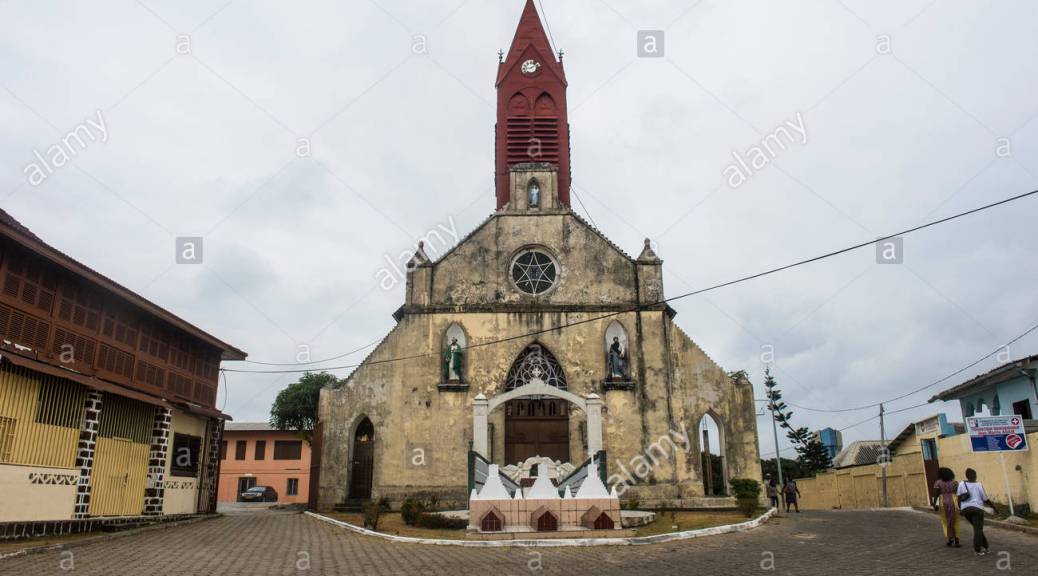
NB-The image on this post is taken from the internet. It shows St. Marie Cathedral, one of the centers used to house refugees during the Nigeria-Biafra war.
*Nneka talks about her mother, late Mrs. Esther Chizube Mgbojikwe, who died in April, 2016.*
“My mum said many of the children in the refugee camps were separated from their families so other families were encouraged to take them in. She said the exercise was documented properly so it would be easy to find their parents eventually. My mum took one of the children. Her name was Angelina and she must have been about ten or eleven years at the time. She told my mum that she was running from the scene of a bombing when she saw people climbing into trucks. She joined them and that is how she ended up in Orlu with other refugees. She lived with us for about fifteen years and became like a big sister to me. I cannot think of my childhood without Angelina.” – Nneka Chris-Asoluka.
———
My mum died in April 2016 and we buried her two months later, on the 10th of June. It was after my children wrote their tributes that I found out there were many things I didn’t even know about her. She was very dedicated to her grandchildren and her accounts about the war were so vivid we felt as though we had witnessed it.
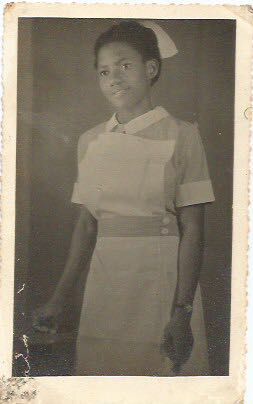
Esther Chizube Mgbojikwe, as a young nurse.
She trained as a midwife in the United Kingdom and when she came back to Nigeria, she worked briefly with Shell B.P. She later went back to the UK to study Child Nutrition and Health Visiting. They were called Health Sisters at the time. When she returned, she didn’t work in hospitals but in rural health centers where the focus of her work was pregnant women, nursing mothers and children. She preferred Health Visiting because after she returned from her midwifery training, she saw that the practice in hospitals here was so different from what she’d been taught abroad.
We were living at Nsukka when the federal troops captured the town. My mother had just returned from Britain with my baby brother. I was only two years old and my father was still abroad at the time. She said they had been hearing gun fire from the previous day but nobody was sure what was happening. They were all terrified. At about 2.00 am, her colleague at the Ministry of health, knocked on our door and said, “We’re leaving and you better do the same. If you stay here, in the next one hour I don’t know what will become of Nsukka.” Frantic, my mum woke everybody up and with the help of our nanny and steward, started to pack. But how do you start packing up the whole house at such short notice? What do you take and what do you leave? She decided to take food, her certificates, some family photos, children’s clothes. The steward had to stay back so he’d lock up and meet us at Oba, our home town. Luckily, she had filled her tank with petrol the previous day because there had been announcements that people who had cars should make sure they had full tanks at any given time.
She put us in the car and set out for Oba. When she got on the road, she saw great multitudes of people all trying to escape – carrying their children and a few belongings. You can imagine her trying to meander through the crowds and not knowing who would try to harm her. At that time many people were looking for transportation so they could have hijacked her car, but nobody did. She thinks it was because of the two small children – my brother and I – who she had in the car. She said she kept praying under her breath until the road became less busy. Throughout the night and into the morning she kept driving, until she got to Oba.
People didn’t know what was happening at Nsukka, so when her mother saw her she screamed, “Chizube, o gini?” [“Chizube, what is it?”] She said. “Mama, it has happened o. Nsukka has fallen.” She said she knew that once Nsukka was taken, Enugu would be next. Do you know what my mum did next? She handed us over to our grandmother, had a bath, changed her clothes and, immediately, turned back to return to Enugu. My grandmother was pleading, “Please, don’t go back.” But mum was already gone.
I remember asking her why she did that and she said she knew there would be refugees from Nsukka and neighbouring towns and her services would be needed. While fleeing Nsukka, she had seen lots of children and pregnant women on the road. She knew they would need medical attention and she was eager to get to Enugu so they’d start planning. That was just her kind of person. She was very dedicated to her work. So, she drove back to Enugu where a meeting had already been convened. She was posted to Owerri and, after staying in Enugu for a few days, she returned to Oba, picked us up and we left for Owerri.
Life was normal when she got to Owerri but when the Nigerian army captured it, she was posted to Orlu where she was placed in charge of distributing relief materials. They had marked trucks filled with relief materials, all of them assigned to designated places with supervisors. The Biafrans used to commandeer people’s vehicles to distribute these supplies and her official car had been commandeered from its owner. He pleaded with them to retain him as the driver of the car so he’d take care of his car. They agreed and that’s how he became my mum’s driver. But she had to learn how to ride a bicycle because the commandeered car was breaking down frequently and when that happened she will just jump on her bicycle and take off. Her senior sister worried so much for her health and safety and was always shouting, “Chizube, take it easy.” But how could she take it easy and waste any minute when people were at the refugee camps needing supplies and medical attention. My mum was so fatigued without knowing it and one day she just collapsed while climbing down from the bicycle. She was admitted in the hospital but when she regained consciousness, she demanded to be discharged. The doctors refused but trust my mum, the next day, she devised a means and sneaked away back to work.
The work was quite enormous but she said the Biafran government was very organised and had a good crisis management strategy especially in the health sector. The refugee camps were well run because the organisations that brought in relief material were comfortable with the Biafran government knowing they had structures in place which were adequate for the ongoing humanitarian work. Another thing my mum always said was that the Catholic Church was wonderful. The humanitarian agencies frequently ensured that the officials in charge of distribution of the food, clothing and medicine had more than enough supplies for themselves so they would not be tempted to take the rations meant for the refugee camps.
My mum was not only overseeing supplies, she was also caring for children and their mothers who made up about 80 % of the population of the refugee camps. They had been displaced from their homes and were very vulnerable. Many of the children had become separated from their families so others were encouraged to take them in. The exercise was documented properly so it would be easy to find their parents eventually. My mum took one of the children. Her name was Angelina and she must have been about ten or eleven years at the time. She told my mum that she was running away from a bombing when she saw people climbing into trucks. She joined them and that’s how she ended up in Orlu with other refugees. She lived with us for about fifteen years and became like a big sister to me. I cannot think of my childhood without Angelina.
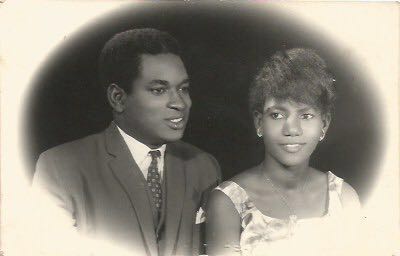
Esther and Emmanuel Mgbojikwe
Some families were able to smuggle their children out. That was how two of my cousins went to London where they had relations. Through the help of my mum they left with one of the planes that brought relief materials into Biafra. My mum said it could take several weeks before people got the chance to be evacuated. They had to be very careful because if the Nigerian planes detected such evacuations, they will bomb the airstrip. So it took several weeks for my cousins to leave. The night they eventually left, my aunt didn’t sleep because she didn’t know the fate of her children. When they got to Gabon, they were put on a plane going to the United Kingdom. She later got word that they reached London safely.
Life was very precarious. My mum said that if she was on her way and a bombing took place, she’d run into the forest and wait for the all-clear signs, thereby reducing the amount of time she wanted to spend at any refugee camp. In addition to the air raids, Nigerian soldiers were abducting women and because she was very young, she always tried to make herself look unattractive by wearing long, loose clothes and tying a scarf over her head.
Immediately the war ended, she was posted to Abakaliki. After spending five years in Abakaliki she was posted to Aba where she spent two years, then to Ohafia, Nsukka, back to Abakiliki and to Nibo from where she retired.
She said it was a traumatic time but in spite of it I didn’t detect any bitterness in her. She said those were normal things that happen in a war. Her training as a nurse also helped her not to internalise the gory experiences. All she focused on was alleviating the suffering of the people so that one day she’d look back and say I did so much. Working round the clock might also have helped her take herself out of the whole thing.
I remember asking her how she felt being away from us so often and for long periods. She said she knew we were in good hands but she needed to be there for other children whose mothers were not there. She never felt we were in any harm because we were left in the care of her mother, our aunties and nannies. Also, we had enough food and medication and were attending classes in a make-shift school which my aunty had started, to ensure that children in the area could continue their learning.
After the war, my mum found Angelina’s parents. She was from Nsukka and I remember vividly the day her brother and uncle arrived Abakaliki to see her. Wow! You can imagine the shouting and crying that went on. My mum said many children got lost like that – younger children who couldn’t talk and nobody knew them or where they were from. They took Angelina back to Nsukka to see her parents. Then, they brought her back and handed her over to my mum, saying, “This girl is now your daughter. Whatever you want to do with her, go ahead.” Angelina’s immediate senior brother also lived with us. His name was Odoja. The relationship between the two families continued for many years after. Until my mother died, she kept praying to see Angelina again.
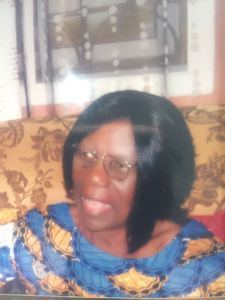
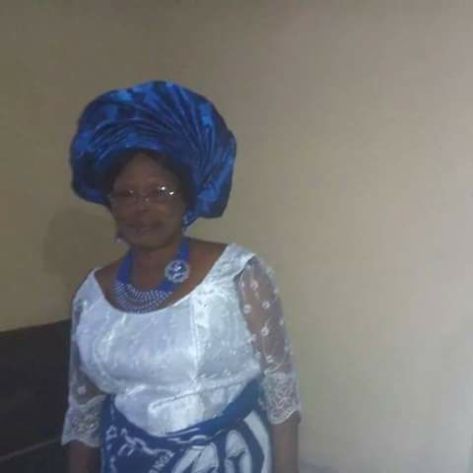
Late Mrs. Esther Chizube Mgbojikwe
My creche is in my mother’s memory. She was looking forward to the times she’d spend with the children there. And then, she just died. All the same, we’re grateful for the life she lived and the sacrifices she made during the war. She was a dynamic woman.
———-
Nneka Asoluka is a Lawyer and President of Soroptimist International of Nigeria, a global volunteer movement advocating for human rights and gender equality. She also runs Esther’s Child Minders, a Crèche and Day Care Center named after her late mother.
“I was already working at Aba General Hospital by the time the war started. They used to bring wounded soldiers, both dead and alive. One faithful day, the Nigeria soldiers threw a bomb at Eke Oha market. That day, I saw something! Many people were buried alive. When the Napalm bomb meets somebody, the person will burn and shrink. The whole body of the person will be like a goat that was burnt inside fire. The leg, the hand, all the body parts will gum together. One of my friends, also a nurse, she identified her sister among the corpses with the cutex on her toe nails. Everybody was stitching. Blood everywhere… They [corpses] were heaped like you are heaping fire wood…It was a horrible experience…That day, the thing was terrible.” – Georgina Nwangwu.
———-
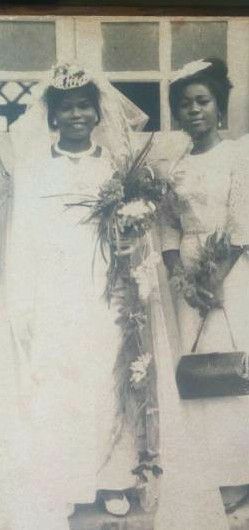
To get my wedding cake was a miracle. My Sister-in-law, the one that saw me and told my husband about me, she met somebody who made my wedding cake. There were things in the market, not that you can’t get them, but you know they had changed the currency from Nigerian to Biafra money, so it wasn’t easy to plan and purchase anything. But I bought satin and lace, and made my wedding gown and that of my Chief Bridesmaid.
That time, whatever you want to do, you will hurry up and do it because of the flying of the planes. When we hear the sound, people will start shouting, “A biala h’o! A biala h’o!” [They have come o! They have come o!] It is because the planes are hovering. You don’t gather much in groups because it is easy to see people in groups. But we still did our wedding and reception. We did everything. It was at St. Barnabas Anglican Church, Omoba, Isiala Ngwa, on 29th of June, 1968. The reverend was Reverend Asiegbu. The church was a bit hidden where the planes cannot see people. Many people came. We ate. We also danced. The house where we cut the cake was covered with palm fronds and we had a [high] table as it is done today.
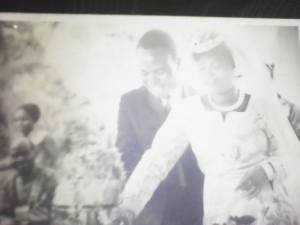
Georgina and Athanasius Nwangwu cutting their wedding cake.Georgina and her Chief-Bridesmaid in their lace-and-satin dresses.
I was already working at Aba General Hospital before the war started. They used to bring wounded soldiers, both dead and alive. One faithful day, the Nigeria soldiers threw a bomb at Eke Oha market. That day, I saw something! Many people were buried alive. As I was running for my dear life, I was near to the wall of the ward. A bullet came and pierced the wall and I was near it. It did not touch me but if it had touched me that would have been the end. People in their shop, selling, their shops were burnt, everything. They were packing all the dead people from Ekeoha and bringing to us. When the Napalm bomb meets somebody, the person will burn and shrink. The whole body of the person will be like a goat that was burnt in a fire. The leg, the hand, all the body parts will gum together. One of my friends, also a nurse, she identified her sister among the corpses with the cutex on her toe nails. Everybody was stitching. Blood everywhere. So that was the horrible experience I had during the war.
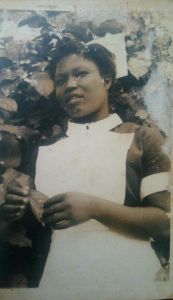
Georgina as a young nurse
After, Ojukwu came to see the dead people in the mortuary. They were heaped like you are heaping fire wood. They were carrying the dead people on top of each other. It was a horrible experience for me. That day, the thing was horrible.
Some people came and identified their own and took them away. The rest were buried in a mass grave. The ones that survived were kept in the hospital and we started treating them till Aba fell. The government took care of them. That was the last bomb attack that was done in Aba. When Aba fell, we didn’t know what to do. No telephone connection. I was carrying my first pregnancy. I was afraid something will happen and my husband will not be nearby. They were evacuating the soldiers in Aba General Hospital and I was among the people that were evacuated because of my pregnancy. I went to Umuahia because that was where my husband was staying. He said he’s not sure of my safety, that I should go to my people in Amaimo, Ikeduru. So I went there. I was there until Ogochukwu was born.
It was during that time that Caritas was working in our place. We were like auxiliary nurses in the refugee camp at Baptist Church, Amaimo. They were supplying us things. People that were sick, that are not able to do anything, they come there in the morning. We recruit the villagers that are strong to do the cooking, then we dish out to them. The World Council of Churches, they give us stock fish, Ghana beans, Ivory Coast beans and other things to cook. That was one of the good things Biafra government did. Some people that would have died of kwashiorkor did not die. They distribute the egg yolk and prepared soup in a tin. They warm it and give people. When we make the milk we give them in cups; they bring their cups and we pour for them. That is how we served the public during the war. The white people tried so much. They were bringing cooked rice, canned food and giving to the people to eat. You will see a child like this – very puffy. That is kwashiorkor. No blood. After the feeding we give them drugs, we de-worm them because a lot of them are sick and inhabiting worms and other bad diseases. They also brought a lot of multivitamins.
The supplies were enough and anybody that comes will get. But some will not come because they prefer dying in their house. Maybe they don’t trust the refugee camp. There was a maternity ward where we refer the pregnant women for proper treatment and delivery. Some nurses even worked at the war front so when the war is tough they will bring any wounded soldier to them. But I was never posted there because I was nursing a baby.
The war did not touch Amaimo. Owerri people ran to us but war didn’t touch us. I was there till after the war. Ogochukwu was about six months when the war ended and we came back to Enugu.
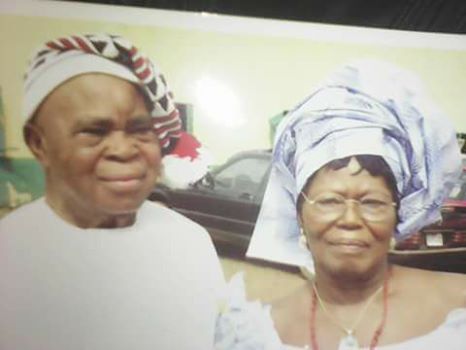
The Nwangwus
Apart from one of my uncles, nobody in my family died. He was a sea man and sometimes he will go on the ship and stay for six months. He died because he was blind not because of the war. He had an operation abroad and he came back blind from Britain. When the war started he couldn’t contain it and he died.
Let us not fight again. War is bad. It is painful. You will not have rest of mind. You’ll be afraid all the time. All those that want to fight again should go and prepare, but I am not among those who will support them. Ojukwu didn’t get it. Is it you who will get it?
Mrs. Georgina Nwangwu
———-
Mrs. Georgina Nwangwu retired as a Chief Nursing Officer from the Anambra State Ministry of Health, on April 1, 1995. She and her husband are parents and grandparents. They live in Enugu, Enugu State, Nigeria.
"…a data base of memories, testimonies, experiences and anecdotes."

 My Biafran Story