
Tag Archives: Women in Biafra

LOVE IN A TIME OF WAR 2


I was there, anya m wee fu zi kwa ife n’ine gaa nu because my husband was an Air Force man – Staff Sergeant Samuel Chukwu. M’ g’a si n’anyi n’abo so wee nu ya bu ogu. Because oge dii j’ano n’ihu aya gi nwa g’a no n’ihu aya – I will say that I fought that war with him. Because when your husband is at the war front, you will also be at the war front. If he doesn’t come back you will never have peace of mind.

He left me at home with his mother to go and fight the war. I was with her for one year and six months. Just imagine a young girl newly married. I hadn’t even conceived then. I couldn’t hold it again.

One day one army man came on raking to our place, to find out what the enemies were doing. I told him I would like to follow him to go and see my husband, that whatever is inside I will take it. He asked me if I would be able to. I said yes, I will. My husband was at Ihiala at the time. The man told me when he will leave and asked me to prepare. When I told my Mother in law she said as long as I have the heart to follow him, I should go.

We left our place around 6.00 pm. We went through Evbu. We went by foot, through forests, forests, forests. We got to a river. I can’t remember the name. The people who ferry people across said we have to wait, because there’s a time enemies walk about, and there’s also a time when everywhere will be safe for us to cross. They took us to a small house where we met other people who wanted to cross. We stayed there till around 2.00 o’clock. Then they asked us to come out. They brought the canoe and we entered. In fact it is God. It was only me and the man in that canoe. I don’t remember how much we paid. [She sighs] I have forgotten. A di a na m’ old now. A di ro m’ e lota zi ife n’ine – I am old now. I don’t remember everything.

We crossed to another town. I have forgotten the name. We rested there for two days because soldiers camped there. The man now arranged for a car to take us to Ihiala.

My husband was very, very happy to see me. He was living in a hostel. It was when I came that he got a house. And that is where we were until the war started raining – air raids, bombers, fighters, all of them.

What the army did is that they will dig bunkers, but sometimes when the bomber comes it will drop bombs on the bunker. So they told us that once we hear the sound of the bomber we should run inside the bush.

We were living in the Air Force quarters at Ihiala. When they are going to fight, they will pack all the Air Force wives and go and dump us in a students’ hostel, because the students were no longer in school. We were many o, including those who had children. That’s how they were carrying us about like people herding cattle. We went to Aguata. We went to Ikenanzizi. When we are going each person will carry her own cooking utensils because nobody will lend you her own. I was pregnant with my first son by then. There was nothing for us to do in the hostel other than cook. Those who didn’t have will go to the market. After that, we will gather together and start discussing our problems. That will be our work until it’s safe to move us back again. [She laughs] The Air Force tried.

Agha Biafra. I can’t remember all I saw in that war.

The day I was having my baby, around 9.00 in the night, it is by God’s grace. If you see air raid that day. I can’t remember the name of the hospital but it’s a general hospital. Everywhere was shaking. I was in labor. You can imagine how I was feeling. But God brought me out. [She chuckles] They didn’t bomb the hospital but the noise erh. If this air raid is in Manchester, the nose will cause your heart to jump. If it is bomber you won’t hear the noise when it’s coming. When it comes close it will start dropping what it is carrying, killing people. After I left the hospital, nobody did omugwo for me.

Both of us took care of the baby. In fact, he was the one who used to massage my body with hot water. He did everything. By God’s Grace, me and my baby were healthy.

When the war ended we went home to Isele Uku. The Nigerian government didn’t want to call back the people who crossed to Biafra. So everybody was waiting to hear news of what will happen. One day we were at home when they brought him a paper to resume work. He decided to go and tell his mother’s people the news, and also that they should keep an eye on me and our children. He went, and on his way back a car killed him. I asked myself, “Is it his destiny?” My happiness is that he didn’t die in that war. He survived. He got home. Because if he died in the war I am not sure I will be alive to come back. To God be the glory, we went home together after the war.

-Rose Chukwu


THE WOMEN FIGHTERS

I was working at Textile Mills Aba when they came and conscripted us. They just took us to Aba Sports Stadium, near Ngwa Road. The whole stadium was filled with people.

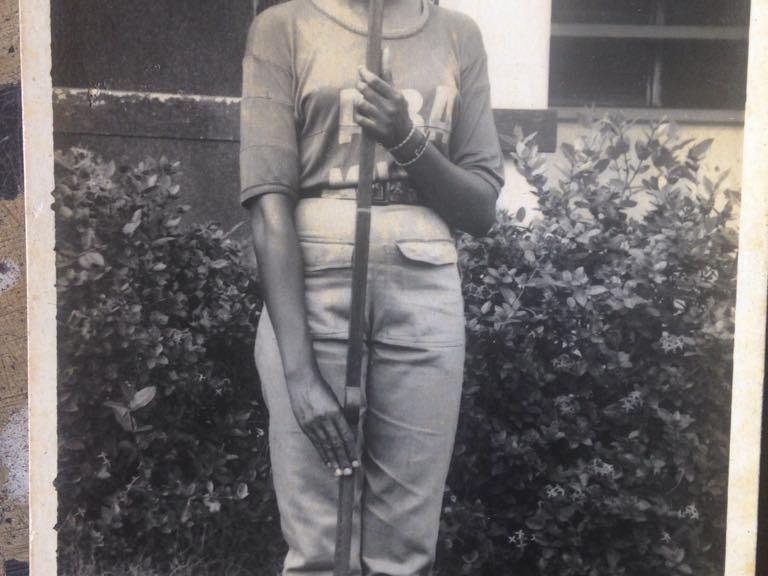
We had group pictures. The one I took with my group I can’t find it. I kept it all this time.

The military people used to come and train us. We did it for about three months. Male and female o. They didn’t train the girls separately o. There’s nothing like you are a girl. Your commander, whatever he says, that’s what you will do.  No going back. Whether you like it or not. When it’s time for us to take cover, everybody will lie down. They showed us how to handle a gun, how to lie down, how to… when they say… erh…what’s that their slang again? ‘Preseeeeent arm!’ You present your arm. ‘Preseeent arm!’ You raise it like this. [She lifts her arms]. When they ask you to shoot, you know that thing is not a real gun, then they’ll show you what to do. [She makes the sound of gun shots with her mouth] Kpa-kpa-kpa-kpa-kpa-kpa. They will shout, “Order!” You bring out your leg. So all that training is what they were doing. But, no, they didn’t allow us to use a real gun. I’m not sure they had it in mind.

We’ll go in the morning and come back in the evening. They gave us uniform. They didn’t camp us. We were coming from our houses.  Even then, my father and mum won’t allow me. They were so scared that we should…arh! [She claps her hands].

They just wanted the first batch to go and assist the real soldiers. We were not the real soldiers. They didn’t train us to that level. The real army was in the war front. This militia was just to go and support them. They sent some to Abagana, Port Harcourt, wherever they know the fight was fierce they sent them there. They were there, helping the casualties, like Red Cross. The women, they were using them in the refugee camps, but my parents refused. They say I won’t go, they won’t allow me to follow them out again. That was the end of my militia training.

In our own case it was this stick they gave us. But the people they were training to go to war front they gave them real gun and showed them what to do, how to use the trigger, how to do this and how to do that, take cover, lie down.

We were excited, yes, especially in the morning when our commander will start chanting ‘Hep! Hep! Hep! Hep!’ [She starts to march.] All of us, we were so excited carrying our guns. But we were scared o. They said all the people that went to the front didn’t come back. So when they conscript some people they will be pretending they are sick or something is wrong with them. They will say they have been in the psychiatric ward, yes. War is not something you wish to experience a second time. Very bad.

The war was not easy o. Not easy. Hei. The air raid will come in the morning from 10.00 o’clock to 12.00 o’clock. It will come again by 4.00 pm in the evening till around 5.00 pm. My mother dug a big bunker, so when the air raid starts all of us will go there and stay. In the morning my mother will disguise herself, paint her face with this black uri, then she will bring a basket with food to us. When she drops it she will quietly go back to the house. Throughout that day we’ll be there. Inside that bunker. Lying down. The little food she’ll bring to us that’s what we’ll eat until evening. After that second air raid all of us will then go back to the house.

There was one air raid at Aba. Look at me. You see this thing here. [She touches a scar on her leg.] It was some of the bullets from that air raid. One afternoon like this the air raid came. It killed so many people near our house. Some of it fell inside one of the rooms in our house. Number 3A Asa Road Aba.  That is where we were living. It shook the whole house. It was then Ojukwu came to our house. That was the first time we saw Ojukwu.  He came with his people. They came and removed the bomb. Big something like this. Come and see dead corpses everywhere. [She touches a scar on her hand]. A piece of that bullet was in me for more than one year before it came out. [She touches her hand again] See the marks. This one, this one. It was moving round my body before they brought it out.

After that air raid we started running. From Aba we ran to Umuahia. From Umuahia we ran to Mbano. From Mbano to Nkwerre. From Nkwerrre, myself, my sister and her husband, and the last born of my mother went to Umuchu. We were at Umuchu when the war ended. We came back to Nkwerre. My parents were at Nkwerre. From Nkwerre we all started coming back to Port Harcourt.

Our parrot from the war followed us till after the war. Pretty boy, that’s what we called the parrot. It followed us till after the war. It was very intelligent. Even when they bombed our house in Aba, the parrot was there. We were hearing they were forcing women into marriage so our mother used to rub uri on our faces. If you see how our faces looked. Pretty Boy will give us sign that the soldiers are coming. When they come close to the house he will start asking them questions, “What are you doing here? What are you doing here?” [She laughs.] Then my mother will start crying and speaking Hausa to the soldiers. My mother, she’s a linguist. If it is Hausa, she will speak. If it is Yoruba, she will speak. Many languages. The parrot knew all our names. Pretty Boy. Yees! If you put sugar in his water he will drink. If you do something wrong he will gossip about you, unless you give him that sugar then he won’t talk. If not, when mama comes he will tell her everything you did.

[Cover Photo shows the contributor. The photograph was taken by Gorgeous Studios, 42 St. Micheal’s Road, Aba.]